Rich Dad Poor Dad by Robert Kiyosaki - Key Ideas and Review
A careful summary and review of Robert Kiyosaki’s influential personal-finance book and its most useful concepts.
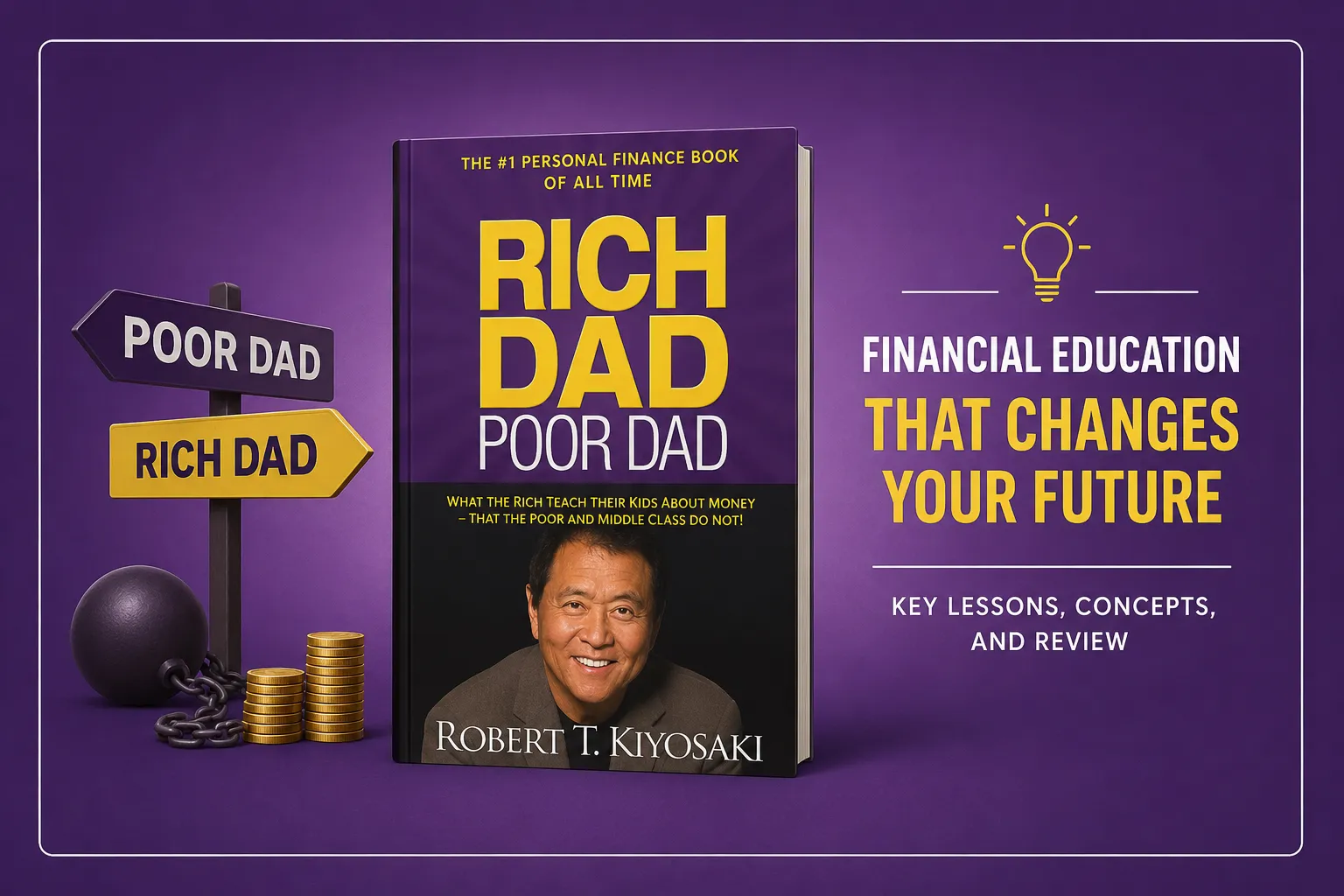
Rich Dad Poor Dad is one of the most widely read personal-finance books of the last generation. Written by Robert T. Kiyosaki, with Sharon L. Lechter credited on earlier editions, it presents money lessons through the contrast between two father figures: the “poor dad,” educated, professionally successful, and financially constrained; and the “rich dad,” entrepreneurial, practical, and focused on ownership, assets, and cash flow.
The book is not best understood as a technical manual. It does not teach portfolio construction, tax law, risk management, or real-estate analysis in enough detail to be used on its own. Its power is simpler and more psychological: it asks readers to reconsider what they think work, income, security, wealth, debt, and education actually mean. That is also where the book needs careful reading. Rich Dad Poor Dad can be motivating, but motivation is not the same as a complete financial plan.
Why this book matters
The enduring importance of Rich Dad Poor Dad comes from the way it reframes ordinary financial assumptions. Many personal-finance books begin with budgeting, saving, reducing expenses, or investing steadily in conventional assets. Kiyosaki begins somewhere else: with the idea that a person’s financial life is shaped by the words, models, and expectations they absorb early.
The book’s central contrast is deliberately simple. One worldview says: get an education, find a stable job, work hard, save, buy a home, and avoid financial risk. The other says: learn how money works, acquire assets, build or buy income-producing systems, understand taxes and debt, and do not confuse employment income with financial freedom. Whether every detail of the story should be read literally is less important than the intellectual contrast it creates. The book gives readers a vocabulary for noticing that a high salary and real wealth are not the same thing.
That distinction is still useful because many households experience financial pressure even when income rises. Higher income can easily produce higher spending, larger obligations, and more dependence on a paycheck. Kiyosaki calls this pattern the “rat race”: money comes in, money goes out, and the person remains tied to work because expenses, debt, and lifestyle commitments absorb the income. The book matters because it names that pattern in memorable language.
The central argument
The core argument of Rich Dad Poor Dad is that financial literacy matters more than formal income alone. Kiyosaki is not saying education is useless. He is arguing that academic and professional education often leave people unable to read a financial statement, understand cash flow, evaluate an investment, use debt carefully, or think like an owner.
The practical heart of the book is the difference between assets and liabilities. In Kiyosaki’s simplified definition, an asset puts money in your pocket, while a liability takes money out of it. This is not the same definition an accountant would use, and that difference matters. A personal residence, for example, may be an asset on a balance sheet because it has market value. Kiyosaki’s point is behavioral and cash-flow oriented: if it produces ongoing costs rather than income, it should not be treated as the foundation of financial freedom.
That framing is both useful and incomplete. It is useful because it forces readers to examine cash flow honestly. A large house, expensive car, or impressive lifestyle can look like wealth while creating fragile monthly obligations. But it is incomplete because not every valuable asset produces immediate cash flow, and not every liability is foolish. A home can provide stability, inflation protection, and long-term value. Student loans can be productive if they finance skills with a strong expected return. The stronger version of Kiyosaki’s argument is not “never own a home” or “all traditional advice is wrong.” It is: do not mistake status, salary, or accounting labels for financial independence.
Key concepts worth understanding
The first important concept is that wealth is measured by time, not just money. A person is financially stronger when their assets can cover living expenses for longer periods without active labor. This shifts the focus from appearing successful to building resilience. Under this lens, the most important number is not salary but the relationship between recurring expenses and recurring income from assets.
The second concept is “pay yourself first.” Kiyosaki uses the phrase to mean prioritizing asset-building before lifestyle expansion. In a careful interpretation, this does not mean ignoring bills or behaving irresponsibly. It means treating investment capital as a serious obligation rather than waiting to see what is left at the end of the month. For readers with unstable income or high-interest debt, this idea needs adaptation. Paying yourself first should not become an excuse to neglect emergency savings or expensive obligations.
The third concept is that fear and cynicism are financial obstacles. Kiyosaki argues that many people avoid investing not because they have carefully studied risk, but because they fear loss, embarrassment, or uncertainty. He also suggests that cynicism can disguise inaction: instead of learning how an opportunity works, a person dismisses it from a distance. This is psychologically sharp. At the same time, skepticism is not the enemy. Serious investing requires skepticism. The question is whether doubt leads to research and discipline, or merely to paralysis.
The fourth concept is the importance of financial education. Kiyosaki repeatedly emphasizes learning the language of money: assets, liabilities, income, expenses, cash flow, corporations, taxes, markets, and leverage. This is one of the book’s most transferable ideas. Even readers who reject the book’s tone or some of its conclusions can benefit from the insistence that financial decisions should be understood, not outsourced blindly.
The fifth concept is ownership. Kiyosaki prefers businesses, real estate, intellectual property, and investments that can generate income without trading each hour directly for pay. The deeper point is that employment income is usually linear: time is exchanged for money. Ownership can become non-linear: systems, assets, teams, or capital can continue working after the owner stops working directly. That does not make ownership easy or safe, but it explains why wealth often compounds around control of assets rather than wages alone.
What the book does well
Rich Dad Poor Dad is effective because it makes financial behavior visible. It gives readers simple mental models that are easy to remember: assets versus liabilities, working for money versus money working for you, the rat race, financial education, and cash-flow thinking. These ideas are not academically complex, but they are sticky. A useful personal-finance book does not always need to be technically exhaustive; sometimes it needs to change what the reader notices.
The book also challenges status-based thinking. Many people associate wealth with consumption: a better car, a bigger home, more impressive purchases, or a higher salary. Kiyosaki pushes in the opposite direction. He asks whether a purchase increases freedom or decreases it. That question is valuable because it cuts through appearances. Someone can look prosperous while being financially trapped; someone else can look modest while quietly building options.
Another strength is that the book treats money as a learnable subject. This matters because people often experience financial confusion as a personal failure. Kiyosaki’s tone can be blunt, but the underlying message is empowering: if money has rules, language, incentives, and patterns, then a person can study them. That does not guarantee wealth, but it replaces helplessness with agency.
Limits, blind spots, and necessary cautions
The main weakness of Rich Dad Poor Dad is that its simplicity can be overextended. “Buy assets” is good advice at the level of orientation, but it does not tell a reader which assets are fairly priced, how to evaluate risk, how to diversify, how to manage taxes legally and prudently, or how to avoid scams. A reader who treats the book as a complete investment education may become overconfident.
The book is especially enthusiastic about entrepreneurship, real estate, and leverage. These can build wealth, but they can also destroy capital when used without skill. Debt is not automatically good because it is used to buy an asset. Real estate is not automatically safe because it is tangible. A business is not automatically superior to employment because it offers upside. The missing middle is execution: valuation, cash reserves, legal structure, market cycles, insurance, tenant risk, liquidity, and personal temperament.
Another limitation is the book’s tendency to frame conventional advice as too narrow. There is truth in that criticism. A job and a savings account alone may not create wealth quickly. But conventional practices such as living below one’s means, maintaining an emergency fund, investing regularly, avoiding high-interest debt, and diversifying remain valuable for many people. The best reading of Rich Dad Poor Dad is not to abandon prudence, but to add asset-building and financial literacy to prudence.
The book also relies on parable-like storytelling. That makes it memorable, but it means readers should be careful about treating every anecdote as evidence. The value of the book lies more in the concepts it provokes than in the verifiability of each scene.
Who should read it
Rich Dad Poor Dad is most useful for readers who are new to personal finance and feel that working harder is not enough. It is also useful for people who earn reasonably well but still feel financially stuck. The book can help those readers separate income from wealth and consumption from freedom.
It is less useful for readers who want detailed, step-by-step investing instruction. Anyone looking for tax guidance, retirement planning, securities analysis, real-estate underwriting, or debt strategy will need more rigorous sources. The book should be treated as a starting point, not a final authority.
The ideal reader is someone who can take the book’s provocation seriously without taking every claim literally. That reader will keep the useful questions: What actually produces income? Which expenses reduce freedom? What financial skills am I avoiding? Am I buying assets or symbols? Where am I relying too heavily on one paycheck? Those questions are worth keeping long after the book is finished.
Editorial verdict
Rich Dad Poor Dad remains influential because it gives readers a new financial lens. Its best ideas are not complicated, but they are clarifying: wealth is not the same as income; assets and liabilities should be judged by cash flow; financial education is a practical necessity; ownership can create freedom; and fear often keeps people inside familiar but limiting patterns.
The book’s weakness is that it can sound more certain than responsible finance allows. Its lessons need to be balanced with diversification, risk control, humility, and careful due diligence. It should inspire study, not shortcut it. Read carelessly, it can encourage simplistic thinking about debt, real estate, and entrepreneurship. Read carefully, it can interrupt passive financial habits and push the reader toward a more active understanding of money.
The most important concept in the book is not any single investment tactic. It is the shift from earning money to building a financial structure. Kiyosaki’s lasting contribution is to make readers ask whether their daily financial choices are buying freedom or buying dependence. That question is simple enough to remember and serious enough to change behavior.
Primary link
Learn more at: https://www.amazon.com/Rich-Dad-Poor-Teach-Middle/dp/1612680194