The Wiggliness of the World: Alan Watts on Straight Lines and a Curved Reality
6 min read≈ 1,360 words
What this is about
Look out of a window and you will find almost no straight lines in nature, yet almost everything people build is straight. You learn what the philosopher Alan Watts meant when he called the world wiggly and why he found straight lines useful but risky. You also see what his idea means for the way you plan your life.
Look out of a window for a moment. The outline of a hill, the branches of a tree, the edge of a cloud and the path of a stream are all curved and irregular. Now look at the room you are in. The walls, the window frame, the table and the screen in front of you are made of straight lines and right angles. Why do people fill a curved world with straight lines? And does it matter? The British-born philosopher Alan Watts thought it matters a great deal, and he had a short word for the curved world: wiggly.
Who was Alan Watts?
Alan Watts was born in England in 1915 and died in California in 1973. He was a writer and speaker who explained Zen Buddhism and Taoism to Western readers. Taoism is a Chinese tradition of thought that teaches people to live in harmony with the natural course of things. His best-known book is The Way of Zen (1957). In the 1960s and early 1970s he gave many talks on radio, on television and in seminars. Recordings of these talks are still widely heard today.
Watts was not a scientist, and he did not write a formal theory of “wiggliness”. The word comes from his talks, where he used it again and again in a playful way. That is why the idea is best understood through the images he used, and not as a strict definition.
What did Watts mean by a wiggly world?
Watts meant that nature does not follow straight lines or fixed shapes. In his talks he pointed to hills, trees, clouds, streams and the way wind moves through grass. None of these has a simple geometric form. People are wiggly too, he said. We only look regular because we usually see each other in groups.
Wiggly does not mean chaotic, and this is the part people often miss. Watts liked to point out that clouds, the foam on waves and the shapes of mountains are never ugly, even though nobody planned them. They have an order, but not the order of a ruler. To describe this, he used the Chinese word li. He explained that it first meant the markings in jade, the grain in wood or the fibres in a muscle. Like the British historian of science Joseph Needham, he translated it as “organic pattern”. This means an order that grows from inside a thing instead of being imposed from outside.
Why do people draw straight lines over it?
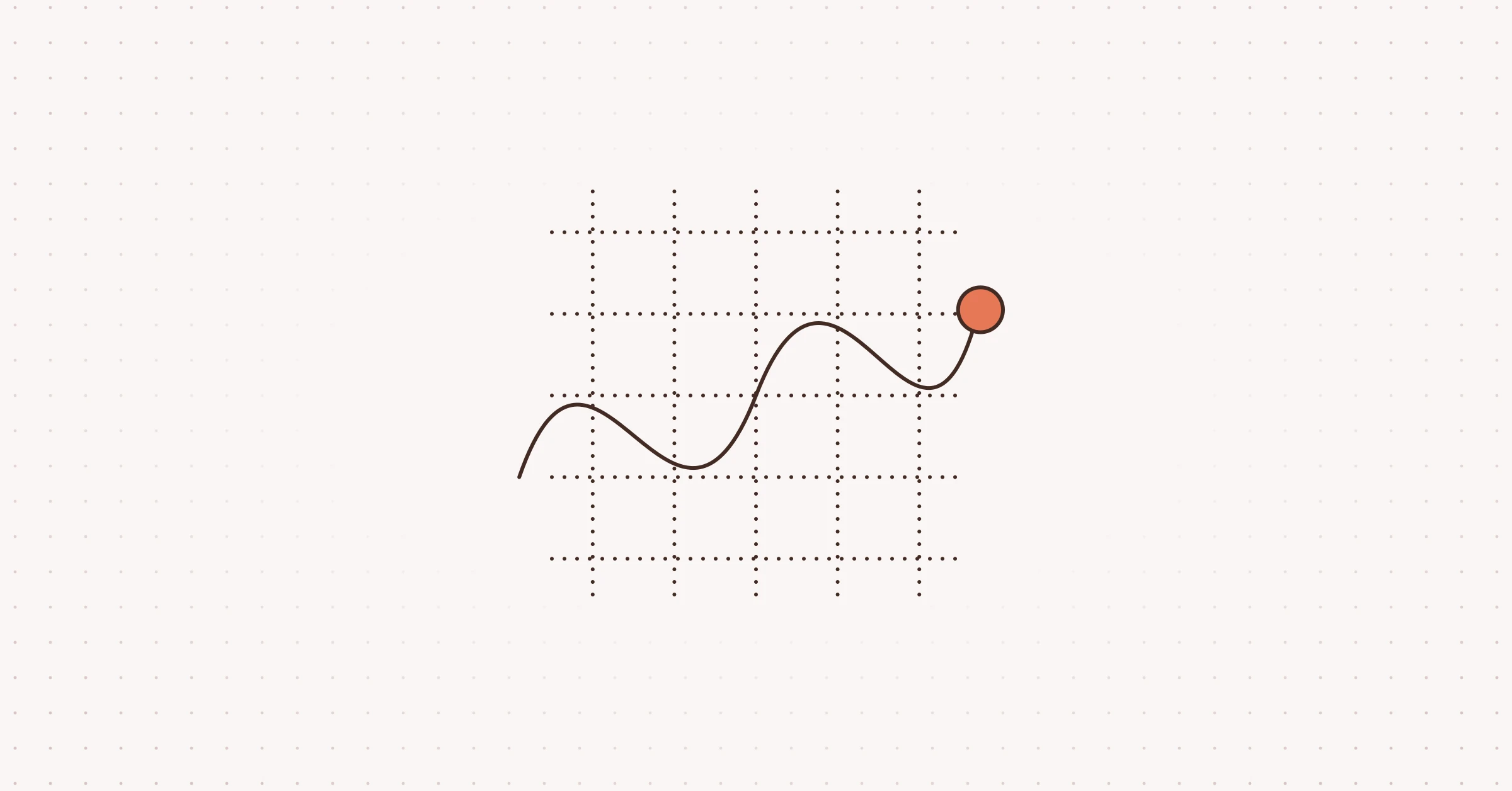
People draw straight lines because wiggly things are hard to keep track of. In one recorded seminar, Watts gave a simple picture for this. Imagine you hang a fishing net in front of the world and look through it. Now you can describe any wiggle by counting holes. This curve goes three holes across and two holes down. Watts said that this is how measurement begins, and with it mathematics and the calculus.
The net is a very good tool. Maps, calendars, clocks and spreadsheets are all versions of it. They break the world into countable parts, so we can compare, plan and build. Watts did not want to throw the net away.
His point was about something else. The parts exist in our description, he said, not in the world itself. We cut the world into pieces for “intellectual convenience”, the way you cut a chicken into pieces to eat it. But no chicken comes out of the egg already cut up.
What goes wrong when we forget the net?
Two different things go wrong.
The first is a mistake in thinking. If you forget that you cut the world into pieces yourself, you start to wonder how the pieces are connected. Watts gave the example of a cat seen through a narrow gap in a fence. First you see the head, then the tail. If the gap is all you know, you might conclude that the head causes the tail. Widen the gap, and you see one cat. Watts thought that many of our puzzles about causes and effects come from looking at one event through narrow gaps.
The second mistake is practical. People do not only describe the world with straight lines. They also try to make the world straight. In a television talk from 1971, filmed in a field above Muir Woods in California, Watts linked this habit to the ecological crisis. He told viewers that they were trying to straighten out a wiggly world, and that this was why they were in trouble.
A real river shows what he meant. The Kissimmee River in Florida once wound for about 103 miles through a wide floodplain. After long floods in 1947, the US Congress approved a large flood-control project in 1948. In the 1960s, engineers cut a straight canal about 30 feet deep through the river’s curves. The floods were controlled, but the wetlands dried out. The South Florida Water Management District reports that more than 90 percent of the waterfowl that used the wetlands disappeared. Bald eagle nesting territories fell by 70 percent.
In 1992 the US Congress approved a plan to undo part of the work. Workers filled in 22 miles of the canal, and a long stretch of the old curving river now flows again. The restoration was completed in 2021.
What does this mean for a life?
Watts applied the same idea to how people live. Many of us plan our lives like a straight canal. School, then a degree, then a job, then a promotion, each step at the right age. Real lives rarely move like that. People change interests, meet someone, get sick, lose a job or find an opportunity nobody expected. If your plan is a straight line, every curve feels like failure.
Watts’s alternative came from Taoism. He used the Japanese word mui (in Chinese, wu wei), which he explained as not going against the grain of things. His examples were a sailor and a judo fighter. A sailor does not fight the wind but uses it to move. A judo fighter does not block an attack but uses its force. Neither of them is passive. Both act with skill, but they act with the movement of the world instead of against it.
In practice this means holding a plan more loosely. You still choose a direction. You still use calendars and goals, because they are part of the net, and the net is useful. But you treat the plan as a description of what you hope for, not as a law the world must obey. When your situation changes, you adjust the route instead of forcing the old one. The parable in What Is the Parable of the Chinese Farmer? shows the same attitude toward events that first seem good or bad.
Where does the idea go too far?
The idea is easy to misuse. “Go with the flow” can become an excuse to avoid effort or responsibility. Watts did not mean that. A sailor still has to steer, and a judo fighter trains for years. Going with the grain needs more attention, not less.
Straight lines also deserve more credit than a romantic reading gives them. A straight bridge, a precise dose of medicine and a reliable train timetable save lives every day. The engineers on the Kissimmee River were not foolish. They were protecting people from real floods. At the time, few people asked what the curves did for the land. Restoring the river later also needed careful planning and measurement, which is the net again.
So the strongest version of Watts’s idea is that every grid you use leaves something out. A good thinker uses the grid and keeps asking what it misses. That is a useful habit for planning a career, reading statistics or judging a person you have only seen through a narrow gap. The essay Beyond Analytics: Why a Human Being Is More Than a List of Parts applies the same question to the human body.
Think about it
There is no right answer here. Take a minute before you move on.
- 1.Where in your life are you trying to force a straight line onto something that keeps changing, such as a career, a relationship or a timetable?
- 2.Think of one plan you have now. Would it work better as a fixed route or as a direction you adjust along the way, and why?
The takeaway
Alan Watts called the world wiggly because hills, rivers, clouds and human lives do not follow straight lines. People describe the world with straight grids and split it into countable parts, which is useful for planning and building. Trouble starts when people forget that the grid is their own tool and force the world to fit it, as when engineers straightened the Kissimmee River in Florida. Use plans and measurements, but change them when the world does not match them.