What Were Tally Sticks?

7 min read≈ 1,460 words3 questions · up to 3 points
What this is about
For more than seven hundred years, the English state kept many of its accounts on sticks of wood. You learn how a notched stick recorded a payment, why it was so hard to cheat and how a receipt could work like money. You also learn why the system ended in a fire that destroyed the old Houses of Parliament.
In a nutshell· skip ahead
A tally stick was a piece of wood with notches that recorded a payment or a debt. The stick was split lengthwise, and each side kept one half. Only the two original halves fitted together, so neither side could change the record alone. Because a tally proved a claim, people could pass it on and use it like money.
Imagine you pay your taxes and get back half of a wooden stick with a few notches in it as your receipt. For more than seven hundred years, this is how the English state kept many of its accounts. The sticks were not only receipts. People bought and sold them, and some historians call them money. How could a piece of wood with a few cuts in it work like money?
How did a notched stick record a payment?
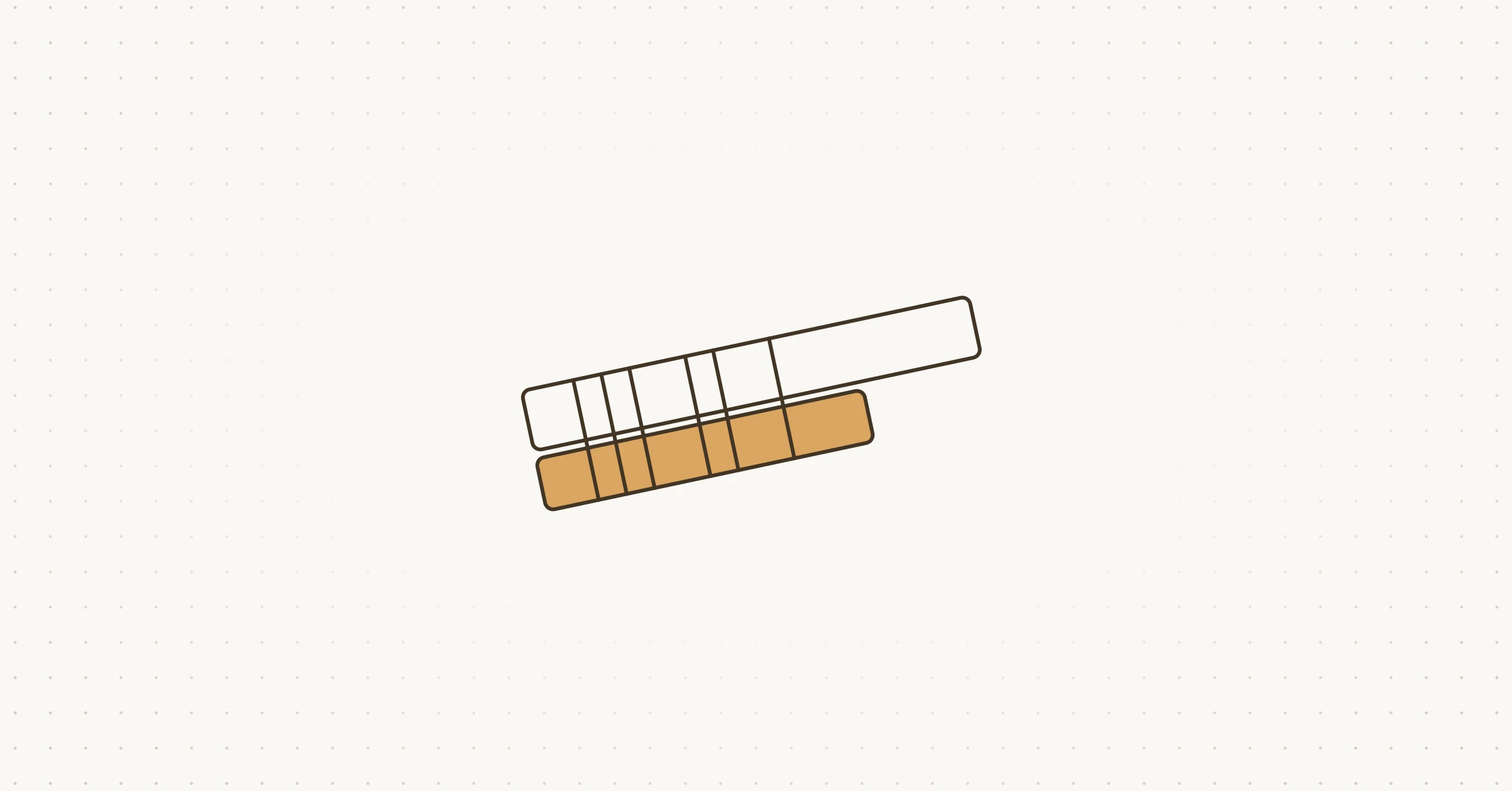
A tally stick was a wooden record of a payment or a debt. The amount was cut into the stick as notches. Then the stick was split along its length, and each side kept one piece. Wood never splits in exactly the same way twice. So only the two original pieces fitted together again.
The best-known tallies come from the Exchequer. This was the office of the English king that received taxes and checked the accounts of royal officials. Let us follow one payment step by step.
- A sheriff brings money. A sheriff was the king’s officer in a county, and he collected the king’s income there. Suppose he pays £121, 1 shilling and 1 penny. In the old system, 12 pence made a shilling and 20 shillings made a pound.
- A clerk cuts the notches. Each size of notch stood for an amount. A notch as wide as a palm meant £1,000. A notch as wide as a thumb meant £100, and one as wide as the little finger meant £20. A notch the width of a swollen grain of barley meant £1. A shilling was a smaller notch, and a penny was a single cut with no wood removed.
- The stick gets five marks. Our sheriff’s tally has one thumb-wide notch, one little-finger notch, one barleycorn notch, one small notch and one thin cut. The clerk also writes the payer’s name and the reason on the wood in ink.
- The stick is split. The cut stops a little before the end. So one piece is longer and keeps a solid handle. This piece is called the stock. The shorter piece is called the foil. Both pieces carry the same notches.
- Each side keeps one piece. The sheriff takes one piece away as his receipt. The Exchequer keeps the other.
- The pieces are matched later. When the sheriff’s accounts are checked, officials put the two pieces together. If the notches and the grain match, the payment is proved.
You might ask why the sheriff could not cut an extra notch into his piece. He could, but then his piece would no longer match the piece the Exchequer kept. He also could not carve a new piece, because no other wood would fit the old one. Neither side could change the record without the other side noticing.
How did a receipt become money?
So far, the tally was only a receipt. It became more than that because one piece of a tally proved a claim. It showed that someone had paid or was owed something. A claim like this can be passed on to another person.
The Crown used this in its own spending. It did not always wait for tax money to arrive. Instead, it gave tallies to people it owed money to, so they could collect the amount later from tax income. These were called tallies of assignment. By the decade from 1437 to 1447, about 64 percent of the Exchequer’s tax receipts were tallies of this kind, not coins.
A person who held a tally and needed money now could sell it. The buyer paid less than the amount on the stick. The difference paid the buyer for waiting and for the trouble of collecting the debt. So tallies changed hands, and some were used to pay wages or to buy goods. When the Bank of England raised new capital in 1697, investors were allowed to pay up to 80 percent of it in tallies.
The economist Geoffrey Hodgson argues that this is why tallies became money. They were not handy coins. They were a safe way to record a debt and to collect it later. A tally was worth what the Crown would pay for it, so its value depended on trust in the Crown.
Why did the tally system end in a fire?
Paper records, banks and printed notes slowly made tallies unnecessary. Parliament passed a law in the 1780s to end them. But the Exchequer only stopped cutting tallies in 1826. By then, huge piles of old sticks were stored at Westminster, the seat of Parliament in London.
In 1834, officials decided to burn two cartloads of these old tallies. Workers fed them into the heating stoves under the chamber of the House of Lords. On 16 October 1834, the overheated stoves set the building on fire. The fire destroyed most of the medieval Palace of Westminster. The prime minister later called it “one of the greatest instances of stupidity upon record.” The Houses of Parliament that you can see in London today were built to replace the old palace.
What tally sticks teach you
The main lesson is that money is often a record of who owes what to whom. Such a record works only as long as people trust the one who has to pay. So whenever you hold something that counts as money, you can ask two questions. Who owes me this? Will they pay?
These two questions help in everyday situations.
- Your bank account. The number in your banking app is not a pile of coins in a safe. It is a record that the bank owes you that amount. Like the holder of a tally, you depend on the bank being able to pay.
- Gift cards, vouchers and loyalty points. Each one is a claim on one company. If the company closes, the claim can become worthless, whatever amount is printed on it.
- Lending money to a friend. A message that you both keep, saying how much was lent and when, does what the two halves of a tally did. Each of you holds the same record, and neither of you can change it alone.
Professionals use the same idea. Accountants still give each side of a deal its own matching record, and they check one record against the other. Some accounting historians call the tally stick an early form of this kind of check. Economists who argue about what money really is often use tallies as an example of money as credit.
Were tally sticks the first money, or an early blockchain?
Two claims about tallies are common, and both are wrong.
The first claim is that tally sticks invented money. They did not. The pound, the shilling and the penny existed before tallies were common, and the notches counted in these units. Tallies were a way to record and pass on debts in money that already existed.
The second claim is that tallies were an early form of cryptocurrency, because the record was hard to fake. This comparison is misleading. A cryptocurrency is designed to work without a central authority. A tally worked only because a strong central authority stood behind it. The king’s Exchequer kept the matching halves, collected the taxes and decided which debts it would honour.
The system also had real weaknesses. Each stick recorded a single debt for a fixed amount, so you could not split it to pay a smaller bill. Holders who sold early lost part of the value. And a tally was worth only as much as the Crown’s ability and willingness to pay. This is the strongest point against calling tallies “money” in the full sense. Good money is accepted at its full value, and tallies often were not.
Learn more
No single person invented the tally stick. People in many places counted with notches on wood and bone long before medieval England. The English Exchequer turned the split tally into a state system around 1100, in the time of King Henry I. Around 1180, the royal treasurer Richard FitzNigel described the notch sizes in the Dialogue of the Exchequer. This handbook is written as a conversation between a master and his student. Today, historians of accounting and economists such as Geoffrey Hodgson study tallies to understand how credit and money grew together.
If you want to see how money depends on shared trust more generally, read “Sapiens” by Yuval Noah Harari: Summary and Review. Harari argues that money works because many people believe in it at the same time, which is the tally’s lesson on a larger scale.
Quiz
3 questions · up to 3 points
Open a question and pick one answer. Only your first answer counts: +1 if it is right, −1 if it is wrong.
Why was it hard to cheat with a split tally stick?
Show answer
Only the two original halves fitted together, with the same notches and the same grain. Wood never splits the same way twice. An extra notch on one half, or a new fake half, would not match the half the other side kept.
A shop sells gift cards and then goes bankrupt. What does the history of tally sticks suggest about the cards?
Show answer
They can lose their value, because a claim is only worth something if the one who owes it can pay. A gift card is a claim on one shop, as a tally was a claim on the Crown. If the one who owes the money cannot pay, the record alone is worth little.
Why is it misleading to call tally sticks an early form of cryptocurrency?
Show answer
A tally was worth something because a central authority, the Crown, stood behind it. Cryptocurrencies are designed to work without a central authority. Tallies depended completely on the king's Exchequer, which kept records and collected taxes.
Your points are saved only in this browser for now. Accounts that keep them for good are on the way.
Continue learning: "Sapiens" by Yuval Noah Harari: Summary and Review →The takeaway
Tally sticks were notched pieces of wood that the English Exchequer used from about 1100 until 1826 to record payments and debts. Each stick was split in two, and only the original halves fitted together, so neither side could change the record alone. Because a tally proved a claim on the Crown, people sold it on, and it worked like money as long as they trusted the Crown to pay. The same question helps with any money today: who owes me this, and will they pay?
References
- Dialogue concerning the Exchequer (Dialogus de Scaccario). Richard FitzNigel, The Avalon Project, Yale Law School
An English translation of the twelfth-century handbook that describes how the notches were cut.
- Medieval Exchequer Tally Sticks. Science Museum Group
Real tallies from about 1440, with a short explanation of stock, foil and how tallies were used as money.
- The Secret History of the Tally Stick. Geoffrey M. Hodgson, 2025
An economist's account of how tallies worked as credit, with myths about them corrected.
- Burning the House down: The Fire of 1834. The History of Parliament, 2013
How the burning of old tallies destroyed most of the medieval Palace of Westminster.