What Is Cognitive Dissonance?
Why people paid one dollar to lie liked a dull task more than those paid twenty, and what cognitive dissonance does and does not explain.
In short
Cognitive dissonance is the uncomfortable tension you feel when two of your beliefs contradict each other, or when your actions contradict your beliefs. In the 1950s Leon Festinger proposed that people try to reduce this tension. Often they do it by changing a belief so that it fits what they have already done, not by changing what they do.
In the late 1950s, students at Stanford University spent an hour on two very boring tasks. Afterwards, some of them were paid one dollar to tell the next participant that the tasks had been fun. Others were paid twenty dollars to say the same thing. Later, all of them rated how much they had really enjoyed the hour. The students who got one dollar liked it more. Common sense says that a bigger reward should make you like something more. So why did the smaller reward win? The answer became one of the most famous ideas in psychology.
What cognitive dissonance is
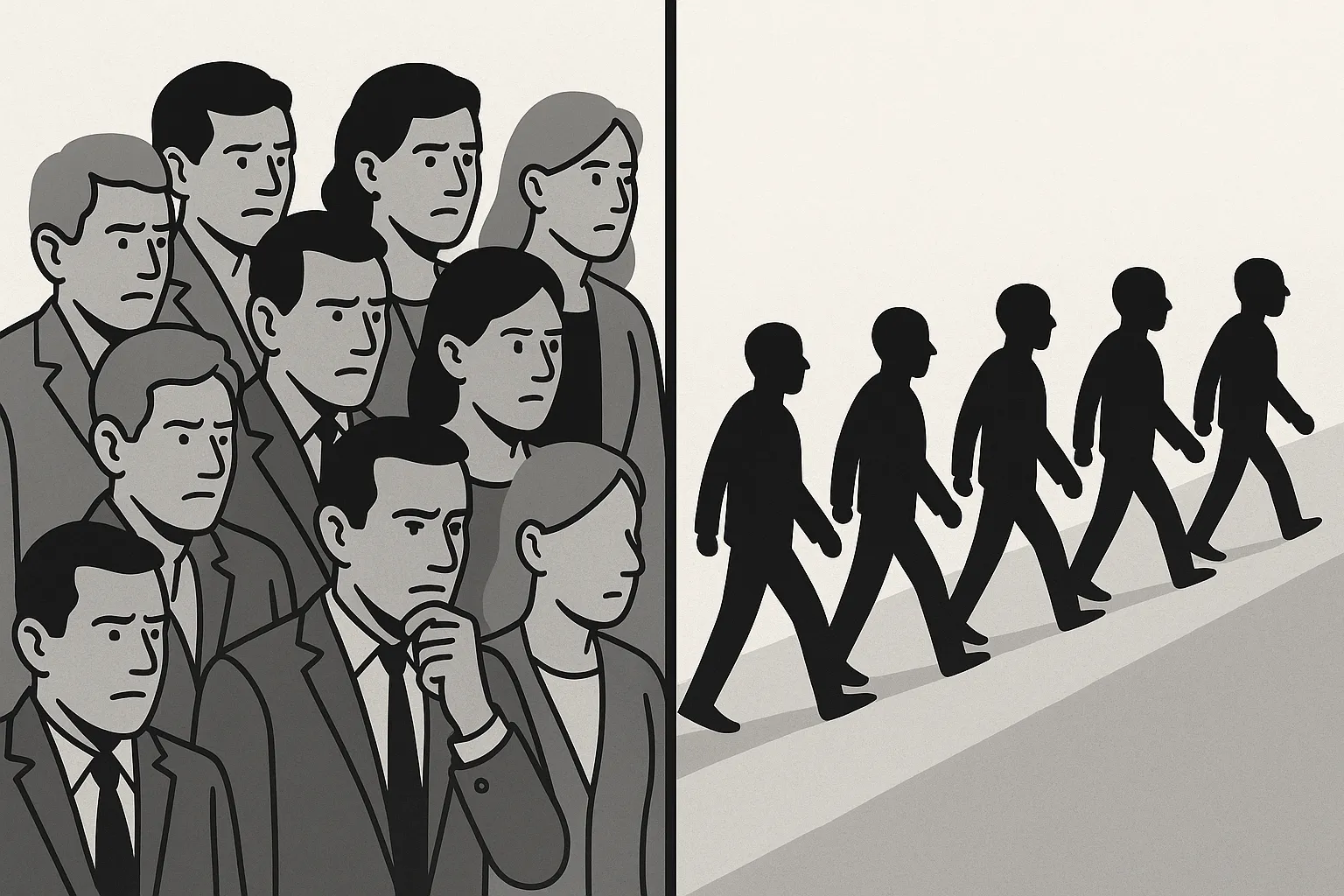
The answer is called cognitive dissonance. It is the uncomfortable tension you feel when two of your beliefs contradict each other, or when your actions contradict your beliefs. The psychologist Leon Festinger developed the idea in the 1950s. His main claim was that people want to get rid of this tension. Often they do it in a surprising way. Instead of changing what they do, they change what they believe, so that it fits what they have already done.
A few words explain the name. “Cognitive” comes from “cognition”, which means anything a person knows or believes. This includes what you know about your own behaviour. “Dissonance” means a clash, like two musical notes that do not sound good together.
The one-dollar experiment, step by step
Festinger tested the idea with his colleague James Carlsmith. They published the results in 1959. The experiment had five steps.
- The boring tasks. Each student spent half an hour putting twelve spools onto a tray, emptying the tray and filling it again. Then the student spent another half hour turning 48 square pegs, a quarter turn at a time.
- The favour. The experimenter then asked for help. His assistant had not come, he said. Could the student tell the next participant, who was waiting outside, that the tasks had been enjoyable?
- The payment. One group was offered one dollar for this. A second group was offered twenty dollars, which is worth well over a hundred dollars today. A third group, the control group, did the tasks but told nobody anything. In the end, each group had 20 students.
- The lie. The waiting “participant” was in fact a student hired by the researchers. Most students did as they were asked and told this person that the tasks were interesting and fun.
- The rating. Later, in what looked like a separate interview, every student rated how enjoyable the tasks had been. The scale went from minus five to plus five.
The results were clear. The control group rated the tasks slightly negative, at -0.45. The twenty-dollar group was almost the same, at -0.05. But the one-dollar group rated the hour at +1.35.
Here is how dissonance explains this. Every student who lied now held two thoughts that did not fit: “The task was boring” and “I told someone it was fun.” For the twenty-dollar students, this clash was easy to explain. They had lied for good money, and that was enough of a reason. The one-dollar students had no such excuse. They could not take the lie back. So the belief changed instead. Perhaps, they told themselves, the task had not been so bad after all.
Festinger and Carlsmith were confident about their result. Their summary ended with this sentence:
The results strongly corroborate the theory that was tested.
“Strongly corroborate” means “strongly support”. Later research, as we will see, made this claim less certain.
The pattern itself is much older than psychology. In one of Aesop’s fables, a fox cannot reach a bunch of grapes. He walks away and tells himself that the grapes were sour anyway. This is where the English phrase “sour grapes” comes from. The fox cannot change the height of the vine, so he changes his opinion of the grapes. Festinger added two things to this old story: a theory of why it happens, and a way to test it.
Where the idea comes from: a group waiting for a flying saucer
The theory did not start in a laboratory. In 1954 Festinger was working at the University of Minnesota. He read about Dorothy Martin, a housewife in Oak Park near Chicago. She said that she received messages from beings on a planet called Clarion. According to these messages, a great flood would destroy much of the world on 21 December 1954. A flying saucer would rescue the true believers.
Festinger and his colleagues placed observers in the small group around Martin. They wanted to see what the believers would do when no saucer came. They reported the results in their 1956 book When Prophecy Fails. The most committed believers did not give up. Instead, they explained the failure away and became even more eager to spread their message.
This became the founding story of the theory. A year later, Festinger set out the full theory in A Theory of Cognitive Dissonance. The laboratory experiment followed, to test it under controlled conditions.
Where you meet dissonance in your own life
The theory is most useful as a tool for noticing your own thinking. It helps you see moments when you defend a choice because it is yours, not because it is good. Here are four common situations.
- After a decision. You have chosen a university, a job or a phone. Now the good features of the options you rejected feel uncomfortable. Many people react by praising their choice and criticizing the others. Knowing this helps you separate two thoughts: “This was the best option” and “I need it to have been the best option.”
- Effort and commitment. The more you have put into a project, a relationship or a belief, the harder it is to admit that it was a mistake. The admission clashes with everything you have invested. The same logic makes people keep spending money on a plan that is failing. A useful question is: “Would I start this today, knowing what I know now?”
- Health and habits. A smoker who knows the risks lives with an obvious contradiction. One way to remove it is to stop smoking. Another way is to decide that the risks are exaggerated, or to say “my grandfather smoked and lived to ninety”. If you notice yourself making the second kind of move, that is often the first step towards the first kind.
- Politics and the news. Sometimes a fact clashes with a view that people have defended in public. Then they usually question the source of the fact before they question their view. Remember this when you try to persuade someone. If you push them into a corner, changing their mind becomes more costly for them. Remember it also when you catch yourself looking for reasons to ignore an inconvenient study.
Does dissonance just mean being a hypocrite?
No. This is the most common misunderstanding. Dissonance does not only mean holding two beliefs that contradict each other. Festinger’s claim was about a feeling and a motive. The contradiction creates discomfort, and the discomfort pushes people to resolve it, usually in the easiest way. Many contradictions never bother anyone, because nobody notices them.
How strong is the evidence today?
Most psychologists accept that people feel this kind of discomfort. But the classic evidence has become weaker, for three reasons.
The first reason is a large replication from 2024. A replication is a study that repeats an earlier experiment to see if the result holds. A team led by David Vaidis repeated a standard version of the dissonance experiment in 39 labs in 19 countries, with 4,898 participants.
In this version, students write an essay against their own opinion. Some are made to feel that they chose freely to write it, and others are not. Dissonance theory predicts that the free choice makes the difference, because only then do people feel responsible for the essay. Writing the essay did shift opinions a little. But free choice made no difference at all. The authors concluded that this kind of experiment may not be strong evidence for cognitive dissonance.
The second reason concerns the flying-saucer study. In 2025 the researcher Thomas Kelly studied Festinger’s private papers, which had recently become available. He published his analysis in the Journal of the History of the Behavioral Sciences. Kelly argued that the observers had encouraged the group’s beliefs several times when its members had doubts. He also argued that the book’s account of what happened afterwards is not reliable. Other historians think that this critique damages the study more than the theory. Either way, the most famous story about dissonance is weaker evidence than textbooks suggested for a long time.
The third reason is that there have always been other explanations. In the 1960s the psychologist Daryl Bem argued that people may just observe their own behaviour and conclude from it what they believe, the way an outsider would. In his view, no inner tension is needed at all.
So what can we say today? People certainly justify their choices and commitments. But the exact mechanism, and how strong it is in the laboratory, is still an open question.
Go deeper
The original 1959 paper is short, readable and free. Reading its method is the best way to judge the experiment yourself, and it is the first reference below. For the wider family of mental shortcuts and self-justifications, read Book Summary of “Thinking, Fast and Slow” by Daniel Kahneman. The most readable book about dissonance in everyday life is Mistakes Were Made (but Not by Me) (Affiliate Link) by Carol Tavris and Elliot Aronson. It applies the theory to marriages, courtrooms and politics.
The takeaway
When you notice yourself defending a choice harder than the evidence warrants, ask whether you are judging the choice or protecting the person who made it.
Test yourself
Answer from memory first, then open the answer.
1.In Festinger and Carlsmith's experiment, why did the one-dollar group rate the boring task as more enjoyable than the twenty-dollar group?
Show answer
Twenty dollars was a good enough reason to tell a lie, so those students felt little tension. One dollar was not, so the gap between 'I said it was fun' and 'it was boring' stayed open, and the easiest way to close it was to decide the task had not been so bad.
2.What did the 2024 multilab replication with almost 4,900 participants find?
Show answer
Writing an essay against one's own view under high choice did not change attitudes more than writing it under low choice. The core prediction of the induced-compliance paradigm did not show up, which calls into question how robust that classic evidence is.
3.A friend has just spent a lot of money on an expensive phone and now dismisses every review that criticizes it. How would dissonance theory explain this?
Show answer
The facts 'I paid a lot for this' and 'this phone has real flaws' sit uncomfortably together. The purchase cannot be undone, so the easier route is to downgrade the critical reviews and emphasize the phone's strengths.
References
- Cognitive Consequences of Forced Compliance. Leon Festinger and James M. Carlsmith, Journal of Abnormal and Social Psychology 58, reproduced by Classics in the History of Psychology, York University, 1959
The full original paper of the one-dollar experiment, with method and results.
- A Multilab Replication of the Induced-Compliance Paradigm of Cognitive Dissonance. David C. Vaidis et al., Advances in Methods and Practices in Psychological Science, 2024
Abstract of the 39-lab replication that did not find the classic effect.
- The Seekers of Cuyler Avenue. Frank R. FioRito, Oak Park River Forest Museum
The local history of the group Festinger's team studied in When Prophecy Fails.
- 'Alarm Bells Went Off': New Research Takes a Critical Look at the Landmark UFO Cult Study 'When Prophecy Fails'. Ryan Whalen, The Debrief, 2025
A report on Thomas Kelly's 2025 archival critique of the study, with a dissenting historian's view.