Kin Selection and Hamilton's Rule, Explained
5 min read≈ 1,170 words3 questions · up to 3 points
What this is about
When a predator appears, some ground squirrels call out a warning and make themselves the easiest target. Natural selection should remove such a habit, yet it persists. You learn the rule that explains which animals help, why the famous line about two brothers or eight cousins is not what it seems, and why biologists still argue about the idea.
In a nutshell· skip ahead
Kin selection is natural selection acting through relatives. A gene can spread not only by helping its carrier reproduce but also by helping relatives, who often carry copies of it. Hamilton's rule gives the condition: a helpful act is favoured when the benefit to the relative, multiplied by how closely they are related, exceeds the cost to the helper.
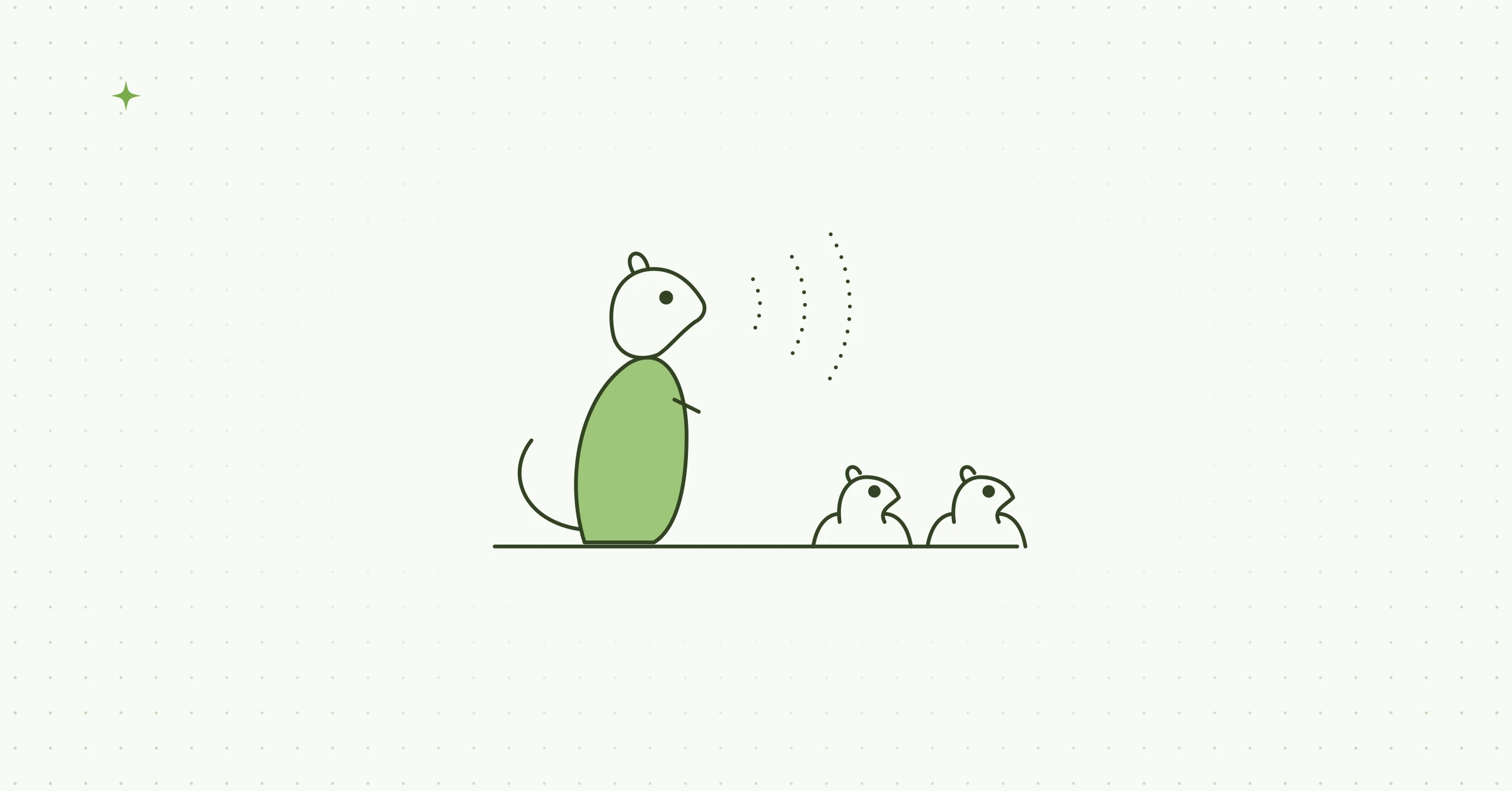
High in the Sierra Nevada of California, a long-tailed weasel moves through a meadow full of Belding’s ground squirrels. One squirrel sits up on a rock and gives a sharp, repeated call, and the others run for their burrows. The caller has now made itself the most visible animal in the meadow. Evolution favours what helps an animal survive and reproduce, so why does it keep a habit that puts the caller in danger?
How can a gene for risky helping spread?
The answer is kin selection: natural selection that works through relatives. A gene spreads not only when its carrier has more young but also when its carrier helps relatives, because relatives often carry copies of the same gene. The British biologist W. D. Hamilton worked out the condition in 1964, and it is now called Hamilton’s rule, usually written rB > C.
- C is the cost to the helper, measured in offspring it loses.
- B is the benefit to the relative, measured in offspring it gains.
- r is the coefficient of relatedness, the probability that the relative carries a copy of a given gene from a shared ancestor. It is 1/2 for a full sister or a daughter, 1/4 for a niece or a grandchild and 1/8 for a first cousin.
So helping a sister is favoured when it gives her more than twice what it costs you, and helping a cousin only when it gives her more than eight times the cost. Hamilton called the total of an animal’s own offspring plus its effects on relatives, each weighted by r, its inclusive fitness.
The biologist Paul Sherman tested the rule on the squirrels of Tioga Pass Meadow. From 1974 to 1976 he and his assistants watched marked animals of known age and family for 3,082 hours and saw 102 encounters with predators.
- Calling is costly. Predators stalked or chased 14 of 107 squirrels that called (13 percent), but only 8 of 168 that stayed silent (about 5 percent). Three of the six adults that predators caught had just called.
- Females call, males rarely do. Adult females called far more often than their numbers predicted, and males called much less.
- Only females live among relatives. Daughters stay near their birthplace for life, beside their mothers, sisters and daughters, while sons leave the area for good, usually before their first winter.
- Relatives make the difference. Females with living close relatives called more often than females without any, and short-term visitors called less than residents.
Applied to the squirrels, the rule explains the pattern. When a female calls, the animals she warns are often her sisters and daughters, so r is high and rB can be larger than C. When a male calls, he warns mostly strangers, r is close to zero and rB stays below the cost. The same species, facing the same predators, behaves differently in exactly the way the rule predicts.
What kin selection teaches you
When you see someone accept a cost, ask who shares in the benefit and how large their share is, because kin selection weighs each benefit in exactly this way and the question is useful far outside biology.
- “For the good of the species.” Nature films often say that an animal sacrifices itself for its group or its species, but kin selection tells you to ask who actually gains. John Maynard Smith made this point in 1964 against the claim that animals limit their own breeding for the good of the group.
- Families. Relatedness predicts conflict as well as help, and Robert Trivers used this reasoning to explain why parents and children disagree about how much care a child should get.
- Work and money. A cost is worth bearing when the benefit goes to people who share your stake. A co-founder who owns a third of a firm gains from a colleague’s success, while an employee without shares does not, although people choose their stakes and genes plan nothing.
Where does kin selection fall short?
The most common mistake is to think that animals must calculate relatedness. They do not, because a gene for calling spreads as long as the animals it makes call mostly live among relatives, and for a female squirrel the neighbours usually are her family. In 1955 the geneticist J. B. S. Haldane imagined a gene that makes a person rescue a drowning child, and he added a dry remark about himself.
But on the two occasions when I have pulled possibly drowning people out of the water (at an infinitesimal risk to myself) I had no time to make such calculations.
The famous line that Haldane “would lay down his life for two brothers or eight cousins” does not appear in his writings. It comes from John Maynard Smith, who wrote in 1975 that he had heard Haldane say it in the Orange Tree, a London pub, after Haldane had calculated on the back of an envelope for some minutes. Years later Maynard Smith admitted in an interview that it might have been ten cousins. Strictly, two brothers is only the break-even point, which is why Hamilton’s 1964 paper says “more than two brothers”.
The strongest objection came in 2010, when the Harvard researchers Martin Nowak, Corina Tarnita and Edward O. Wilson argued in Nature that inclusive fitness works only in special cases and that standard models of natural selection explain social insects better. In 2011, 137 biologists answered in the same journal that the critique misunderstood the theory and misrepresented the evidence. Most evolutionary biologists still use kin selection, but the debate about how general Hamilton’s rule is has not ended.
Two smaller limits matter too. In ants, bees and wasps a female shares more genes with her sisters than with her own young, which was long told as the full explanation of their sterile workers, but its importance is disputed today. Kin selection also cannot explain help between unrelated animals, which needs other ideas such as reciprocal help.
Learn more
The puzzle is old: Darwin treated sterile worker ants as a special difficulty for his theory in chapter 7 of On the Origin of Species, and Haldane sketched the answer in his 1955 article. W. D. Hamilton, then working at the Galton Laboratory of University College London, gave the first full theory in two papers in the Journal of Theoretical Biology in July 1964. John Maynard Smith gave the idea its name in a short paper in Nature in March of the same year, titled “Group Selection and Kin Selection”.
The review “The Selfish Gene” by Richard Dawkins: Summary and Review is the best next step, because Dawkins built his famous book around Hamilton’s idea and explains it without equations. If you want the foundation first, Natural Selection: How It Works and Why It Matters explains the process that kin selection extends.
Quiz
3 questions · up to 3 points
Open a question and pick one answer. Only your first answer counts: +1 if it is right, −1 if it is wrong.
What does Hamilton's rule, rB > C, say?
Show answer
A helpful act is favoured when the benefit to the receiver, multiplied by relatedness, is larger than the cost to the helper. r is the relatedness, B the benefit to the relative and C the cost to the helper, all measured in offspring. If r times B is larger than C, a gene for the act can spread.
In a bird species, daughters leave the place where they hatched while sons stay and breed near their parents and brothers. Following Sherman's findings, which birds should give the most risky alarm calls?
Show answer
The adult males, because they live among close relatives. This mirrors the ground squirrels with the sexes reversed. The sex that stays at home has relatives nearby, so its warnings help copies of its own genes.
Does kin selection mean that animals work out how closely they are related before they help?
Show answer
No. A gene for helping can spread if the animals it makes helpful mostly meet relatives, for example because relatives live nearby. Kin selection is about which genes spread, not about thinking. Haldane himself wrote that he had no time for such calculations when he pulled people out of the water.
Your points are saved only in this browser for now. Accounts that keep them for good are on the way.
Continue learning: "The Selfish Gene" by Richard Dawkins: Summary and Review →The takeaway
Kin selection is natural selection acting through relatives: a gene for helping spreads when it helps relatives who carry copies of it, which Hamilton's rule states as rB > C, relatedness times benefit larger than cost. In 1977 Paul Sherman showed that female Belding's ground squirrels, which live among close relatives, give risky alarm calls far more often than males, which leave home. The animals need not calculate anything, but how general the rule is has been debated since 2010. When someone accepts a cost, ask who shares in the benefit and how much.
References
- The genetical evolution of social behaviour. I and II. W. D. Hamilton, Journal of Theoretical Biology 7(1): 1–16 and 17–52, 1964
The two original papers that introduce inclusive fitness and the condition now called Hamilton's rule. Mathematical, but the summaries are readable.
- Nepotism and the Evolution of Alarm Calls. Paul W. Sherman, Science 197(4310): 1246–1253, 1977
The ground squirrel study, with 102 encounters with predators at Tioga Pass Meadow and the tables on who calls.
- Biological Altruism. Samir Okasha, Stanford Encyclopedia of Philosophy, 2013
A clear overview of kin selection, Hamilton's rule, relatedness values and the debate about group selection.
- Haldane on kin selection, 1955. Joe Felsenstein, Joe Felsenstein's website, University of Washington
Haldane's original passage about saving a drowning child, with a short comment by a population geneticist.
- Inclusive fitness theory and eusociality. Patrick Abbot and 136 co-authors, Nature 471: E1–E4, 2011
The reply to Nowak, Tarnita and Wilson's 2010 critique, which links to the original paper and to their answer.