What Is Dunbar's Number?
5 min read≈ 1,190 words3 questions · up to 3 points
What this is about
Some farming communities in North America split up whenever they come close to 150 members, and an Oxford anthropologist thought he knew why. You learn how a study of monkey and ape brains produced the number and how your own contacts are said to form layers. You also learn why a reanalysis in 2021 found the number far less certain than its fame suggests.
In a nutshell· skip ahead
Dunbar's number is the proposal that a person can keep only about 150 stable relationships at once, meaning people they know personally and stay in touch with. The anthropologist Robin Dunbar derived it from the link between brain size and group size in monkeys and apes. The circles people keep do seem limited, but the exact figure is disputed.
The Hutterites are a Christian farming people in Canada and the northern United States who live in colonies that share land, work and meals. When a colony grows too large, it buys new land and splits into two, and in 1993 the British anthropologist Robin Dunbar reported that the Hutterites regard about 150 people as the limit for one colony. Other groups seem to stop near the same size, from village clans to the companies of modern armies. Is there something about people that makes 150 a natural size for a group?
What is Dunbar’s number?
Dunbar’s number is the proposal that a person can keep only about 150 stable relationships at once: people they know personally, whose relations to each other they also know, and with whom they stay in touch. Dunbar’s explanation is the social brain hypothesis, the idea that primates evolved large brains mainly to manage life in groups. Keeping track of who is friends with whom, who owes a favour and who cannot be trusted takes mental capacity, so the size of the brain should limit the size of the group.
Dunbar turned this idea into a number in four steps.
- Measure the brain. He used the neocortex ratio, the volume of the neocortex (the outer layer of the brain used for thinking and planning) divided by the volume of the rest of the brain.
- Compare primates. In 1992 he showed that monkeys and apes with a higher ratio live in larger groups. In his comparison of 36 groups of related primate species, the ratio explained about three quarters of the differences in average group size.
- Put in the human value. The human ratio is 4.1, about 50% higher than in any other primate. Placed into the same equation, it gave a group size of 147.8, which Dunbar rounded to 150.
- Check real groups. In nine hunter-gatherer and farming societies, the middle level of social life, the clan or village, averaged 148 people, while overnight camps were smaller and whole tribes much larger.
A better test came later. In 2003 Russell Hill and Dunbar asked adults to list everyone they sent Christmas cards to, including all members of each household. The lists averaged 153.5 people, very close to the prediction.
But why should a brain limit friendships at all? Dunbar’s answer is that every relationship needs time as well as memory. Monkeys and apes keep their bonds by grooming each other, and Dunbar calculated that a group of 150 would need about 42% of each day for grooming, more than twice the most any primate spends. He suggested that language evolved as a cheaper kind of grooming, because talk can reach several people at once.
How are the 150 people arranged?
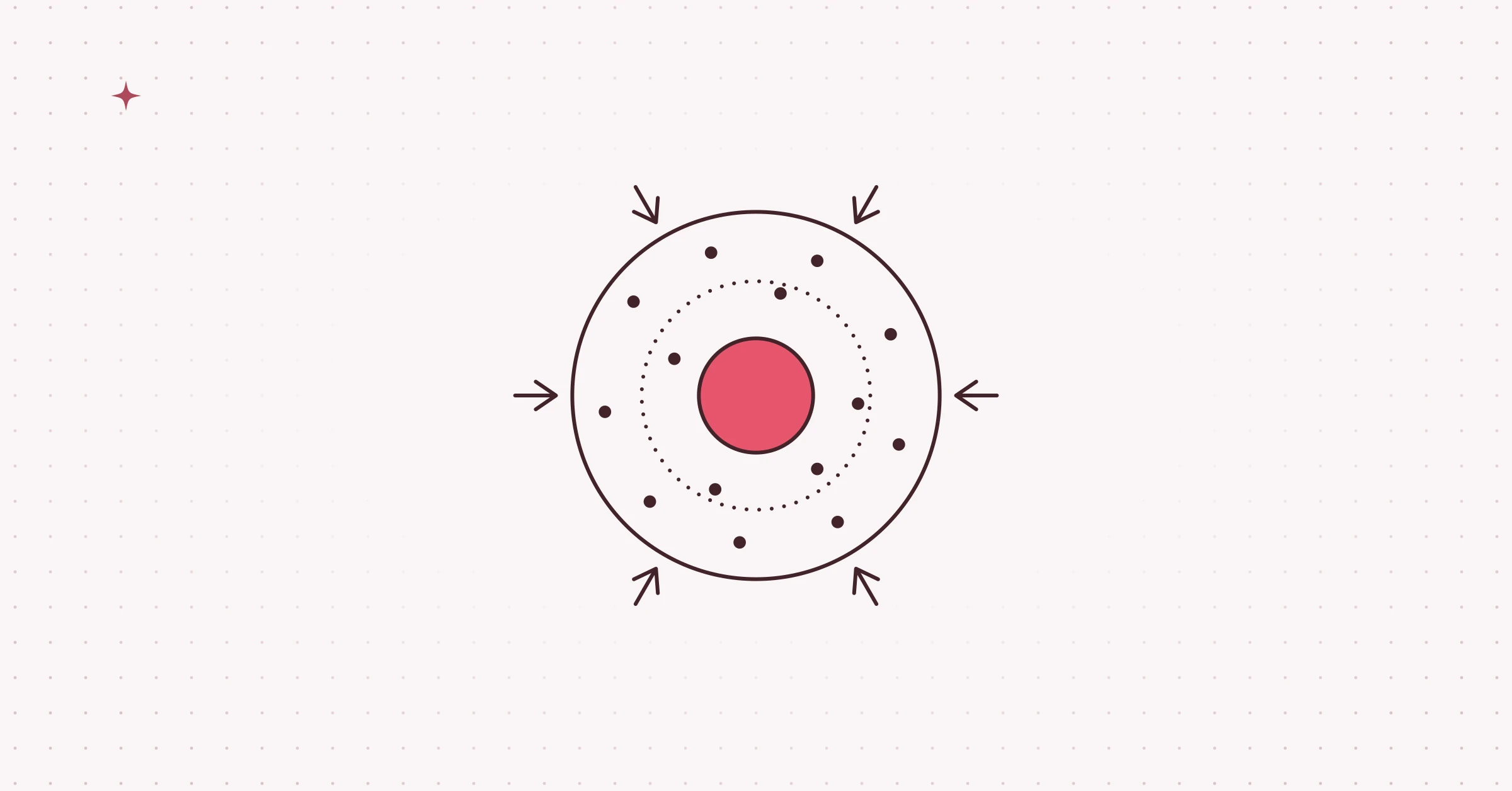
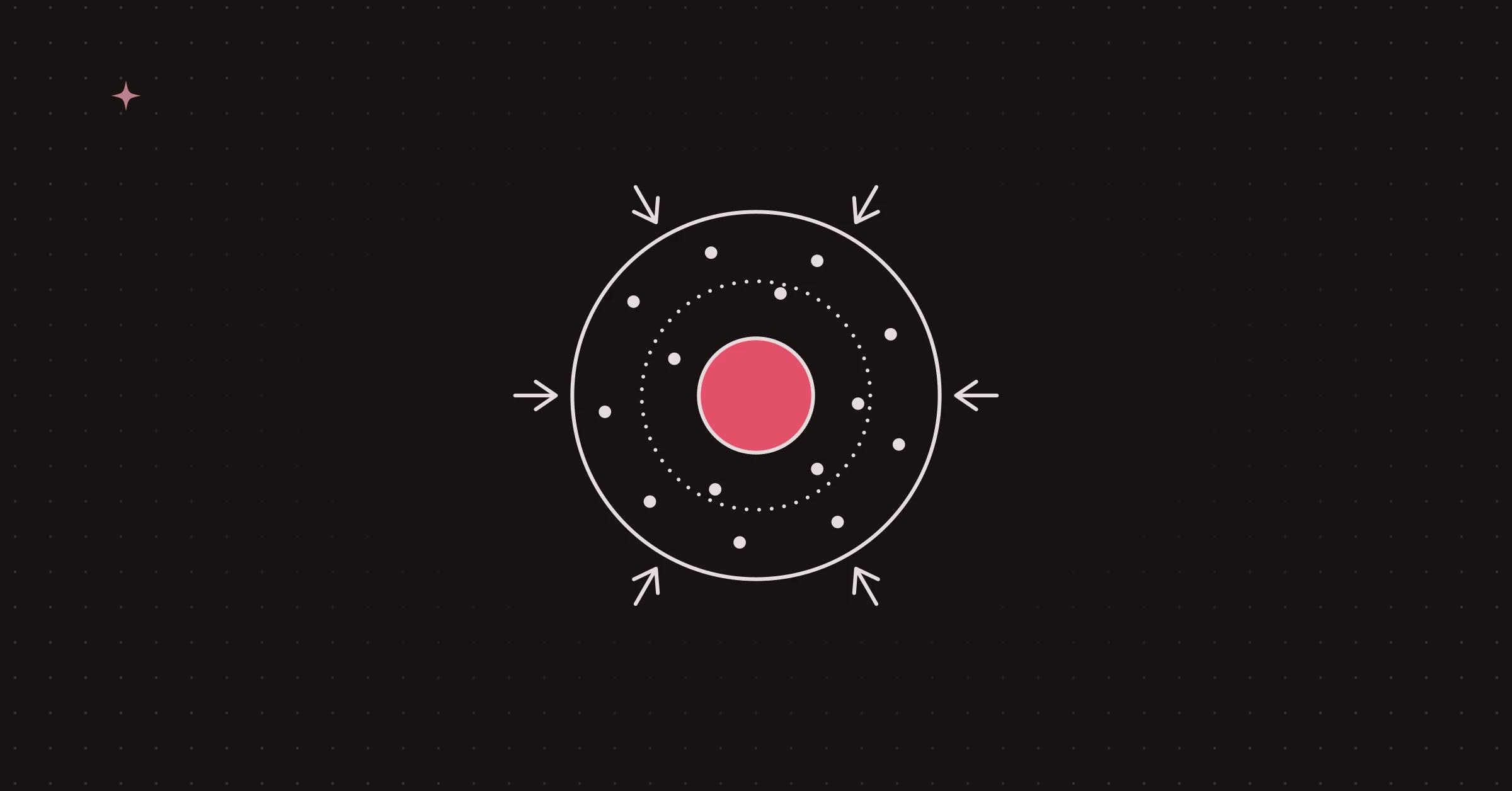
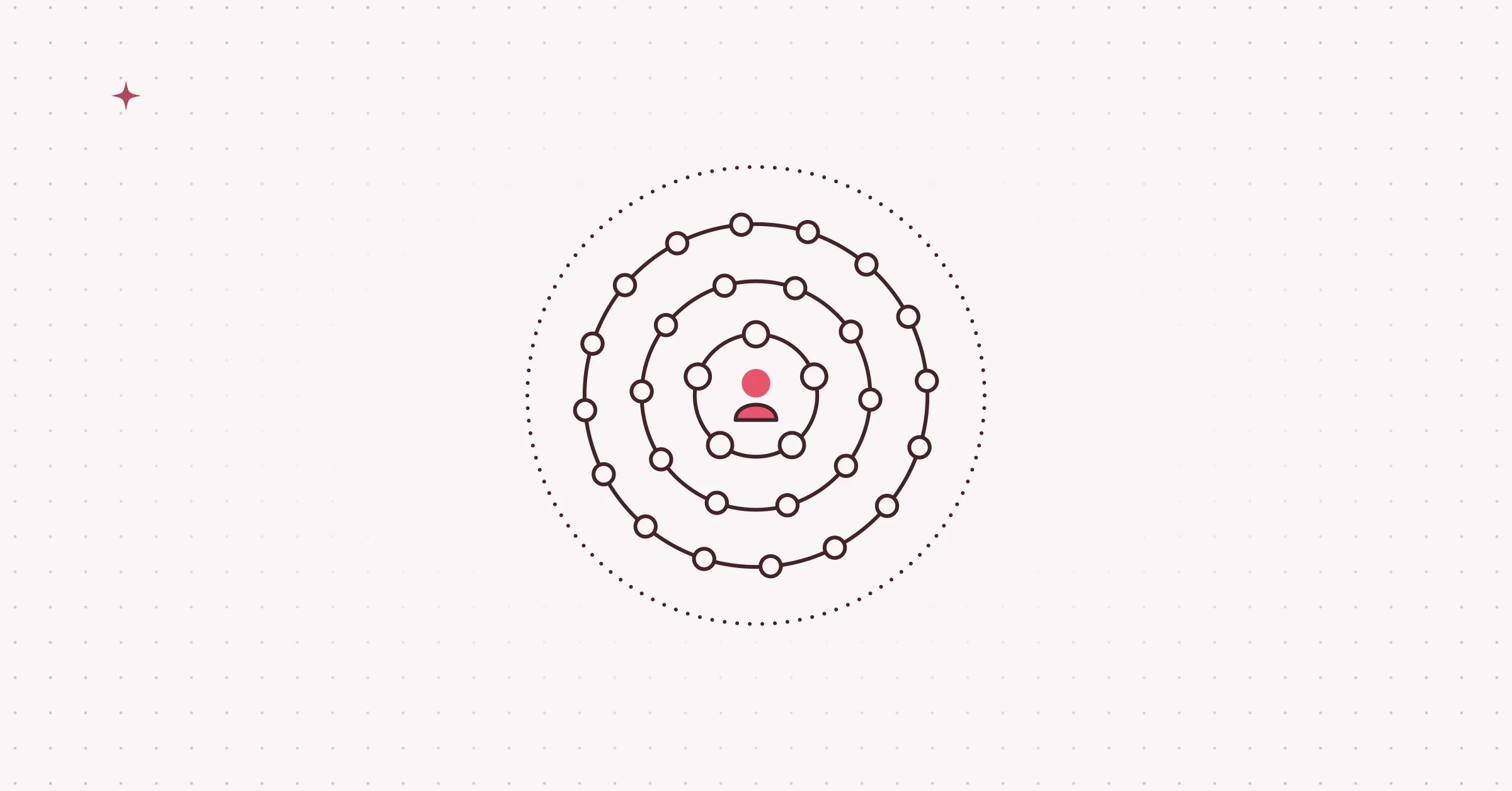
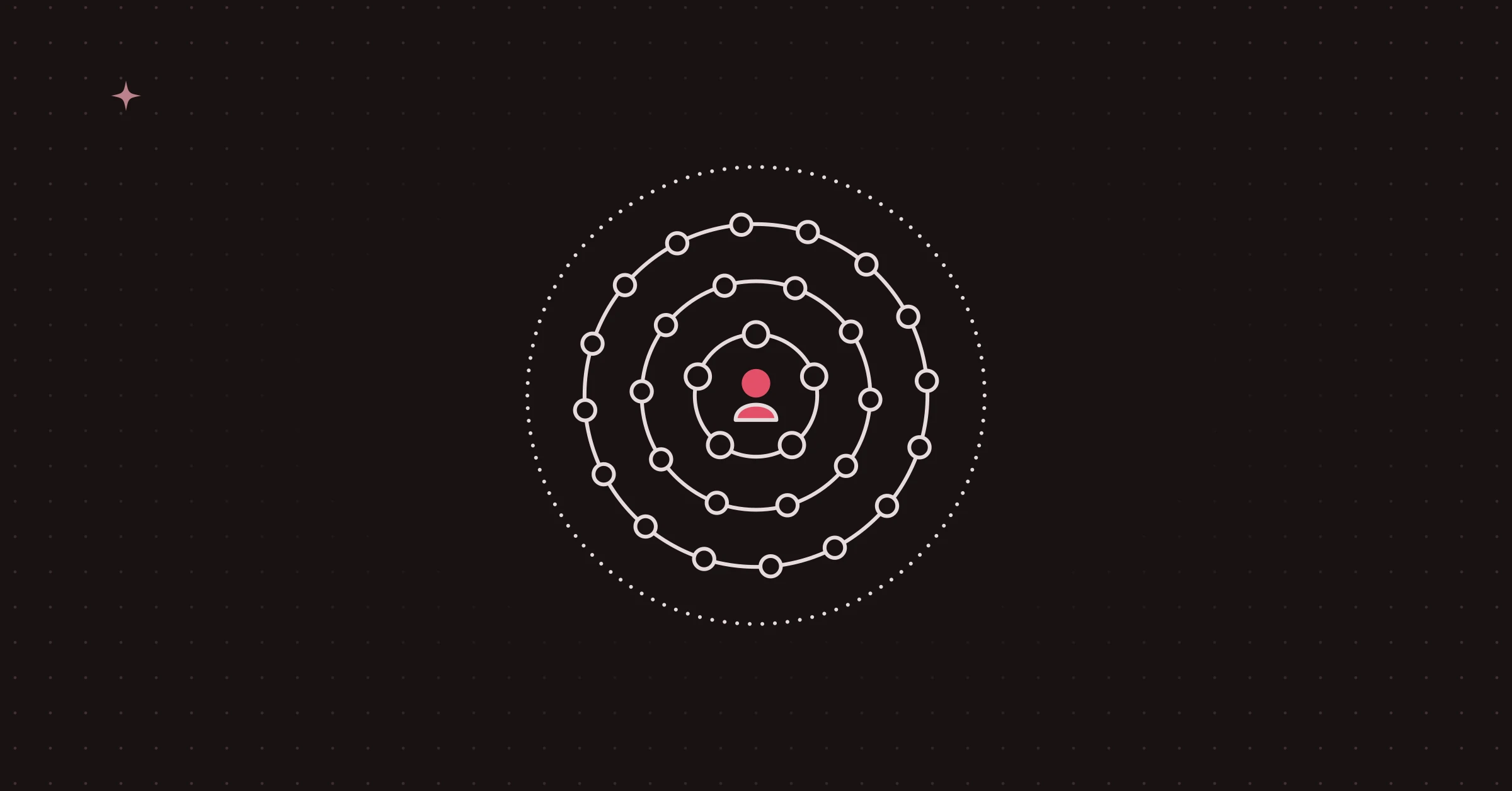
Dunbar and his colleagues argue that the 150 form a set of circles inside each other, each about three times larger than the one inside it. The inner circle holds about 5 people you would turn to in a crisis, the next about 15 close friends, then about 50 good friends and finally about 150 stable relationships. Beyond them lie about 500 acquaintances and about 1,500 faces you can put a name to. The closer the circle, the more often you see its members and the more time each one costs.
Social media do not seem to break these circles. In two British surveys in 2016, people had on average 155 and 183 Facebook friends, and the people they could turn to in a crisis averaged 4.1. Having more contacts online did not give them more close friends.
What Dunbar’s number teaches you
The useful question is: how much time can I give each of the people who matter to me, and who will get less if I add more? The number reminds you that friendship is limited by time, not only by goodwill.
- Your own friendships. Close friends cost the most time, so when a new job, a new partner or a new city fills your week, ask which close friends will now get less of it.
- Groups that grow. A school, club or company with a few dozen members can run on personal trust, but as it grows past a few hundred, people no longer know each other and need written rules, roles and smaller units.
- Shared resources. Communities that manage a common pasture or fishing ground well tend to be small groups whose members know each other, which What Is the Tragedy of the Commons? explains.
Harari builds part of his history of our species on this limit, arguing that shared stories let humans cooperate far beyond 150 people, as “Sapiens” by Yuval Noah Harari: Summary and Review describes.
Where does the number break down?
The most common misunderstanding is that 150 is a hard limit. Dunbar calculated an average, and his own 1993 paper gave a 95% confidence range from 100 to 231 people, the range in which the true value most likely lies. So the number describes a typical group, not the largest possible one.
The strongest objection came in 2021, when the Swedish researchers Patrik Lindenfors, Andreas Wartel and Johan Lind repeated the brain calculation with larger primate data sets and modern methods that take account of how related the species are. Their estimates ranged from 16 to 109 people, and the most careful one gave 69 people with a 95% confidence range from 3.8 to 292. A range that wide fits a family as well as a large village, so the brain data cannot fix any number at all.
A cognitive limit on human group size cannot be derived in this manner.
Dunbar replied that their regression method underestimates the slope of the line, and that the method he prefers gives 158 for the same data instead of 71. The debate has not been settled. My judgment is that the calculation from monkey brains is weak, while the evidence that personal circles are small and layered is stronger, although most of it comes from Dunbar’s own research group and from rich Western countries.
Learn more
Dunbar’s number is named after Robin Dunbar, a British anthropologist and evolutionary psychologist at the University of Oxford. He published the primate comparison in the Journal of Human Evolution in 1992 and the estimate for humans in 1993, and in 1998 he summarized the wider argument in a paper called “The social brain hypothesis”. Much of the later work on the circles of 5, 15, 50 and 150 came from his group, with colleagues such as Russell Hill.
For why small groups of people who meet again and again can learn to trust each other, read “The Evolution of Cooperation” by Robert Axelrod: Summary and Review. Dunbar’s own book for general readers, Friends: Understanding the Power of our Most Important Relationships (Affiliate Link), explains the circles of friendship in detail, mostly from the research of his own group.
Quiz
3 questions · up to 3 points
Open a question and pick one answer. Only your first answer counts: +1 if it is right, −1 if it is wrong.
How did Robin Dunbar first arrive at the number 150 for humans?
Show answer
He extended a link between brain size and group size in monkeys and apes to the human brain. Dunbar found that primates with a larger neocortex live in larger groups, then put the human value into the same equation and got 147.8.
A climbing club has grown from 60 to 400 members, and the old members say it no longer feels like one group. What does Dunbar's idea suggest?
Show answer
Most members can no longer know each other personally, so the club may need smaller sections or written rules. Dunbar's claim is that personal trust and informal pressure work in groups of roughly 150 or fewer, which is why Hutterite colonies split as they grow.
Which statement about Dunbar's number is correct?
Show answer
It is an estimate of an average, and a 2021 reanalysis found the data fit almost any number from a handful to several hundred. Lindenfors, Wartel and Lind showed that the regression gives averages, and their best estimate had a 95% range of 3.8 to 292 people.
Your points are saved only in this browser for now. Accounts that keep them for good are on the way.
Continue learning: "Sapiens" by Yuval Noah Harari: Summary and Review →The takeaway
Dunbar's number is the proposal that a person can keep only about 150 stable relationships, because keeping track of people takes brain capacity and time. Robin Dunbar extended a link between brain size and group size in monkeys and apes to humans and found 148, close to the 153 people in an average Christmas card list. A 2021 reanalysis showed that the brain data allow almost any number, from a handful to several hundred. Treat 150 as an average, not a limit, and remember that close friends cost the most time.
Cheat card
The whole idea on one page. Tap to open it full size, download it below, or test yourself against it tomorrow.
Download
- Light card · PNG image, 385 KB
- Dark card · PNG image, 389 KB
- Printable light card · PDF, searchable, 24 KB
Read the card as text
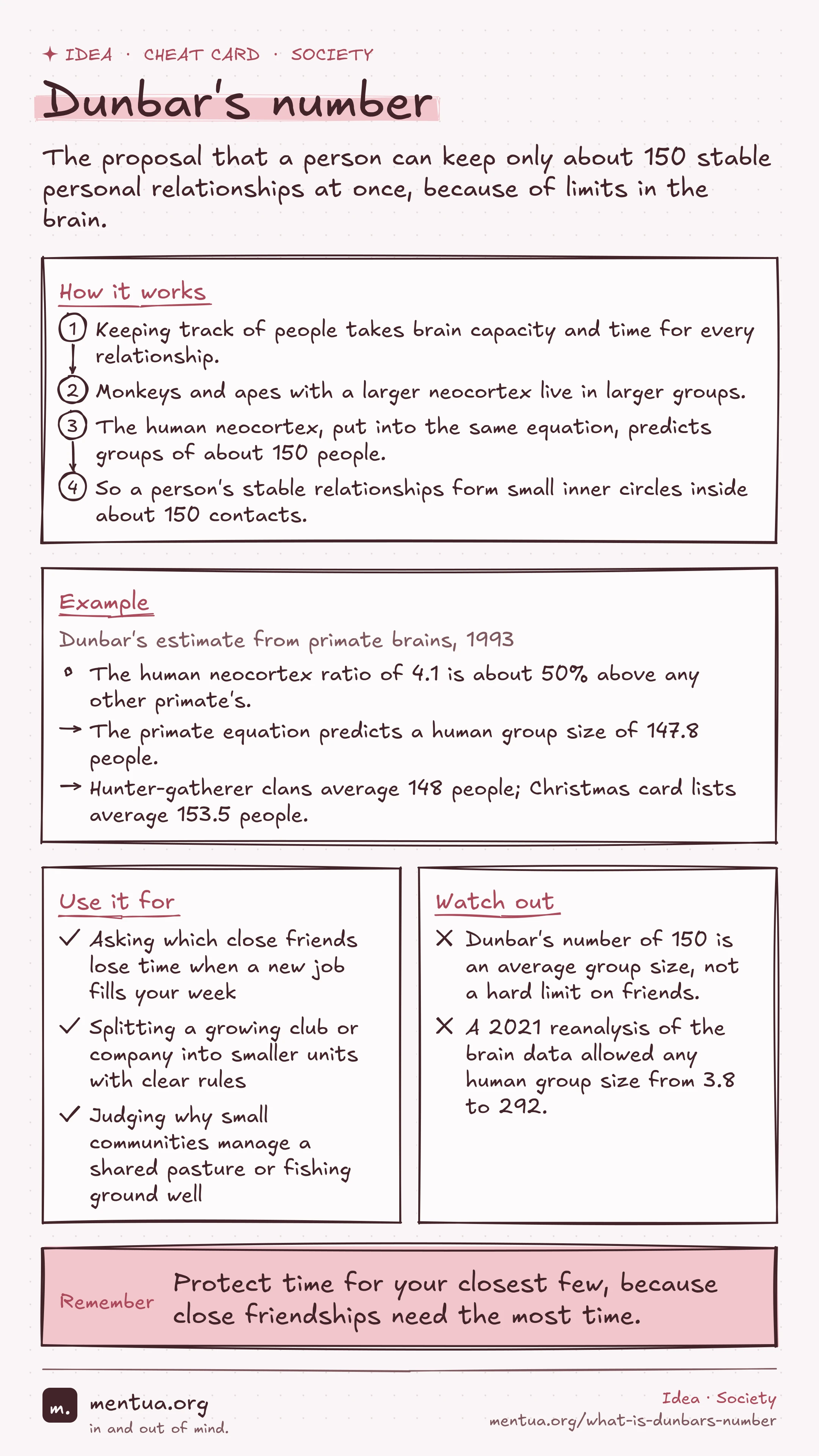
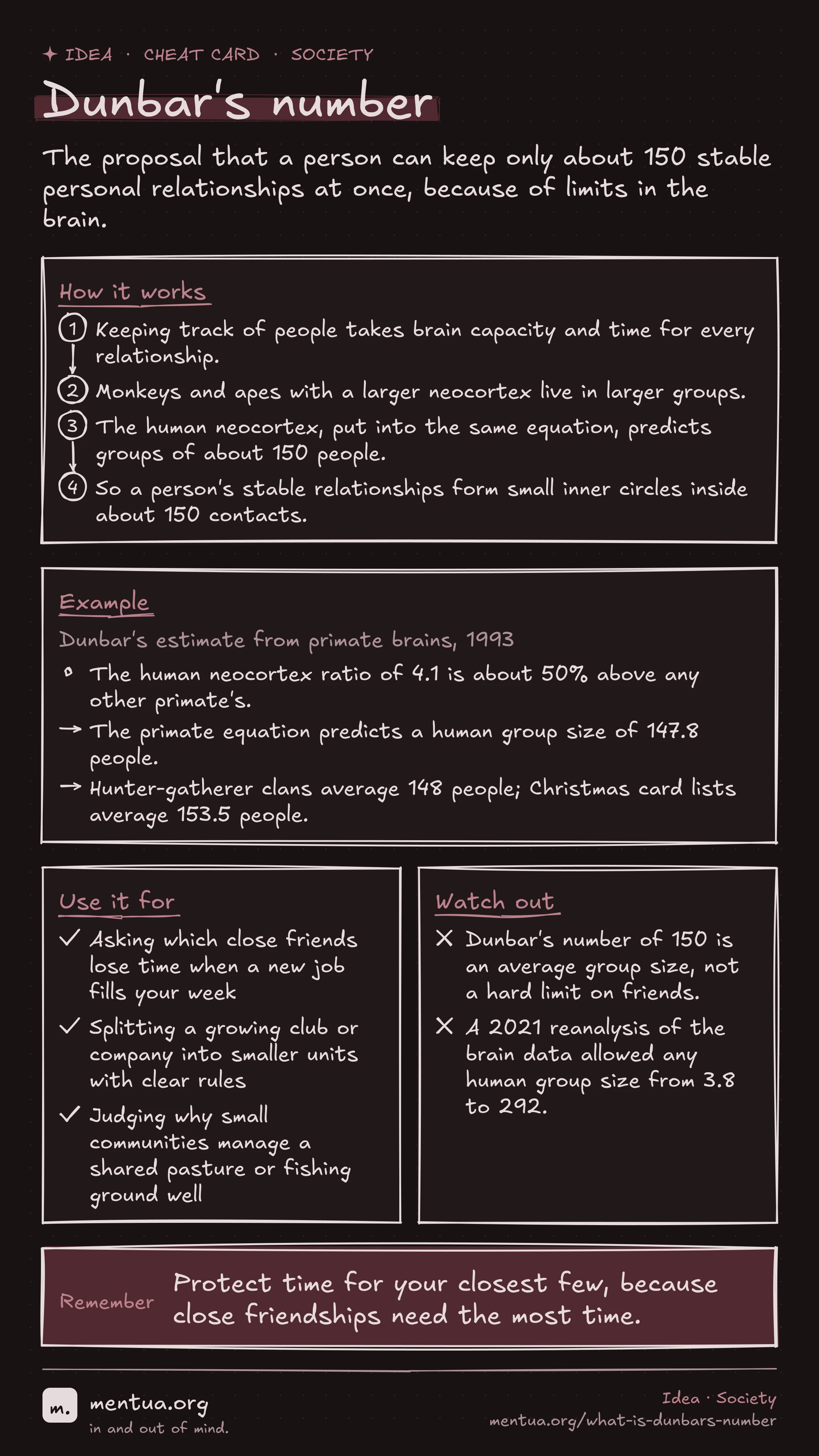
Dunbar's number: The proposal that a person can keep only about 150 stable personal relationships at once, because of limits in the brain.
How it works
- Keeping track of people takes brain capacity and time for every relationship.
- Monkeys and apes with a larger neocortex live in larger groups.
- The human neocortex, put into the same equation, predicts groups of about 150 people.
- So a person's stable relationships form small inner circles inside about 150 contacts.
Example: Dunbar's estimate from primate brains, 1993
- The human neocortex ratio of 4.1 is about 50% above any other primate's.
- → The primate equation predicts a human group size of 147.8 people.
- → Hunter-gatherer clans average 148 people; Christmas card lists average 153.5 people.
Use it for
- Asking which close friends lose time when a new job fills your week
- Splitting a growing club or company into smaller units with clear rules
- Judging why small communities manage a shared pasture or fishing ground well
Watch out
- Dunbar's number of 150 is an average group size, not a hard limit on friends.
- A 2021 reanalysis of the brain data allowed any human group size from 3.8 to 292.
Remember: Protect time for your closest few, because close friendships need the most time.
References
- Coevolution of neocortical size, group size and language in humans. R. I. M. Dunbar, Behavioral and Brain Sciences 16 (4), 681–694, 1993
The paper that applies the primate equation to humans and gets 147.8, with the confidence range, the hunter-gatherer groups and the idea of language as a cheap way of grooming.
- Social network size in humans. R. A. Hill and R. I. M. Dunbar, Human Nature 14 (1), 53–72, 2003
The Christmas card study, in which the people on each card list averaged 153.5.
- Do online social media cut through the constraints that limit the size of offline social networks?. R. I. M. Dunbar, Royal Society Open Science 3, 150292, 2016
Two British surveys of Facebook friends and close friends, with a clear summary of the layers of 5, 15, 50 and 150.
- 'Dunbar's number' deconstructed. Patrik Lindenfors, Andreas Wartel and Johan Lind, Biology Letters 17 (5), 20210158, 2021
The reanalysis with modern statistics and larger primate data sets, which finds estimates from 16 to 109 and confidence ranges of several hundred people.
- Dunbar's number: why my theory that humans can only maintain 150 friendships has withstood 30 years of scrutiny. Robin Dunbar, The Conversation, 2021
Dunbar's reply to the 2021 critique, explaining why he thinks its choice of regression method gives numbers that are too low.