What Is Opportunity Cost?
5 min read≈ 1,160 words3 questions · up to 3 points
What this is about
A free concert ticket sounds as if it costs nothing, yet in a 2005 survey most economists could not say what it really costs. You learn how to work out the cost of any choice in four steps, why shoppers forget this cost until someone reminds them, and where the idea stops being exact.
In a nutshell· skip ahead
Opportunity cost is the value of the best alternative you give up when you choose, because the same time or money cannot be used twice. It is often more than the price you pay, since studying, for example, also costs the income you could have earned in a job. A good choice compares an option with its best alternative.
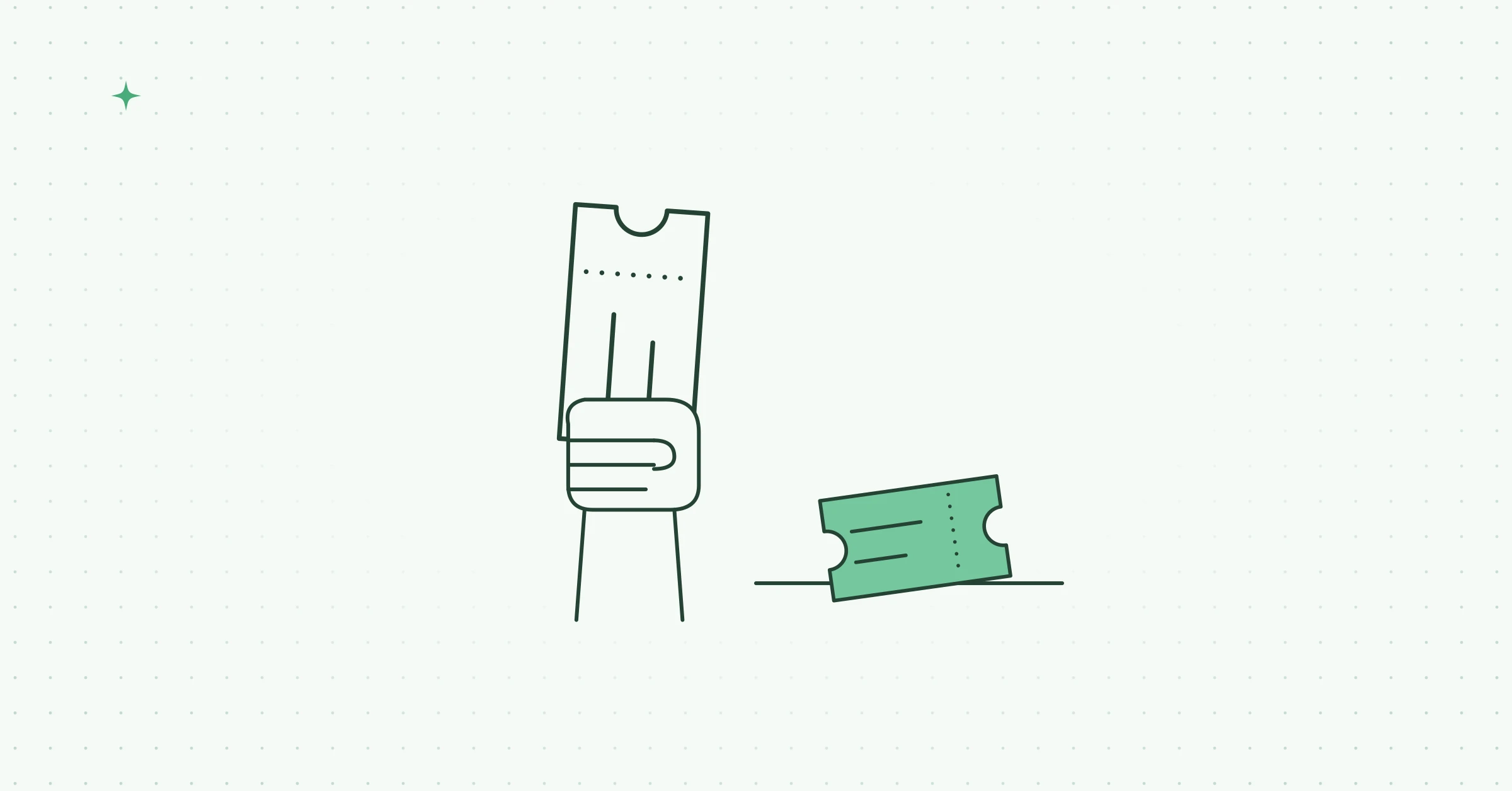
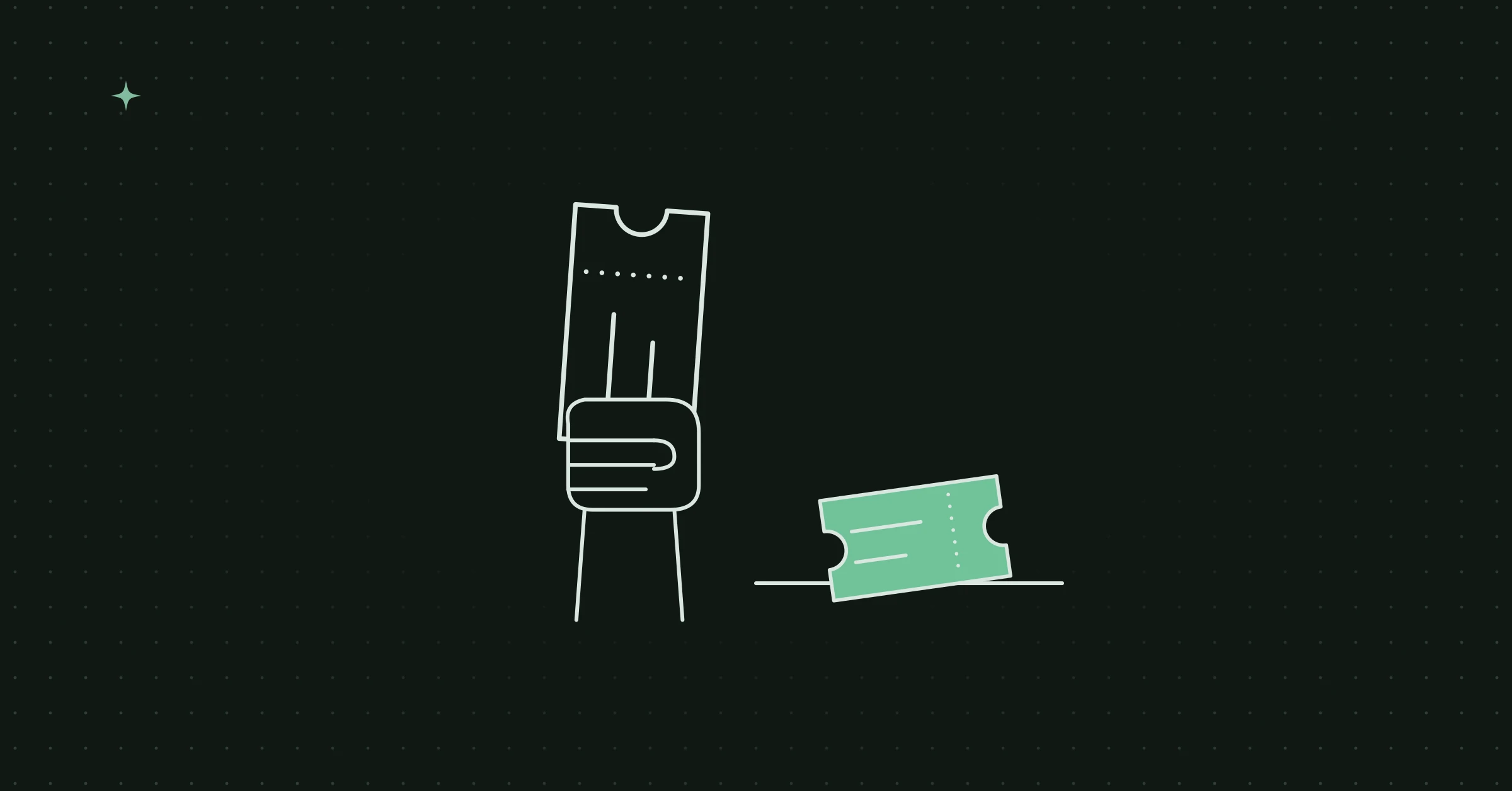
At the 2005 meeting of American economists in Philadelphia, 199 economists and economics PhD students answered one question from an introductory textbook. You have a free ticket to an Eric Clapton concert that you cannot sell, while Bob Dylan plays the same night, and you would pay up to $50 for a Dylan ticket that costs $40. What does going to the Clapton concert cost you? Only 21.6% chose the right answer, fewer than random guessing among the four options would give.
How do you work out an opportunity cost?
Opportunity cost is the value of the best alternative you give up when you choose, because the same time or money cannot be used twice. The price is often only a small part of it. In the survey the Clapton ticket was free, but it still used up the evening you could have spent with Dylan.
Paul Ferraro and Laura Taylor, who ran the survey, give the textbook answer in four steps.
- Find the best alternative. The question says the Dylan concert is your next-best option for the evening.
- Count what the best alternative would give you. Seeing Dylan is worth $50 to you, because that is the most you would pay for it.
- Subtract what the best alternative would have cost. The Dylan ticket costs $40, and by going to Clapton you also avoid paying that.
- The difference is the opportunity cost. You give up $50 of enjoyment and keep $40, so going to Clapton costs you $10.
So you should go to Clapton only if that evening is worth more than $10 to you. Each wrong answer in the survey left out one of the steps. A quarter of the respondents answered $0, because the ticket was free, and another quarter answered $40, the price of the other ticket. The largest group, 27.6%, answered $50, the value of seeing Dylan without subtracting what it would have cost.
The authors then gave the same question to 358 undergraduates in the first week of an introductory course. The surprising result was that students who had already taken an economics course chose the right answer less often (7.4%) than students who had never taken one (17.2%).
Why do people overlook opportunity costs?
People overlook them mainly because the best alternative is invisible: you see the thing you buy, but nobody shows you what else the same money could have bought. In 2009 the psychologist Shane Frederick and four colleagues called this opportunity cost neglect.
In one of their studies, students imagined that they could buy a DVD of a film they liked for $14.99. When the option to decline read “Not buy this entertaining video”, 75% chose to buy, but when it read “Keep the $14.99 for other purchases”, only 55% did. The offer was the same, so the reminder only worked because many students had not thought of other uses for the money by themselves.
The French economist Frédéric Bastiat made the same point in 1850 in a pamphlet called What Is Seen and What Is Not Seen. A boy breaks a window, and the neighbours comfort his father by saying that at least the glazier now earns six francs. Bastiat replied that the glazier’s work is only what is seen. What is not seen are the new shoes or the book the father would have bought with the same six francs, so the town as a whole is one window poorer.
What opportunity cost teaches you
Before any choice, ask “Compared with what?” and name your best alternative, instead of comparing the option with doing nothing or only with its price.
- Studies. In an example by the economist David Henderson, a student pays $4,000 in fees but gives up $20,000 of pay from a job. The lost income is by far the largest part of what studying costs.
- Work and time. A better-paid job offer has to be compared with your best alternative, including the hours, the travel and the work you would stop doing. Thoreau priced everything in hours of life, as “Walden” by Henry David Thoreau: Summary and Review explains.
- Trying something new. An evening at a new restaurant costs you a meal at a favourite place you know is good, and What Is the Explore-Exploit Tradeoff? shows when that price is worth paying.
the cost of a thing is the amount of what I will call life which is required to be exchanged for it, immediately or in the long run.
Where does the idea stop working?
The most common mistake is to add up everything you give up. If a free evening could go to a concert, a film or a dinner, the opportunity cost of the concert is the value of the better of the other two. It is not both together, because you could only have done one of them.
The strongest objection is that real values are rarely as clear as in a textbook. The Clapton question tells you that Dylan is worth exactly $50 to you, but in real life you seldom know what an evening or a year is worth, so an opportunity cost is an estimate. In 2012 the economists Joel Potter and Shane Sanders even argued that the survey question allows several reasonable ways of counting, which would make every answer defensible. If so, the survey shows how loosely the term is defined as much as what economists understand.
The evidence for opportunity cost neglect has held up, but it is weaker than the first studies suggested. A 2023 review of 39 experiments with 14,005 participants found the effect again, at between a quarter and a half of the size Frederick and his colleagues had reported. Listing alternatives before every small purchase would also be exhausting, so the idea is most useful for large or frequent choices.
Learn more
There is no single originator of opportunity cost. Bastiat described the unseen alternative in 1850 without naming it. From 1876 onward the Austrian economist Friedrich von Wieser built a theory of cost on the idea that a resource costs as much as the value it could have produced in its best other use. He set it out most fully in his 1889 book Natural Value. According to later historians, the English term “opportunity cost” first appears in an 1894 article by the American economist David I. Green called “Pain-Cost and Opportunity-Cost”.
Money that is already spent has no opportunity cost, because it cannot go anywhere else, and What Is the Sunk Cost Fallacy? explains why people still let it guide their next choice. Knowing the term does not mean you will remember it when a real offer arrives, which is the problem Mental Models: Why Collecting Them Is Not Enough takes up.
Quiz
3 questions · up to 3 points
Open a question and pick one answer. Only your first answer counts: +1 if it is right, −1 if it is wrong.
You have a free Clapton ticket you cannot sell. Your best alternative is a Dylan concert the same night, which costs $40 and is worth $50 to you. What is the opportunity cost of going to Clapton?
Show answer
$10, the value of seeing Dylan minus the price you would have paid for it. By choosing Clapton you give up $50 of enjoyment but also save the $40 ticket, so the net value you give up is $10.
A town council plans to spend 2 million euros on a new car park. Which question shows the opportunity cost of this plan?
Show answer
What is the best other use the town has for the same 2 million euros? The opportunity cost is the value of the best alternative the money could pay for, such as a school repair or lower taxes, which nobody sees if the car park is built.
Which statement about opportunity cost is correct?
Show answer
It counts only the best alternative you give up, not all the alternatives added together. You could only have done one other thing with the same time or money, so the value you lose is the value of the best of those things.
Your points are saved only in this browser for now. Accounts that keep them for good are on the way.
Continue learning: What Is the Sunk Cost Fallacy? →The takeaway
Opportunity cost is the value of the best alternative you give up when you choose, minus what that alternative would have cost you. In a 2005 survey, only 21.6% of 199 economists found that a free Clapton ticket costs $10 when the best alternative is a $40 Dylan concert worth $50. Shoppers also buy less once reminded of other uses for their money. Real values are often unclear, so the cost is an estimate, but before a big choice, name your best alternative and compare the option with it.
Cheat card
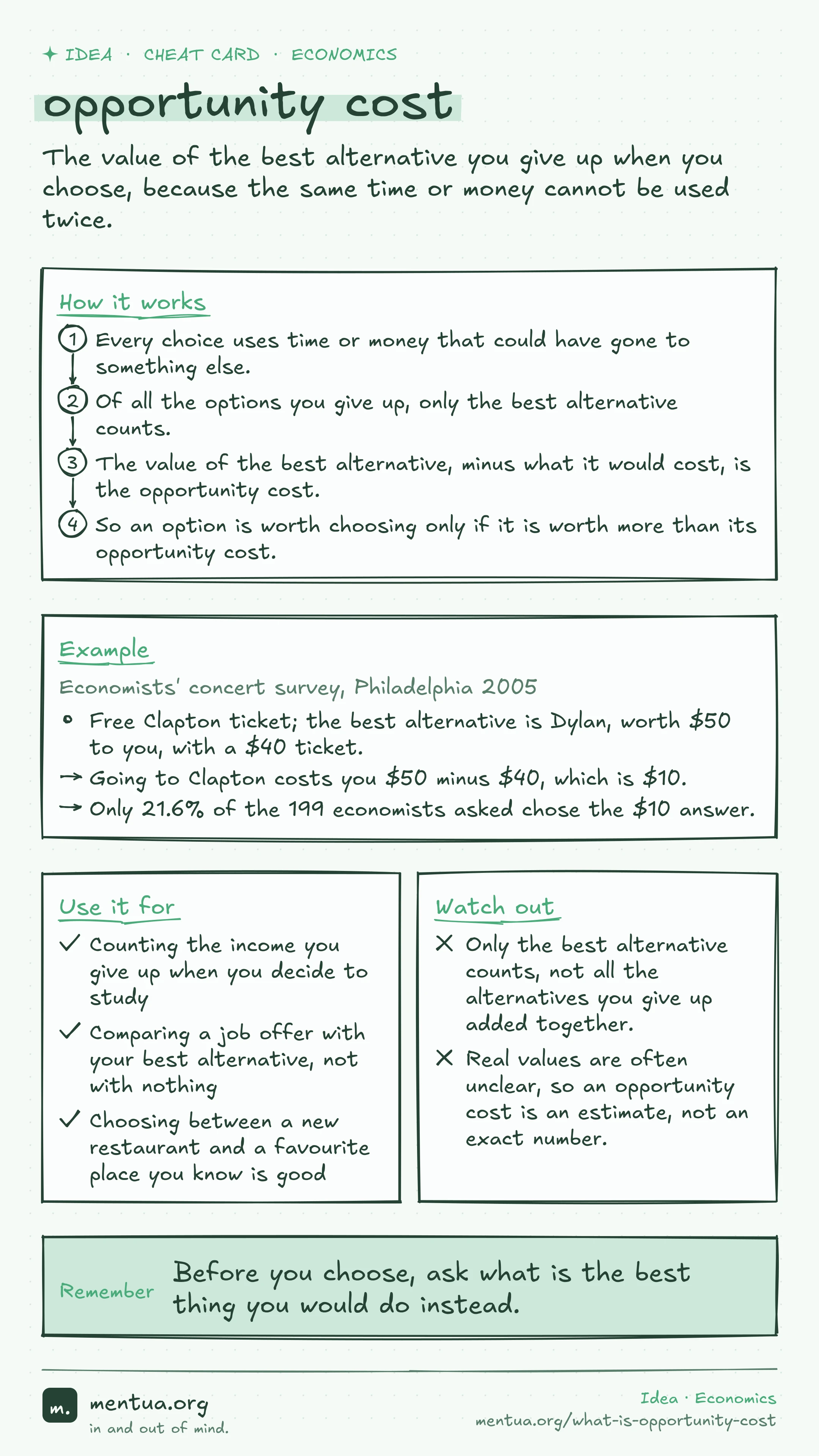
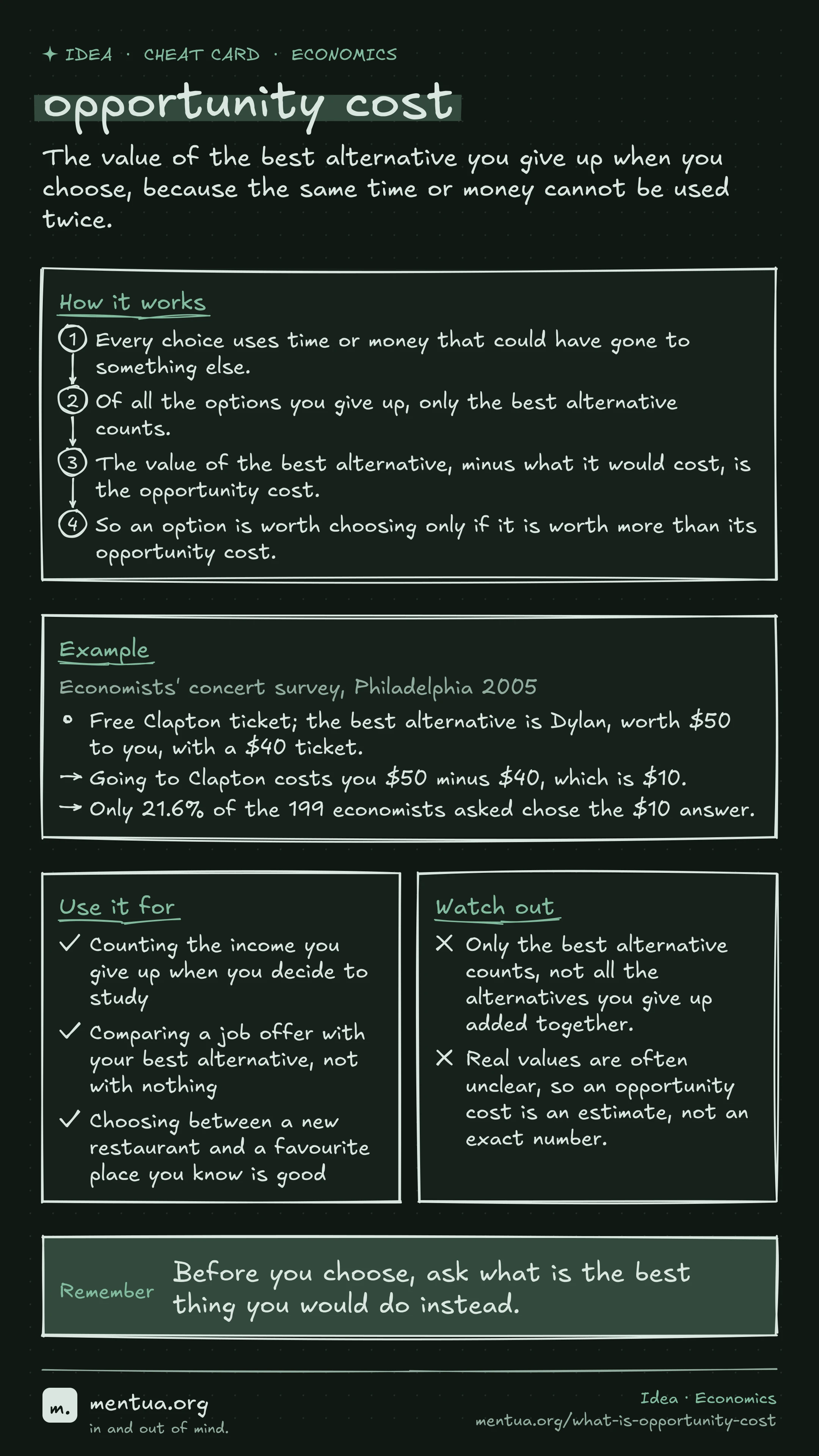
The whole idea on one page. Tap to open it full size, download it below, or test yourself against it tomorrow.
Download
- Light card · PNG image, 377 KB
- Dark card · PNG image, 386 KB
- Printable light card · PDF, searchable, 24 KB
Read the card as text
opportunity cost: The value of the best alternative you give up when you choose, because the same time or money cannot be used twice.
How it works
- Every choice uses time or money that could have gone to something else.
- Of all the options you give up, only the best alternative counts.
- The value of the best alternative, minus what it would cost, is the opportunity cost.
- So an option is worth choosing only if it is worth more than its opportunity cost.
Example: Economists' concert survey, Philadelphia 2005
- Free Clapton ticket; the best alternative is Dylan, worth $50 to you, with a $40 ticket.
- → Going to Clapton costs you $50 minus $40, which is $10.
- → Only 21.6% of the 199 economists asked chose the $10 answer.
Use it for
- Counting the income you give up when you decide to study
- Comparing a job offer with your best alternative, not with nothing
- Choosing between a new restaurant and a favourite place you know is good
Watch out
- Only the best alternative counts, not all the alternatives you give up added together.
- Real values are often unclear, so an opportunity cost is an estimate, not an exact number.
Remember: Before you choose, ask what is the best thing you would do instead.
References
- Do Economists Recognize an Opportunity Cost When They See One? A Dismal Performance from the Dismal Science. Paul J. Ferraro and Laura O. Taylor, The B.E. Journal of Economic Analysis & Policy 4 (1), 2005
The Clapton and Dylan question, the answers of 199 economists at the 2005 meeting in Philadelphia, and the survey of 358 undergraduates.
- Opportunity Cost Neglect. Shane Frederick, Nathan Novemsky, Jing Wang, Ravi Dhar and Stephen Nowlis, Journal of Consumer Research 36 (4), 553–561, 2009
The experiments in which a short reminder of other uses for the money, such as the $14.99 DVD, made people buy less.
- Opportunity cost neglect: a meta-analysis. Anna Maguire, Emil Persson and Gustav Tinghög, Journal of the Economic Science Association 9 (2), 176–192, 2023
A review of 39 experiments with 14,005 participants, which finds the effect again but smaller than in the first studies.
- What Is Seen and What Is Not Seen. Frédéric Bastiat, Library of Economics and Liberty (Econlib), from Selected Essays on Political Economy, 1850
The full English text of the pamphlet, starting with the story of the broken window and the six francs.
- Opportunity Cost. David R. Henderson, The Concise Encyclopedia of Economics, Econlib
A short, clear entry with the worked example of what a year of college costs once lost earnings are counted.