What Is the Fermi Paradox?

5 min read≈ 1,190 words3 questions · up to 3 points
What this is about
In 1950 the physicist Enrico Fermi joked with three colleagues about a cartoon of aliens stealing New York's trash cans, and then asked a question that astronomers still argue about. You learn why a few simple numbers make the silence of the sky so strange, which answers are on the table, and why one of them would be bad news for us.
In a nutshell· skip ahead
The Fermi paradox is the conflict between the expectation that intelligent life should be common in our galaxy and our failure to find any sign of it. The galaxy is billions of years old, and one civilization with slow starships could spread across it in a few million years, so someone should have arrived long ago.
In the summer of 1950, four physicists walked to lunch at Los Alamos, the American weapons laboratory in New Mexico, and joked about a cartoon in which little green men carried off New York’s public trash cans. At the table, Enrico Fermi suddenly asked: “Where is everybody?” Everyone understood that he meant beings from other planets. Our galaxy has more than a hundred billion stars and has existed for billions of years, so why has nobody come to visit?
What is the Fermi paradox?
The Fermi paradox is the conflict between the expectation that intelligent life should be common in our galaxy and our failure to find any sign of it. The expectation comes from numbers: there are many stars, the galaxy is old, and travel between stars, though slow, seems possible. The observation is a silence, with no visitors on Earth and, so far, no clear radio signal from anywhere.
Michael Hart turned this into a careful argument in 1975, in a journal of the Royal Astronomical Society. He started from what he called “Fact A”: there are no intelligent beings from outer space on Earth now. Then he estimated how long one civilization would need to spread through the galaxy.
- The speed. Hart assumed ships that travel at a tenth of the speed of light, which is far beyond our rockets but, as he argued, needs no new physics.
- The spread. Each new settlement sends out ships of its own, so the frontier moves outward like a wave. Most of the galaxy would be crossed within 650,000 years.
- The pauses. Settlers stop to build before they move on. If each pause lasts about as long as a voyage, the time roughly doubles, to about 1.3 million years.
- The comparison. Hart took the galaxy to be about 10 billion years old, so one wave of settlement would fit into its history thousands of times.
Unless every civilization began to travel less than about two million years ago, someone should be here already. Since nobody is, Hart concluded that there are no other civilizations in our galaxy. Most later estimates of the settlement time come out near ten million years, still only a thousandth of the galaxy’s age.
So there are three ways out. Intelligent life may be rare; civilizations may exist but not travel, not last or stay hidden; or we have not searched enough yet.
What does the silence tell us about our own future?
The economist Robin Hanson gave the most worrying reading in an essay from 1996. He listed the steps from dead matter to a civilization that settles space, among them the first molecules that copy themselves, simple cells, complex cells, many-celled life and tool-using animals with big brains. The universe looks empty, so at least one step must be extremely unlikely, and Hanson called it the Great Filter.
If the filter lies behind us, for example because life almost never starts, we are rare and lucky. If it lies ahead, most civilizations that reach our stage are destroyed or stop before they spread, and we would probably share their fate. So Hanson argued that evidence of alien life, even of simple cells that arose on their own on Mars, would be bad news. It would show that the early steps are easy and make a filter ahead of us more likely.
Our own existence does not settle the question, because we could only ask it on a planet where life succeeded. What Is Survivorship Bias? describes this trap of judging a group by the cases a filter let through.
What the Fermi paradox teaches you
When a confident estimate predicts something you do not see, the absence is information, and the weakest guess inside the estimate is usually where the answer lies. Ask yourself, “If my numbers were right, what should I already see?”
- Plans and markets. If a business idea promises a large, easy market, ask why nobody has entered it. Others may have tried and failed for a reason you have not found.
- Long chains of guesses. Many forecasts multiply uncertain numbers, such as the share of people who see an advert, click and then buy. One guess that is ten times too high makes the whole result ten times too high.
- Risks to a civilization. The Great Filter turns a question about aliens into a question about which dangers could end a technological society like ours.
Astronomers meet the second point in the Drake equation, which the radio astronomer Frank Drake wrote for a meeting at Green Bank, West Virginia, in 1961. It estimates the number of civilizations in our galaxy by multiplying seven factors, such as the share of stars with planets and the share of planets where life begins. Drake meant it as an agenda for discussion, not as a measurement.
Is the Fermi paradox really a paradox?
The most common misunderstanding is that the Fermi paradox is a strict paradox, an argument that contradicts itself. It is a conflict between an estimate and an observation, and an estimate can be wrong. Robert Gray argued in the journal Astrobiology in 2015 that it is neither Fermi’s nor a paradox. Fermi never published on the subject, and the claim “they are not here, so they do not exist” first appeared in Hart’s paper.
The strongest challenge came in 2018 from Anders Sandberg, Eric Drexler and Toby Ord at Oxford. Earlier work put a single number into each factor of the Drake equation, and most results gave many civilizations. Sandberg and his colleagues gave each factor an honest range of uncertainty instead. The average number of civilizations was still 27 million, because a few huge outcomes pull it up, but the middle value was only 0.32, and the chance that we are alone in the galaxy came out at 52 percent.
Taking the silence into account raised that chance to between 53 and 99.6 percent. The result depends on ranges that nobody can check yet, but it shows that an empty sky needs no strange explanation.
Learn more
The puzzle is named after the Italian-American physicist Enrico Fermi, who asked his question in 1950 while walking to lunch with Emil Konopinski, Edward Teller and Herbert York. York recalled Fermi making a quick estimate and concluding that Earth should have been “visited long ago and many times over”. Eric Jones collected their letters in a Los Alamos report in 1985. Hart’s paper and a 1980 paper by the physicist Frank Tipler made the argument famous, which is why it is also called the Hart-Tipler argument.
“Cosmos” by Carl Sagan: Summary and Review explains the Drake equation and why Sagan thought a civilization’s lifetime matters most. Why Is the Night Sky Dark? Olbers’ Paradox, Explained shows another case where what the sky does not show reveals how the universe works. If the Great Filter lies ahead, “Superintelligence” by Nick Bostrom: Summary and Review examines one danger of our own technology.
Quiz
3 questions · up to 3 points
Open a question and pick one answer. Only your first answer counts: +1 if it is right, −1 if it is wrong.
Why does the silence of the sky seem so strange to people who think about the Fermi paradox?
Show answer
Crossing the galaxy would take a few million years, but the galaxy is billions of years old. Hart's estimate of about a million years fits into the galaxy's history thousands of times, so even one early civilization should have reached us.
A friend's plan for a business multiplies six optimistic guesses and predicts a huge market that no company has entered. What does the Fermi paradox suggest?
Show answer
Ask which of the six guesses is weakest, because the missing competitors are evidence too. As with the Drake equation, a product of uncertain guesses can hide a large chance that the true result is close to zero, and the absence of others is a clue.
Which statement about the Fermi paradox is correct?
Show answer
It is a conflict between an estimate and an observation, not a logical contradiction. The expectation that life is common is built from guessed numbers. If the guesses are wrong, the conflict disappears, so it is a puzzle rather than a strict paradox.
Your points are saved only in this browser for now. Accounts that keep them for good are on the way.
Continue learning: Why Is the Night Sky Dark? Olbers' Paradox, Explained →The takeaway
The Fermi paradox is the conflict between the expectation that intelligent life should be common in our galaxy and our failure to find any sign of it. Michael Hart calculated in 1975 that one civilization could cross most of the galaxy in about a million years, a tiny part of its 10-billion-year history. It is not a strict paradox, because the expectation is built from guessed numbers, and a 2018 study found a good chance that we are alone. When an estimate predicts something you do not see, check which of its guesses is weakest.
Cheat card
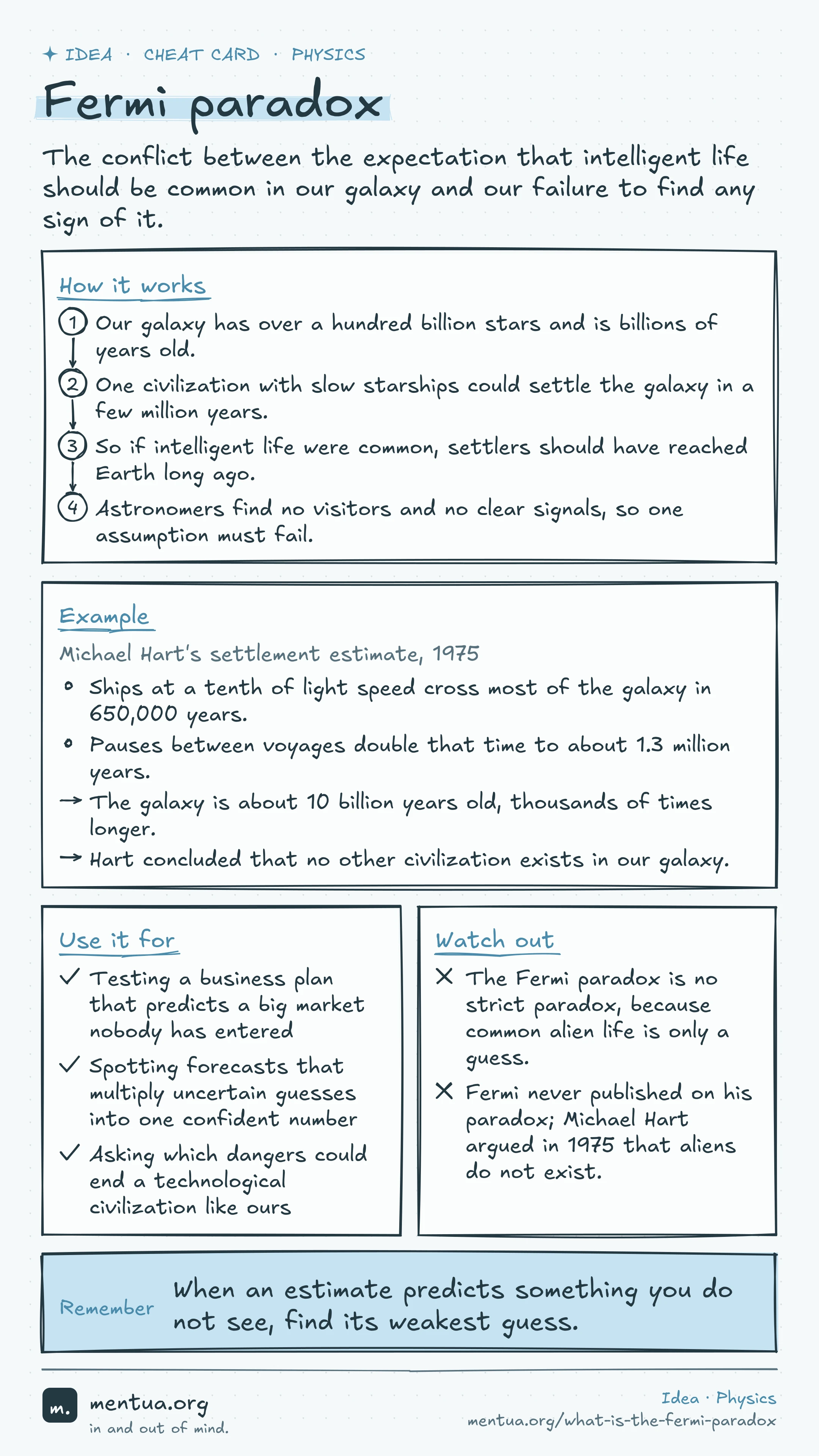
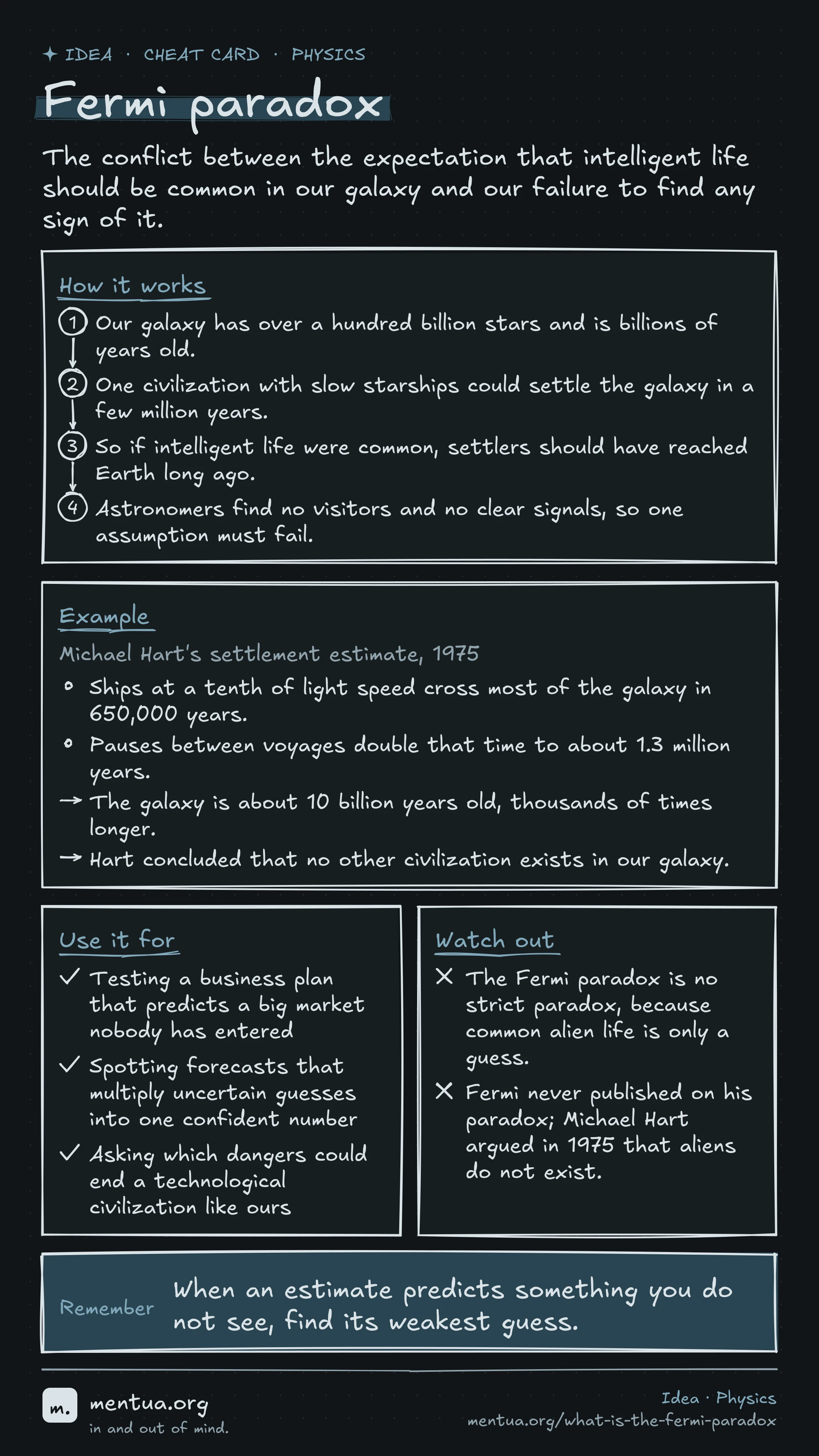
The whole idea on one page. Tap to open it full size, download it below, or test yourself against it tomorrow.
Download
- Light card · PNG image, 398 KB
- Dark card · PNG image, 401 KB
- Printable light card · PDF, searchable, 24 KB
Read the card as text
Fermi paradox: The conflict between the expectation that intelligent life should be common in our galaxy and our failure to find any sign of it.
How it works
- Our galaxy has over a hundred billion stars and is billions of years old.
- One civilization with slow starships could settle the galaxy in a few million years.
- So if intelligent life were common, settlers should have reached Earth long ago.
- Astronomers find no visitors and no clear signals, so one assumption must fail.
Example: Michael Hart's settlement estimate, 1975
- Ships at a tenth of light speed cross most of the galaxy in 650,000 years.
- Pauses between voyages double that time to about 1.3 million years.
- → The galaxy is about 10 billion years old, thousands of times longer.
- → Hart concluded that no other civilization exists in our galaxy.
Use it for
- Testing a business plan that predicts a big market nobody has entered
- Spotting forecasts that multiply uncertain guesses into one confident number
- Asking which dangers could end a technological civilization like ours
Watch out
- The Fermi paradox is no strict paradox, because common alien life is only a guess.
- Fermi never published on his paradox; Michael Hart argued in 1975 that aliens do not exist.
Remember: When an estimate predicts something you do not see, find its weakest guess.
References
- "Where is everybody?" An account of Fermi's question. Eric M. Jones, Los Alamos National Laboratory, report LA-10311-MS, 1985
The history of the 1950 lunch, built from letters by Konopinski, Teller and York, with each man's memory of what Fermi said.
- An Explanation for the Absence of Extraterrestrials on Earth. Michael H. Hart, Quarterly Journal of the Royal Astronomical Society 16, 128, 1975
The paper that turned Fermi's question into an argument, with 'Fact A' and the estimate of how fast the galaxy could be settled.
- Dissolving the Fermi Paradox. Anders Sandberg, Eric Drexler and Toby Ord, arXiv:1806.02404, 2018
Shows how the Drake equation changes when each factor is given an honest range of uncertainty instead of a single number.
- The Great Filter: Are We Almost Past It?. Robin Hanson, George Mason University, 1998
The original essay on the Great Filter, with the list of steps from dead matter to a civilization that spreads through space.
- The Fermi Paradox is Neither Fermi's Nor a Paradox. Robert H. Gray, Astrobiology 15 (3), 195–199, 2015
A short critique of the name and the logic, arguing that the argument belongs to Hart and that it is not a true paradox.