What Is the St. Petersburg Paradox?


6 min read≈ 1,230 words3 questions · up to 3 points
What this is about
A coin is tossed until it lands heads, and the prize doubles with every toss. How much would you pay to play? You learn what the standard calculation answers, the two explanations of why sensible people offer so little, and why neither of them settles the puzzle completely.
In a nutshell· skip ahead
The St. Petersburg paradox is a coin game whose expected value is infinite, although no sensible person would pay more than a few coins to play it. Two explanations resolve most of it: each extra coin matters less to you the more you already have, and no real bank could pay the giant prizes that create the infinite average.
Peter tosses a coin until it lands heads. If heads comes on the first toss, he pays Paul one ducat, a gold coin of the time; on the second toss, two ducats; on the third, four; and with every further toss the prize doubles. How much should Paul pay for the right to play? The standard calculation says that no price is too high, yet the mathematician who first asked the question thought that any reasonable person would gladly sell the chance for twenty ducats.
Why is the coin game worth an infinite amount on paper?
The St. Petersburg paradox is the puzzle that this coin game has an infinite expected value, although no sensible person would pay more than a few coins to play it. The expected value of a gamble is its average result: you multiply each possible prize by its chance and add up the results. For most gambles this average is a good guide to a fair price, and the paradox comes from following the rule step by step.
- The chances halve. Heads on the first toss has a chance of 1/2, heads first on the second toss 1/4, on the third 1/8, and so on.
- The prizes double. The prizes for those outcomes are 1, 2 and 4 ducats, and they keep doubling.
- Every outcome adds the same amount. One half of 1 ducat is half a ducat, one quarter of 2 ducats is half a ducat, and one eighth of 4 ducats is again half a ducat.
- There is no last outcome. Since heads could in principle come on any toss, the halves never stop, and their sum grows without limit.
So by the rule of expected value, Paul should pay any finite price, because the game is worth more. Yet half of all games end on the first toss with a prize of 1 ducat, three quarters pay 2 ducats or less, and the chance of winning more than 20 ducats is only 1 in 32. The infinite average comes entirely from prizes that Paul will almost certainly never see.
Why would a sensible person pay so little?
There are two answers, and the first is the one Daniel Bernoulli made famous in 1738. He argued that the value of an item “must not be based on its price, but rather on the utility it yields”, in Louise Sommer’s English translation. Utility here means how much a gain actually improves your life, and Bernoulli assumed that it grows ever more slowly as you get richer, an idea now called diminishing marginal utility. In his model each doubling of your wealth adds the same amount of utility, so going from 1,000 to 2,000 ducats means as much to you as going from 1 million to 2 million.
With that rule, the endless prizes no longer add up to an endless value. Bernoulli calculated that the game is worth exactly 2 ducats to a player who owns nothing, about 3 to one who owns 10 ducats, about 4 to one with 100 and about 6 to one with 1,000.
The second answer is about Peter. No real person or bank can pay a prize larger than everything it owns, so the giant prizes are promises that would never be kept, and without them the game is worth surprisingly little. If Peter owns a million ducats, a fair price is about 11 ducats; if he owns a billion, about 16; and even a bank with a trillion ducats could offer the game fairly for about 21. Each doubling of the bank’s wealth adds only half a ducat, because it adds just one more toss whose prize the bank can pay.
What the St. Petersburg paradox teaches you
When a risky offer is judged by its average, ask what the typical result is and what a gain or a loss means to you, given what you already have.
- Insurance. Bernoulli’s own example was a merchant he called Caius, shipping goods worth 10,000 rubles from Amsterdam to St. Petersburg, at a time of year when 5 of every 100 ships were lost. Insurance cost 800 rubles, more than the expected loss of 500 rubles. Bernoulli still advised buying it if the merchant owned less than about 5,043 rubles besides the cargo, because a loss weighs more for someone who has less.
- Your own bets. The same 100 euros means more when you have little, so a bet with a good average can still be a bad idea if losing it would leave you without the rent.
- Offers built on rare huge wins. A lottery, a start-up pitch or a trading scheme that promises an enormous but very unlikely payoff should raise two questions: how likely is the big prize, and could anyone actually pay it?
Does diminishing utility solve the paradox for good?
It does not, and this is the main limit of the classic answer. In 1934 the Austrian mathematician Karl Menger pointed out that Bernoulli’s solution works only for this one game. If the prizes grow so fast that each one adds a fixed amount of utility, the expected utility, the average of the utilities instead of the prizes, becomes infinite again and the paradox returns. Only a utility that cannot rise above some upper limit escapes every version, which is why the economist Kenneth Arrow argued that utility should be bounded.
The finite bank has its own weakness. It explains why no real casino offers the game, but philosophers reply that the puzzle can be restated with a bank that could pay any prize, and then the question of why people offer so little comes back. Nicolaus Bernoulli himself suggested a third explanation, namely that people treat very small chances as if they were zero.
A common misreading is that the paradox makes expected value useless. Expected value remains a good guide for small bets repeated many times, but it can mislead for a single gamble whose average depends on outcomes you will never see or that no one could pay. There is still no agreed solution, and the Stanford Encyclopedia of Philosophy discusses several rival ones.
Learn more
The Swiss mathematician Nicolaus Bernoulli first posed the problem in 1713, in a letter to the French mathematician Pierre Rémond de Montmort, who printed it in his book on games of chance. In that first version a player rolled a die until a six appeared, and Montmort saw no difficulty in it. In 1728 the Geneva mathematician Gabriel Cramer replaced the die with a coin and suggested that sensible people value money by the use they can make of it. Nicolaus’s cousin Daniel Bernoulli reached the same idea independently and published it in 1738 in the journal of the Imperial Academy of Sciences in St. Petersburg, which gave the paradox its name.
The Stanford Encyclopedia entry in the references is the best next step for the proposed solutions. For another probability puzzle that becomes a rule for real decisions, read What Is the Secretary Problem?. For why a sensible bet can still end badly, read A Good Decision Can End Badly: How to Judge Choices When Luck Is Involved.
Quiz
3 questions · up to 3 points
Open a question and pick one answer. Only your first answer counts: +1 if it is right, −1 if it is wrong.
Why is the expected value of the St. Petersburg game infinite?
Show answer
Because every possible outcome adds half a ducat to the average, and there are endlessly many outcomes. Heads on toss 1 pays 1 ducat with chance 1/2, on toss 2 pays 2 ducats with chance 1/4, and so on. Each term is half a ducat, and the terms never stop.
A friend offers a coin flip: heads, you win 300 euros; tails, you lose 200 euros. Your savings are 250 euros. What does the article suggest?
Show answer
Refusing can be sensible, because losing most of your savings weighs more than the gain. The expected value is plus 50 euros, but with diminishing marginal utility the loss of 200 out of 250 euros costs you more than the gain would add.
Which statement about the proposed solutions of the St. Petersburg paradox is correct?
Show answer
Diminishing marginal utility explains why people pay little, but faster-growing prizes can bring the paradox back. Karl Menger pointed out in 1934 that if the prizes grow fast enough, even logarithmic utility gives an infinite expected utility again.
Your points are saved only in this browser for now. Accounts that keep them for good are on the way.
Continue learning: What Is the Secretary Problem? →The takeaway
The St. Petersburg paradox is a coin game whose prize doubles with every toss before heads appears, so its expected value is infinite, yet nobody would pay even 20 coins to play. Each extra coin matters less the more you own, as Daniel Bernoulli argued, so the game is worth about 6 coins to someone with 1,000; and a bank with a trillion coins could offer it fairly for only about 21. Faster-growing prizes can bring the paradox back, so before judging a risky offer by its average, ask what usually happens and whether the biggest prizes could be paid.
Cheat card
The whole idea on one page. Tap to open it full size, download it below, or test yourself against it tomorrow.
Download
- Light card · PNG image, 426 KB
- Dark card · PNG image, 428 KB
- Printable light card · PDF, searchable, 24 KB
Read the card as text
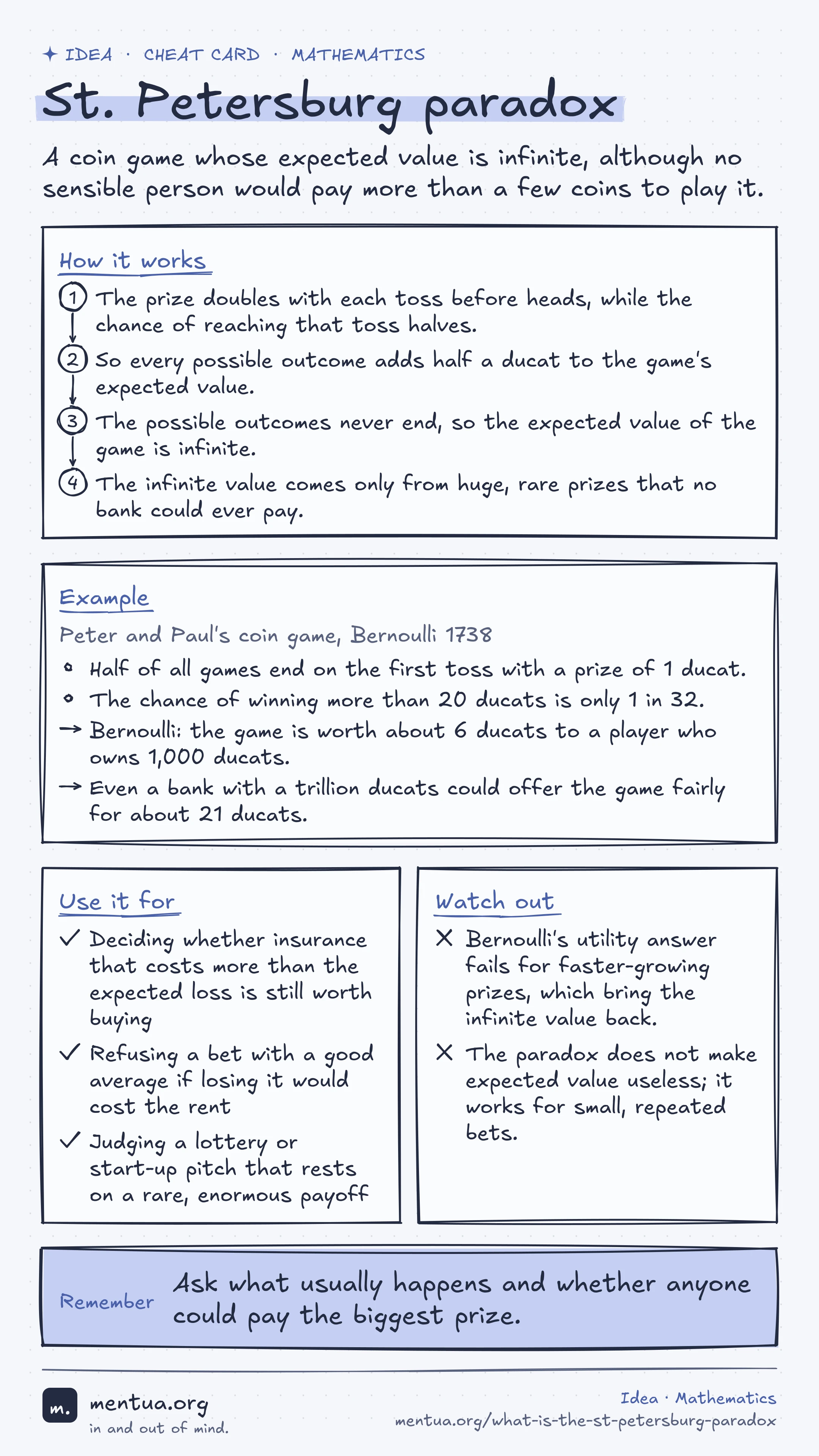
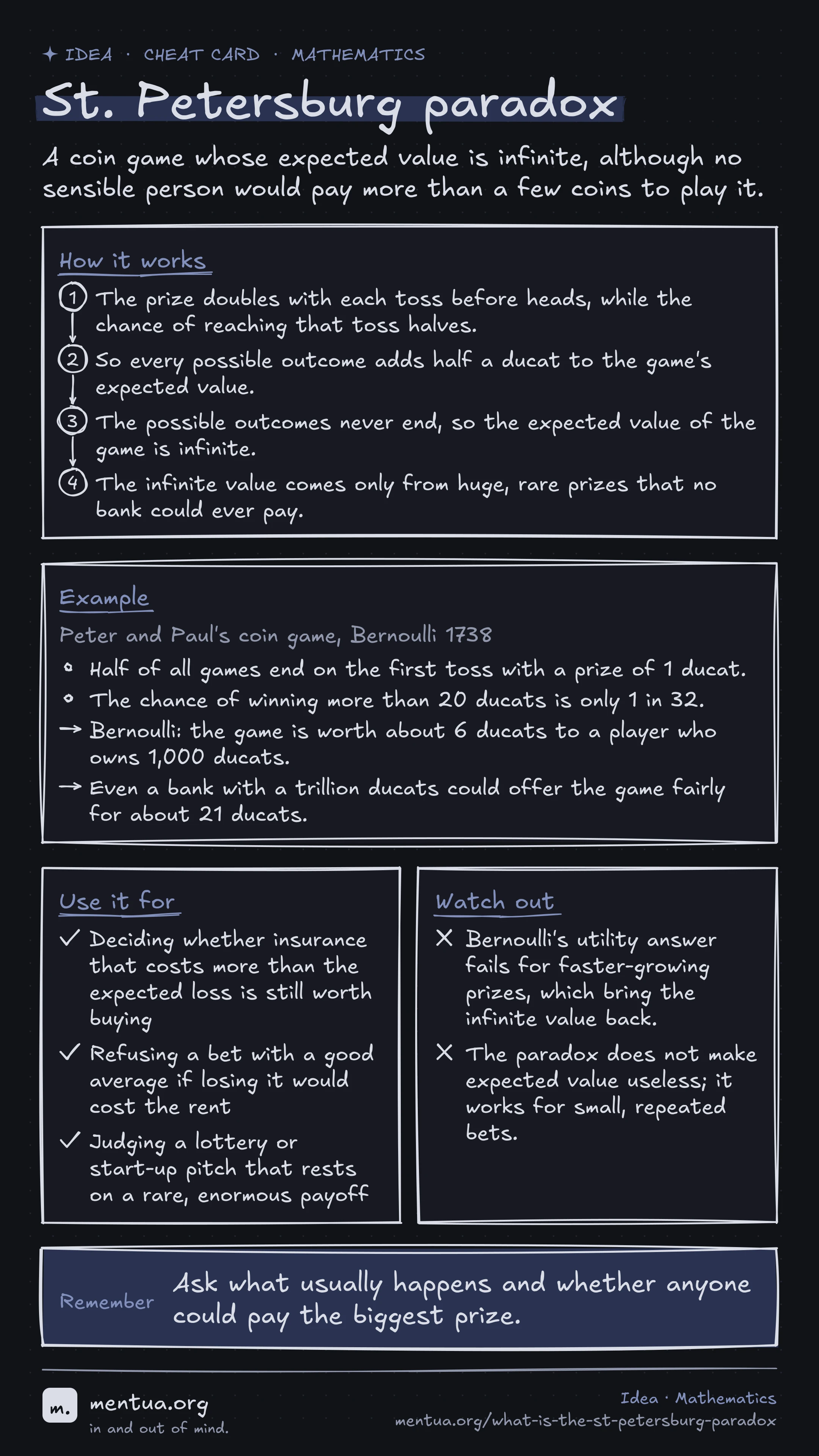
St. Petersburg paradox: A coin game whose expected value is infinite, although no sensible person would pay more than a few coins to play it.
How it works
- The prize doubles with each toss before heads, while the chance of reaching that toss halves.
- So every possible outcome adds half a ducat to the game's expected value.
- The possible outcomes never end, so the expected value of the game is infinite.
- The infinite value comes only from huge, rare prizes that no bank could ever pay.
Example: Peter and Paul's coin game, Bernoulli 1738
- Half of all games end on the first toss with a prize of 1 ducat.
- The chance of winning more than 20 ducats is only 1 in 32.
- → Bernoulli: the game is worth about 6 ducats to a player who owns 1,000 ducats.
- → Even a bank with a trillion ducats could offer the game fairly for about 21 ducats.
Use it for
- Deciding whether insurance that costs more than the expected loss is still worth buying
- Refusing a bet with a good average if losing it would cost the rent
- Judging a lottery or start-up pitch that rests on a rare, enormous payoff
Watch out
- Bernoulli's utility answer fails for faster-growing prizes, which bring the infinite value back.
- The paradox does not make expected value useless; it works for small, repeated bets.
Remember: Ask what usually happens and whether anyone could pay the biggest prize.
References
- The St. Petersburg Paradox. Martin Peterson, Stanford Encyclopedia of Philosophy, 2023
A clear survey of the history and of every major proposed solution, including bounded utility and the objection from finite resources.
- Exposition of a New Theory on the Measurement of Risk. Daniel Bernoulli, translated by Louise Sommer, Econometrica 22 (1), 23–36, 1954
The English translation of the 1738 paper, with the coin game in sections 17 to 19, the insurance example and Cramer's letter.
- Correspondence of Nicolas Bernoulli concerning the St. Petersburg Game. Richard J. Pulskamp (translator), Royal Holloway, University of London, 2013
The original letters of 1713 to 1732 in English, including the first version with a die and Cramer's solution with the coin.