"Tao Te Ching" by Laozi: Summary and Review

10 min read≈ 2,180 words5 questions · up to 5 points
What this is about
A book of about 5,000 Chinese characters has been translated more than 2,000 times, and no two translations sound alike. You learn the seven ideas that carry it, from the nameless Way to the ruler nobody notices, how it differs from Confucius, Sun Tzu and Marcus Aurelius, and which translation to start with.
The book in three sentences· skip ahead
The Tao Te Ching argues that the world follows a nameless course, the Tao, and that people and states do best when they stop forcing against it. Its main move is to reverse common values: the soft beats the hard, the empty is useful, and the ruler who does least governs best. The payoff is a short, rereadable guide to acting with less force and less wanting, in private life and in politics.
Tao Te Ching
- Author
- Laozi (Lao Tzu)
- Publisher
- Penguin Classics (tr. D. C. Lau)
- Length
- 192 pages
- Audiobook
- 1h 24m, read by Jason Reel
- Best for
- Readers who want the founding text of Taoism in a careful translation and who like to read a few short chapters at a time.
The Tao Te Ching is a very short classic of about 5,000 Chinese characters, and its very first line says that the way it describes cannot really be described. It was put together in the Warring States period of ancient China, when many states fought for power and rival teachers advised rulers on how to keep order. Against all of them, this small book gave a strange answer: do less, want less, and let things take their own course. A count cited by the Stanford Encyclopedia of Philosophy finds more than 2,000 translations.
Who wrote it, and which translation is used here?
Tradition names Laozi, also written Lao Tzu and meaning “the Old Master”, as the author. The Chinese historian Sima Qian, writing around 100 BCE, described him as a keeper of archives at the Zhou court whom Confucius visited. When Laozi left China, the warden of a border pass asked him to write down his teaching, and he produced a book of about 5,000 characters in two parts.
Few scholars outside China accept this story in full. The Stanford Encyclopedia of Philosophy suggests that the sayings were written down from the late 5th century BCE and had reached a fairly stable form by the middle of the 3rd. The oldest known copy, on bamboo strips from a tomb at Guodian closed around 300 BCE, holds only about 2,000 of the characters.
The received text has 81 short chapters. Chapters 1 to 37 are about the Tao, the Way, and chapters 38 to 81 about Te, virtue or power. Together they give the book its name, the classic of the Way and its power.
The translations differ a great deal, because the Chinese is very compressed and each word can be read in several ways. This review recommends the translation by D. C. Lau, who lived from 1921 to 2010 and was a scholar of Chinese philosophy who taught at the School of Oriental and African Studies in London. His Penguin Classics version, first published in 1963, stays close to the Chinese, is cheap and easy to find, and comes with an introduction that treats the book as an anthology of sayings.
Lau’s translation is still under copyright, so the quotations below come from the public-domain translation that the Scottish scholar James Legge published in 1891, checked against a scan of the original edition. Legge’s wording is old-fashioned, and his brackets mark words he added to make the Chinese readable.
The Tao can be followed but not fully named
The book’s first claim is that the deepest order of the world, the Tao, cannot be caught in words. Tao means “way” or “path”, and the book uses it for both the nameless source of all things and the course they follow by themselves. Chapter 1 begins with this line:
The Tâo that can be trodden is not the enduring and unchanging Tâo.
This first line already shows how much translations differ. As a verb, dao can mean “to walk” or “to speak”, so Legge writes “trodden”, while the Stanford Encyclopedia translates “The Way that can be spoken of is not the constant Way.” Both are defensible, and each gives a different first impression.
The book does not conclude that we should stay silent. It keeps pointing at the Tao with images, such as a mother, a valley, an uncarved block of wood and water, and lets the reader see what they share. Chapter 56 adds the warning that the one who knows does not talk about it, and the one who talks about it does not know. The idea is explained in more detail in What Is the Tao?, including the famous story of the cook whose knife never grows dull.
Opposites create each other, and things turn into their opposites
The second idea is that every quality exists only together with its opposite. Chapter 2 says that as soon as everyone knows what beauty is, they also know ugliness, and that long and short, high and low, difficult and easy produce each other. Our labels divide the world into pairs, and each half depends on the other.
From this follows the book’s habit of reversal. Chapter 40 says that the movement of the Tao proceeds by contraries, and chapter 22 lists examples: the crooked becomes straight, the empty becomes full, the worn out becomes new. A strong position tends to turn weak and a low one tends to rise, so the wise person takes the low place on purpose. The many paradoxes in the book are not riddles for their own sake; they ask you to notice that the thing you are fighting for already contains its opposite.
Empty space makes things useful
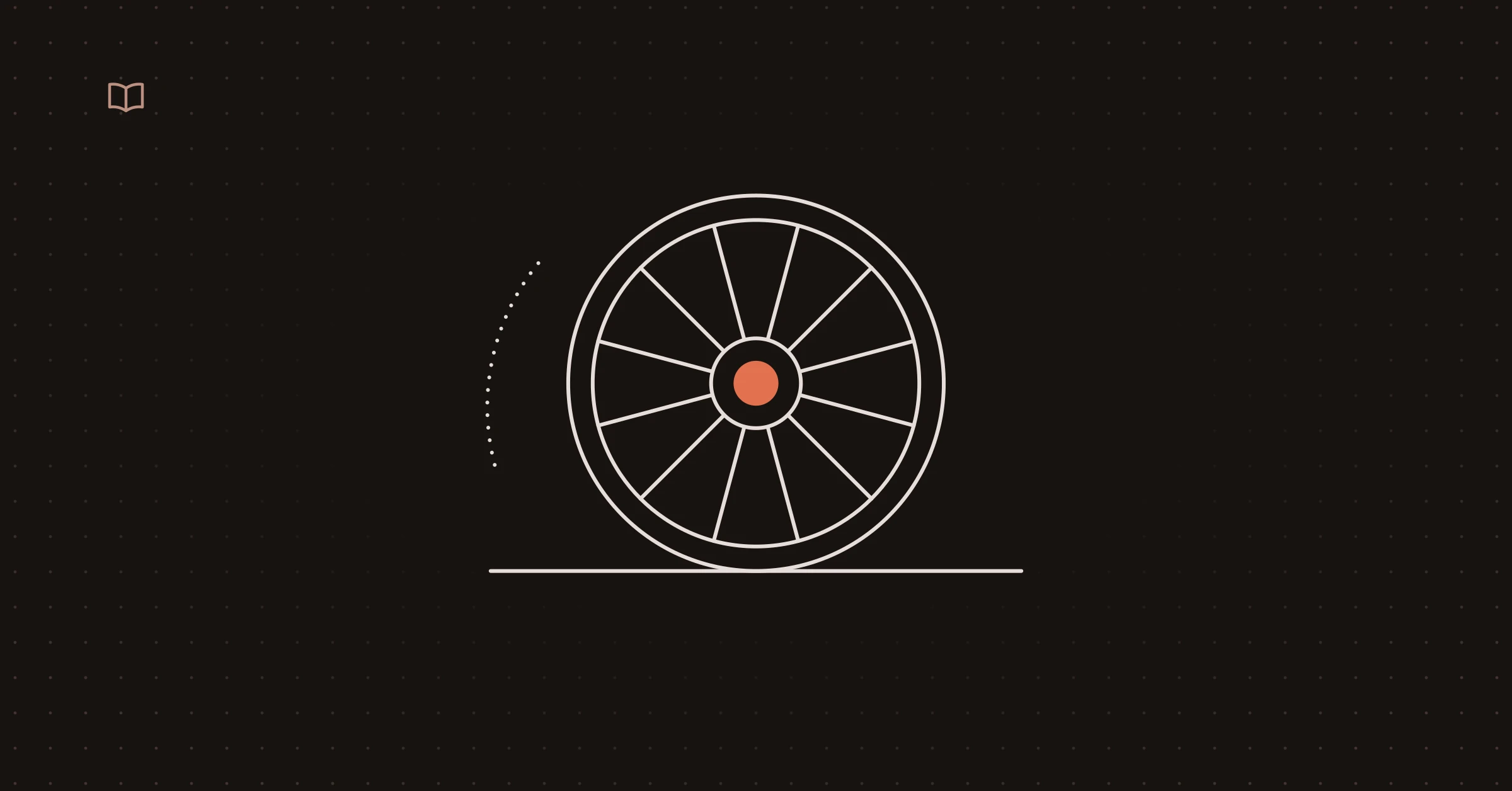
The third idea is that the empty part of a thing is often the useful part. Chapter 11 gives three examples. A wheel has thirty spokes, but the cart can move only because the hub has an empty hole for the axle. A clay pot is useful because of the hollow inside it, and a room is useful because of the space between its walls, door and windows. What is there gives a thing its form, but what is not there lets you use it.
These ordinary examples prepare a larger argument. If emptiness is useful in a pot, then a mind that is not crowded with plans, or a day that is not filled with activity, may also be more useful than a full one. Chapter 9 makes the same point from the other side: it is better to stop before a vessel is full than to try to carry it full.
The soft and weak overcome the hard and strong
The book’s best-known image is water, and the idea behind it is that softness wins in the long run. Chapter 8 says that the highest good is like water, which benefits all things, does not compete, and settles in the low places that people dislike. Chapter 76 observes that living things are soft and supple while dead things are hard and stiff, so hardness belongs with death and softness with life. Chapter 78 brings these thoughts together:
Every one in the world knows that the soft overcomes the hard, and the weak the strong, but no one is able to carry it out in practice.
The second half of that sentence is the honest part. Laozi does not pretend that softness is easy; he admits that people agree with the idea and then push anyway. In practice the image works as a test. When you meet resistance in an argument or a task, you can ask whether more pressure will help, or whether a softer and more patient approach, like water around a stone, would get further.
“Wu wei”: do less, and nothing is left undone
The central practical idea of the book is wu wei, usually translated as “non-action” or “action without forcing”. It does not mean doing nothing. It means acting without strain, without a hidden purpose and without wanting credit, so that things can follow their own course. Chapter 37 says that the Tao does nothing for the sake of doing it, and yet nothing is left undone.
Chapter 48 turns this into a direction for a whole life. The person who studies adds something every day, while the person who follows the Tao takes something away every day, until they reach non-action, and then nothing remains that they cannot do. Chapter 64 adds that a great tree grows from a tiny sprout, and that a journey of a thousand li, an old Chinese measure of distance, begins with a single step. The famous proverb comes from here, and in context it means that you act early and gently, while a problem is still small, instead of fighting it later with force.
The best ruler is hardly noticed
Much of the book speaks to rulers, which modern readers often overlook. Chapter 17 ranks rulers: the people hardly know that the best ones exist, they love and praise the next best, fear the next, and despise the worst. When the best rulers finish their work, the people believe that everything happened by itself.
Chapter 57 explains why. The more prohibitions there are, the poorer the people become, and the more laws are displayed, the more thieves and robbers appear. Chapter 60 compares governing a great state to cooking small fish, which Legge explains as governing in the most quiet and easy manner. Chapter 80 describes the ideal as a small state with few people, who own boats and weapons but never need them. This is a sharp criticism of the Confucian program of rituals and moral teaching. Chapter 18 even says that benevolence and righteousness became fashionable only after the great Tao had been lost.
Contentment and knowing when to stop keep you safe
The last major theme is personal restraint, and the book presents it as protection rather than as a virtue for its own sake. Chapter 46 says that there is no calamity greater than being discontented with one’s lot, and chapter 44 praises the person who knows when to stop.
Chapter 33 links this restraint to self-knowledge. Knowing others is clever, the chapter says, but knowing yourself is wiser, and conquering yourself is greater than conquering others. In chapter 67 Laozi names three things he values most, which are gentleness, economy and not trying to be first. These lines are the easiest to take into daily life, because they ask for small changes: to want a little less, to stop a little sooner, and to look at your own motives before judging other people’s.
How it differs from Confucius, Sun Tzu and Marcus Aurelius
Three neighbours show what is special about the book.
- The Analects of Confucius come from the same world and offer the opposite cure. Confucius wanted to restore order through ritual, study and moral example, while Laozi thought that these efforts were a symptom of the disorder. Reading the two together shows the main debate of early Chinese philosophy.
- “The Art of War” by Sun Tzu: Summary and Review shares Laozi’s image of water and his dislike of costly force. But Sun Tzu writes for a general who wants to win, while Laozi doubts the whole business of conquest and, in chapter 31, calls weapons tools of evil omen.
- “Meditations” by Marcus Aurelius: Summary and Review also teaches acceptance of what happens and a calm mind. The difference is in the method. Marcus trains his reason and his sense of duty every day, while Laozi distrusts effortful self-improvement and asks the reader to let go of striving altogether.
The Tao Te Ching is also unique in its form, because it proves almost nothing and instead offers short poems, images and paradoxes, leaving the reader to find the connection.
Where it falls short
The book’s openness is also its main weakness. Because it rarely defines a term or gives a concrete case, it can be made to support almost any view, and the large number of free versions shows how easily readers find in it what they bring. “Follow the natural course” does not tell you which course is natural, and the book offers no way to decide between two readings.
Its politics also have a darker side that popular versions tend to soften. Chapter 3 says that the sage empties the people’s minds and fills their bellies, and chapter 65 praises the ancient rulers who kept the people simple instead of enlightening them. The Stanford Encyclopedia suggests that such paradoxes may be meant to shake the reader’s assumptions, but read literally, they are advice for keeping subjects easy to rule. Its suspicion of learning in chapters 19, 48 and 81 can also sound like a rejection of knowledge itself, which few modern readers would accept.
Which translation to read
Start with D. C. Lau’s Penguin Classics translation, because it is careful and close to the Chinese. You could read it in one evening, but the book is better taken a few chapters at a time and reread. Then read a second version next to it, since the gap between two translations of the same chapter shows you where the Chinese is open.
Ursula K. Le Guin’s version of 1997, made with the help of J. P. Seaton, a professor of Chinese, is freer and more poetic and adds her own notes. Stephen Mitchell’s popular version of 1988 reads beautifully, but Mitchell calls it a new English version. In his foreword he explains that he worked from Paul Carus’s word-by-word version and from existing translations, so treat his book as an interpretation rather than a translation.
Print works best, because you will want to turn back and compare chapters. An audiobook of Lau’s translation exists and runs under an hour and a half, which suits a first listen, but each chapter needs a pause before the next one.
Quiz
5 questions · up to 5 points
Open a question and pick one answer. Only your first answer counts: +1 if it is right, −1 if it is wrong.
What does the first chapter of the Tao Te Ching say about the Tao?
Show answer
Any Tao that can be put into words is not the constant Tao. The opening line separates the Tao we can talk about from the lasting one. The book still talks about it, but only through images that point toward it.
Why does the book keep praising water?
Show answer
Water is soft and takes the low place, yet nothing wears down hard things better. Chapters 8 and 78 use water as the model: it benefits everything without striving and still overcomes what is firm and strong.
A manager sees a team that works well and is tempted to add new rules and weekly reports. Which advice fits the book's idea of wu wei?
Show answer
Add as little as possible, because each new rule can create the problems it was meant to stop. Chapter 57 says that more prohibitions make the people poorer and more laws make more thieves. Wu wei means not forcing what already works.
According to chapter 17, how do people speak about the best rulers?
Show answer
They hardly know the rulers are there, and when the work is done they say it happened by itself. The best rulers are barely noticed. The second best are loved and praised, the worse ones feared, and the worst despised.
You want to start reading the Tao Te Ching. What does this review suggest?
Show answer
Read a careful translation such as D. C. Lau's slowly, and compare it with a second one. The translations differ so much that a second version shows where a line is uncertain. Lau stays close to the Chinese.
Your points are saved only in this browser for now. Accounts that keep them for good are on the way.
Continue learning: What Is the Tao? →The takeaway
The Tao Te Ching is a short Chinese classic credited to Laozi, and its key idea is wu wei: act without forcing, along the course of things that the book calls the Tao. Around this idea it praises water, softness, empty space, contentment and a ruler whom the people hardly notice. It gives images instead of arguments and sometimes advises keeping people ignorant, so read it slowly and compare two translations. When you meet resistance, ask whether less force would work better.
Key quotes
“He who knows other men is discerning; he who knows himself is intelligent.”
“Governing a great state is like cooking small fish.”
Should you read it?
Read it if
- You know the word Tao or wu wei and want to see what the original text actually says.
- You want a short book that you can read in an evening and reread for years.
- You are interested in Chinese thought, or in how people can act well with less force.
Skip it if
- You want clear arguments and definitions; the book gives images and paradoxes instead.
- You want practical rules for daily life; the advice is general and often aimed at rulers.
As an Amazon Associate, mentua.org earns from qualifying purchases. It costs you nothing and never shapes the verdict.
Ideas from this book
References
- Laozi. Alan Chan, Stanford Encyclopedia of Philosophy, 2025
The legend of Laozi, the dating of the text, the Guodian and Mawangdui manuscripts, the main commentaries, and the key ideas of dao, wu wei and naturalness.
- The Texts of Taoism, Part I (Sacred Books of the East, vol. 39). James Legge (translator), Clarendon Press, Oxford; scan at the Internet Archive, 1891
The public-domain translation quoted in this review, with all 81 chapters and Legge's notes.
- Tao Te Ching, translated by D. C. Lau. Penguin Classics
The publisher's page for the translation this review recommends.
- Tao Te Ching: A New English Version. Stephen Mitchell
Mitchell's own page, including the part of his foreword that explains how he worked from Paul Carus's literal version.