What Is Chesterton's Fence?


6 min read≈ 1,220 words3 questions · up to 3 points
What this is about
In 2006 a programmer deleted one line of code that a testing tool called a mistake, and for almost two years secret keys made on many Linux computers could be guessed. You learn the 1929 parable of a fence across a road, the reasoning behind it, and how to tell when the rule protects you and when it only protects old habits.
In a nutshell· skip ahead
Chesterton's fence is the principle that you should not remove a rule, custom or structure until you know why it was put there. Someone built it for a reason, so if you cannot see that reason, you are probably missing part of the picture. Once you know the reason, you can judge whether the fence still deserves to stand.
In September 2006, a programmer who looked after the encryption software OpenSSL for Debian, a free version of Linux, removed one line of code because a testing tool reported it as an error. For the next twenty months, OpenSSL on Debian computers, and later on Ubuntu computers built from Debian, could produce only about 32,000 different secret keys of each type and size, few enough for an attacker to try them all. The line had looked like a harmless mistake. How can you tell whether something that looks useless is safe to remove?
What does Chesterton’s fence say?
Chesterton’s fence is the principle that you should not remove a rule, custom or structure until you know why it was put there. It is named after Gilbert Keith Chesterton, an English writer who described it in an essay in 1929. In his short parable, a reformer finds a fence across a road, sees no use for it and wants it cleared away, but a wiser reformer tells him that this is exactly why he may not remove it yet.
If you don’t see the use of it, I certainly won’t let you clear it away. Go away and think. Then, when you can come back and tell me that you do see the use of it, I may allow you to destroy it.
The reasoning behind the story has three steps.
- Someone had a reason. A fence does not grow by itself, and people built it with effort, so somebody once thought it would do some good.
- Not seeing the reason is a warning. If you cannot see why the fence is there, the likeliest explanation is that you are missing part of the picture, not that the builders were fools.
- Find the reason, then judge it. Once you know what the fence was for, you can decide whether that purpose was good, bad all along or no longer relevant, and in the last two cases you may remove the fence.
In the Debian case, the fence was a line in OpenSSL’s random number generator, the part of the program that produces the unpredictable numbers from which secret keys are made. A testing tool called Valgrind warned that the line read computer memory that had never been given a value. A similar line nearby was already switched off for that reason, so this one looked like an error nobody had cleaned up.
In fact the line did two jobs: it added that unset memory, which caused the warning, and it also added all the real random data the program had collected from the computer. Without it, the only changing ingredient left was the process ID, a number the system gives every running program, which on Linux was below 32,768. Luciano Bello found the flaw, and on 13 May 2008 Debian told its users to replace every key the software had made since September 2006.
The surprising part is that the programmer did ask. In May 2006 he wrote to the OpenSSL developers’ mailing list that he was not sure what the code did and asked whether the two lines could go. One reply was “If it helps with debugging, I’m in favor of removing them.” The question was answered as a question about debugging, and the change went out without anyone noticing what the line contributed.
What Chesterton’s fence teaches you
When something looks pointless, the useful question is not “Why is this still here?” but “What problem was this solving, and what would happen if it disappeared?” The second question is a form of inversion: instead of asking how a change will help, you ask how it could fail.
- At work. A second signature on large payments, an odd step in a form or a strange column in a spreadsheet may have been added after an expensive mistake. Ask the person who introduced it, or the colleague who has been there longest, before you remove it.
- At home. A family habit, such as eating together every Sunday, may be the only time some family members really talk to each other.
- In the news. When a politician promises to scrap a “pointless” regulation, ask what happened before it existed, because many safety rules were written after a specific accident.
Software engineers use the phrase when they meet old code they do not understand. The lesson also points the other way: when you build a fence, leave a note that says why. An after-action review is one way to write such reasons down while they are still fresh.
When does Chesterton’s fence become a bad argument?
Many people read Chesterton’s fence as advice to keep old things. In fact Chesterton wrote that a reformer who knows the purpose may find that it was bad or is no longer served, and then the fence can go. His own example was Joan of Arc, who understood why women of her time wore skirts and so had the best right not to wear one.
That misreading matters because people already lean towards keeping things as they are. William Samuelson and Richard Zeckhauser showed in 1988 that people choose the existing option more often than standard economic theory predicts, both in experiments and in real choices of health and pension plans. They called this status quo bias, and a rule that says “wait before you remove anything” can easily become an excuse for it. The effort that went into building a fence is also no reason to keep it, as What Is the Sunk Cost Fallacy? explains.
The strongest objection is that a reason is not always a good reason. Some fences were built by mistake, some to protect the people who built them, and some for problems that ended long ago, so “someone had a reason” tells you to look, not that you will like what you find.
The last limit is cost, because sometimes nobody alive remembers the reason and searching would cost more than the fence itself. Then the sensible move is a careful test that you can undo: remove the fence on a small scale, watch closely, and be ready to put it back. In the Debian case, a check that generated many keys and looked for repeated ones would probably have shown the problem early.
Learn more
Chesterton, who lived from 1874 to 1936, was an English journalist and writer, best known today for his Father Brown detective stories. The fence opens “The Drift from Domesticity”, an essay in his collection The Thing, published in London in 1929. There he used it to defend the family against people who wanted to leave it behind without asking why it existed. Chesterton called it a principle that “will probably be called a paradox”, and he gave it no name of his own. The short name “Chesterton’s fence” was added later by his readers, and today it is used far beyond his debate about the family, from politics to old computer code.
To turn the question into a habit, read What Is Inversion? Thinking Backward to Avoid Mistakes, which shows how to list the ways a change could fail before you make it.
Quiz
3 questions · up to 3 points
Open a question and pick one answer. Only your first answer counts: +1 if it is right, −1 if it is wrong.
According to Chesterton's fence, what should you do before you remove a rule whose purpose you cannot see?
Show answer
Find out why the rule was made, then judge whether that reason still holds. Chesterton's reformer may remove the fence once he can explain its use. The rule asks for knowledge first and leaves the decision open.
A new manager wants to drop the rule that every payment over 10,000 euros needs a second signature. Nobody on the team remembers why it exists. What does Chesterton's fence advise?
Show answer
Find out when and why the rule was introduced, for example from the finance team, and then decide. The rule may have been made after a fraud or an expensive error. Once the manager knows the reason, the manager can judge whether it still applies.
Which statement about Chesterton's fence is correct?
Show answer
It allows removing a fence once you know its reason and find that reason bad or outdated. Chesterton wrote that a reformer who knows the purpose may be able to say that the purpose was bad or is no longer served. Understanding comes before change, not instead of it.
Your points are saved only in this browser for now. Accounts that keep them for good are on the way.
Continue learning: What Is Inversion? Thinking Backward to Avoid Mistakes →The takeaway
Chesterton's fence is the principle that you should learn why a rule, custom or structure exists before removing it, because someone once had a reason to build it. In 2006 a Debian programmer deleted a line of code that a testing tool had flagged, and the encryption software could then make only about 32,000 different keys of each type and size. The rule asks for understanding, not for keeping old things, and it can become an excuse for doing nothing. If nobody can find the reason, remove the fence in a way you can undo.
Cheat card
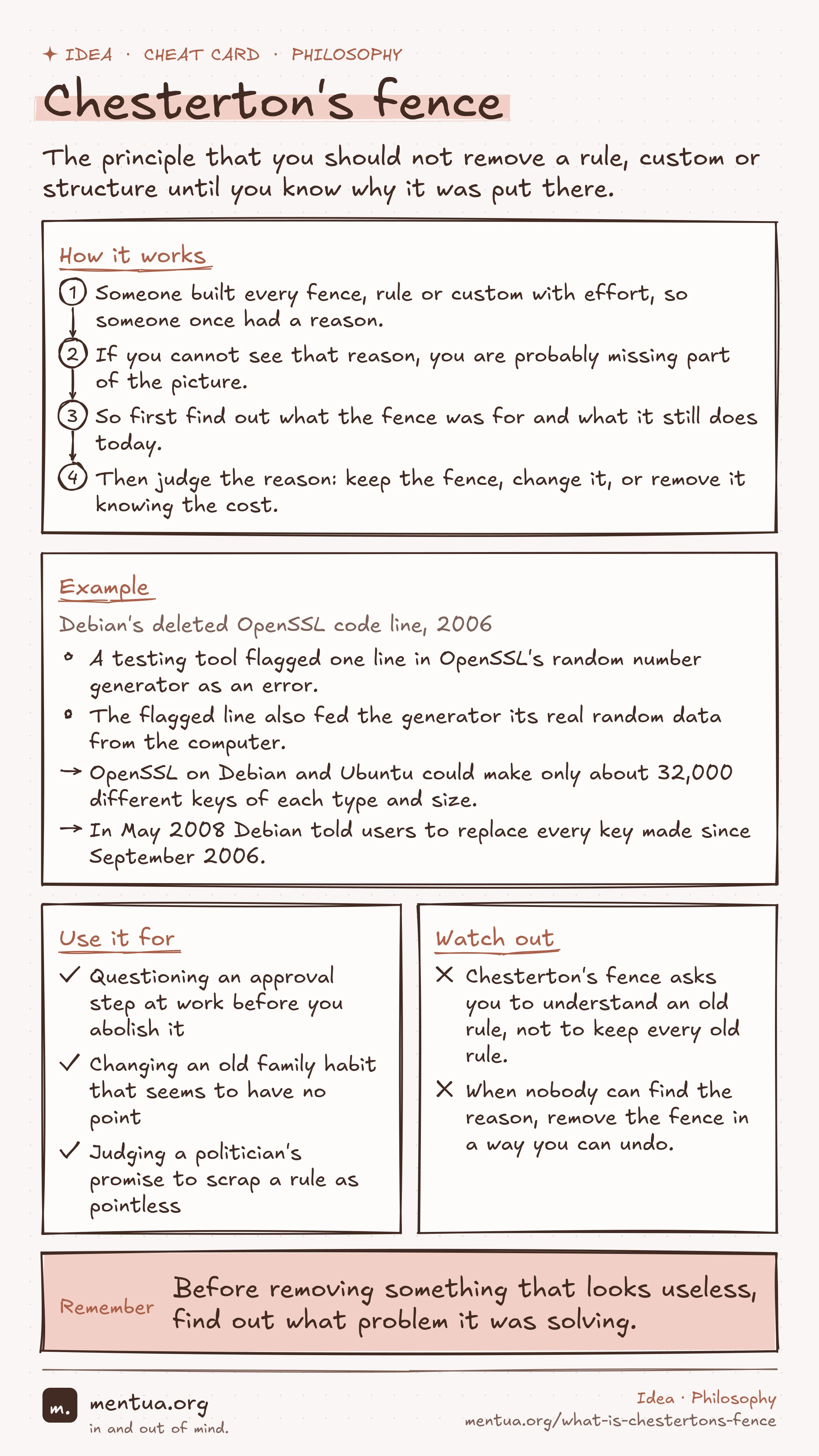
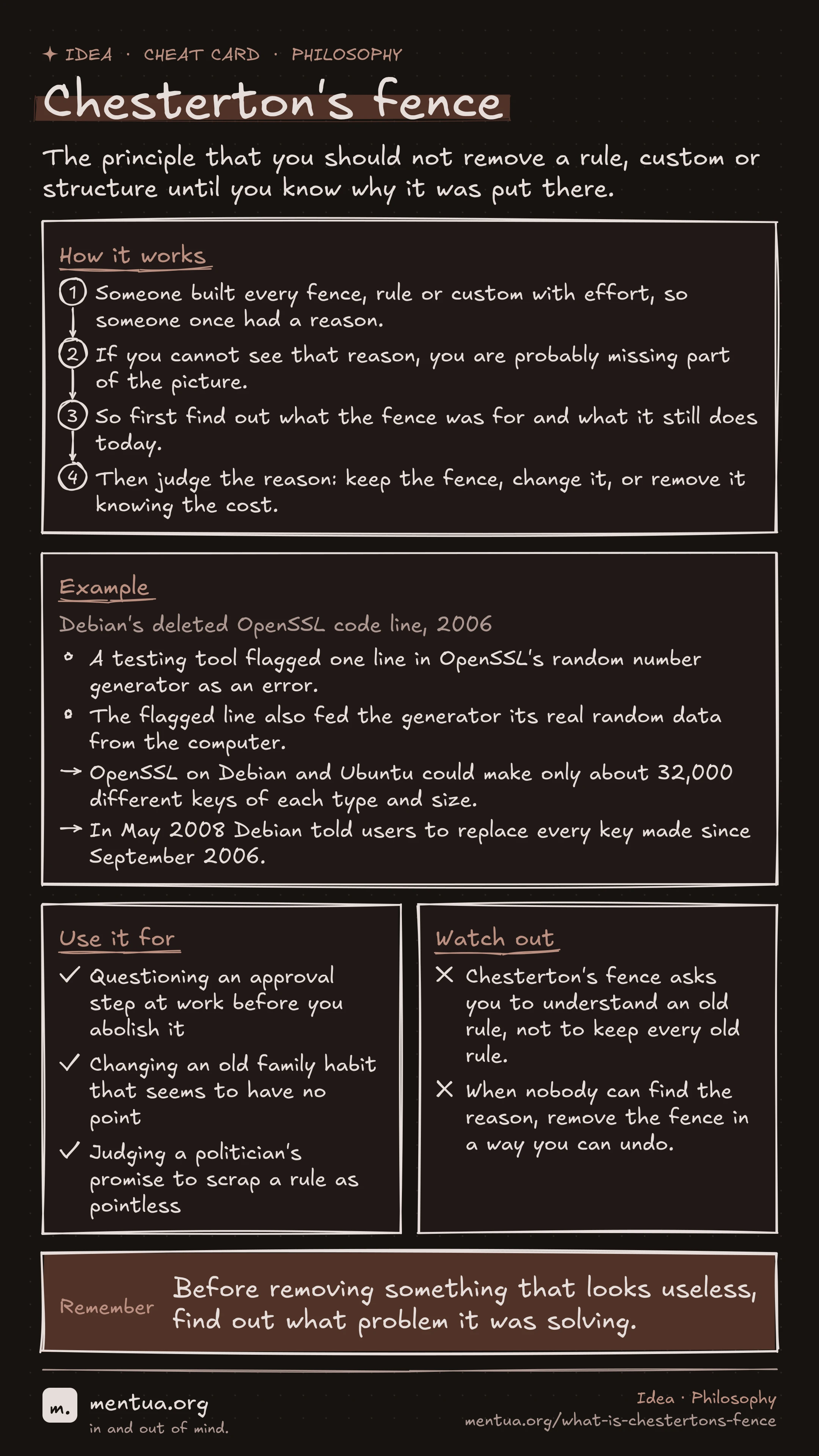
The whole idea on one page. Tap to open it full size, download it below, or test yourself against it tomorrow.
Download
- Light card · PNG image, 402 KB
- Dark card · PNG image, 407 KB
- Printable light card · PDF, searchable, 25 KB
Read the card as text
Chesterton's fence: The principle that you should not remove a rule, custom or structure until you know why it was put there.
How it works
- Someone built every fence, rule or custom with effort, so someone once had a reason.
- If you cannot see that reason, you are probably missing part of the picture.
- So first find out what the fence was for and what it still does today.
- Then judge the reason: keep the fence, change it, or remove it knowing the cost.
Example: Debian's deleted OpenSSL code line, 2006
- A testing tool flagged one line in OpenSSL's random number generator as an error.
- The flagged line also fed the generator its real random data from the computer.
- → OpenSSL on Debian and Ubuntu could make only about 32,000 different keys of each type and size.
- → In May 2008 Debian told users to replace every key made since September 2006.
Use it for
- Questioning an approval step at work before you abolish it
- Changing an old family habit that seems to have no point
- Judging a politician's promise to scrap a rule as pointless
Watch out
- Chesterton's fence asks you to understand an old rule, not to keep every old rule.
- When nobody can find the reason, remove the fence in a way you can undo.
Remember: Before removing something that looks useless, find out what problem it was solving.
References
- The Thing: Why I Am a Catholic. G. K. Chesterton, Dodd, Mead and Company, New York (scan on the Internet Archive), 1930
The American edition of the 1929 essay collection. The fence parable opens the essay "The Drift from Domesticity".
- DSA-1571-1: New openssl packages fix predictable random number generator. Debian Security Team, debian-security-announce mailing list, 2008
The official warning of 13 May 2008, with the date the flawed package first appeared and the advice to replace all affected keys.
- Lessons from the Debian/OpenSSL Fiasco. Russ Cox, research.swtch.com, 2008
A clear account by a programmer of which line was removed, what it did, and the 2006 mailing list exchange before the change.
- Status Quo Bias in Decision Making. William Samuelson and Richard Zeckhauser, Journal of Risk and Uncertainty 1 (1), 7–59, 1988
The study that showed in experiments and in real choices of health and pension plans that people pick the existing option more often than they should.