What Is Endosymbiotic Theory?
5 min read≈ 1,200 words3 questions · up to 3 points
What this is about
Some common antibiotics can leave a small group of patients deaf, although the drugs were made to attack bacteria, not people. You learn why that happens, what endosymbiotic theory says about the origin of complex cells, and the five clues that show where mitochondria came from. You also learn which parts of the story are still open.
In a nutshell· skip ahead
Endosymbiotic theory says that mitochondria, which supply the energy of our cells, and the chloroplasts of plants were once free-living bacteria. Long ago they were taken into another cell, survived there and became permanent parts of it. They still have two membranes, their own ring of DNA and bacterial-type ribosomes, and their genes are closest to bacterial genes.
Almost every cell in your body contains small structures called mitochondria, each with a little DNA of its own, separate from the DNA in the nucleus. You inherited this DNA only from your mother. And some common antibiotics, drugs made to stop bacteria, can damage these structures in certain patients and leave them permanently deaf. Why would a part of a human cell behave so much like a bacterium?
What does endosymbiotic theory say?
The answer is endosymbiotic theory: the idea that mitochondria, and the chloroplasts of plants and algae, were once free-living bacteria that came to live inside another cell and never left. An endosymbiont is an organism that lives inside the cells of another. Over time the guest became an organelle, a permanent working part of the cell.
The theory describes two such events. In the first, probably between 1.5 and 2 billion years ago, a cell took in a bacterium that could use oxygen to release energy from food. Its descendants are the mitochondria that power the cells of animals, plants and fungi. In the second, a cell that already had mitochondria took in a cyanobacterium, a bacterium that makes its food from sunlight, and its descendants are the chloroplasts of plants and algae. The host in the first event was most likely an archaeon, a member of the archaea, the second large group of single cells without a nucleus besides the bacteria.
How can we tell that mitochondria were once bacteria?
Nobody watched the merger, so the evidence is the clues a former bacterium would leave. Take one mitochondrion in a muscle cell and check it for them.
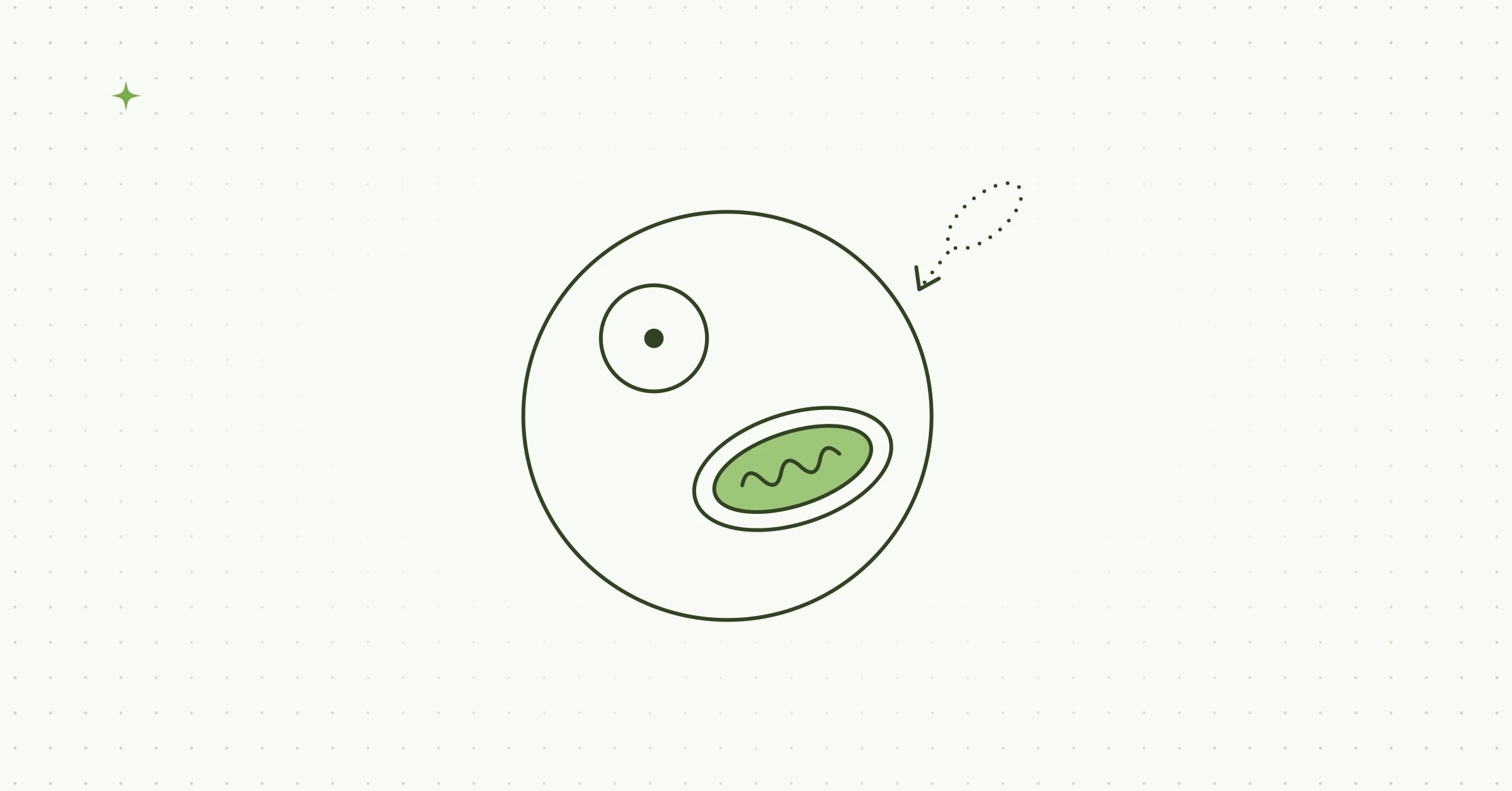
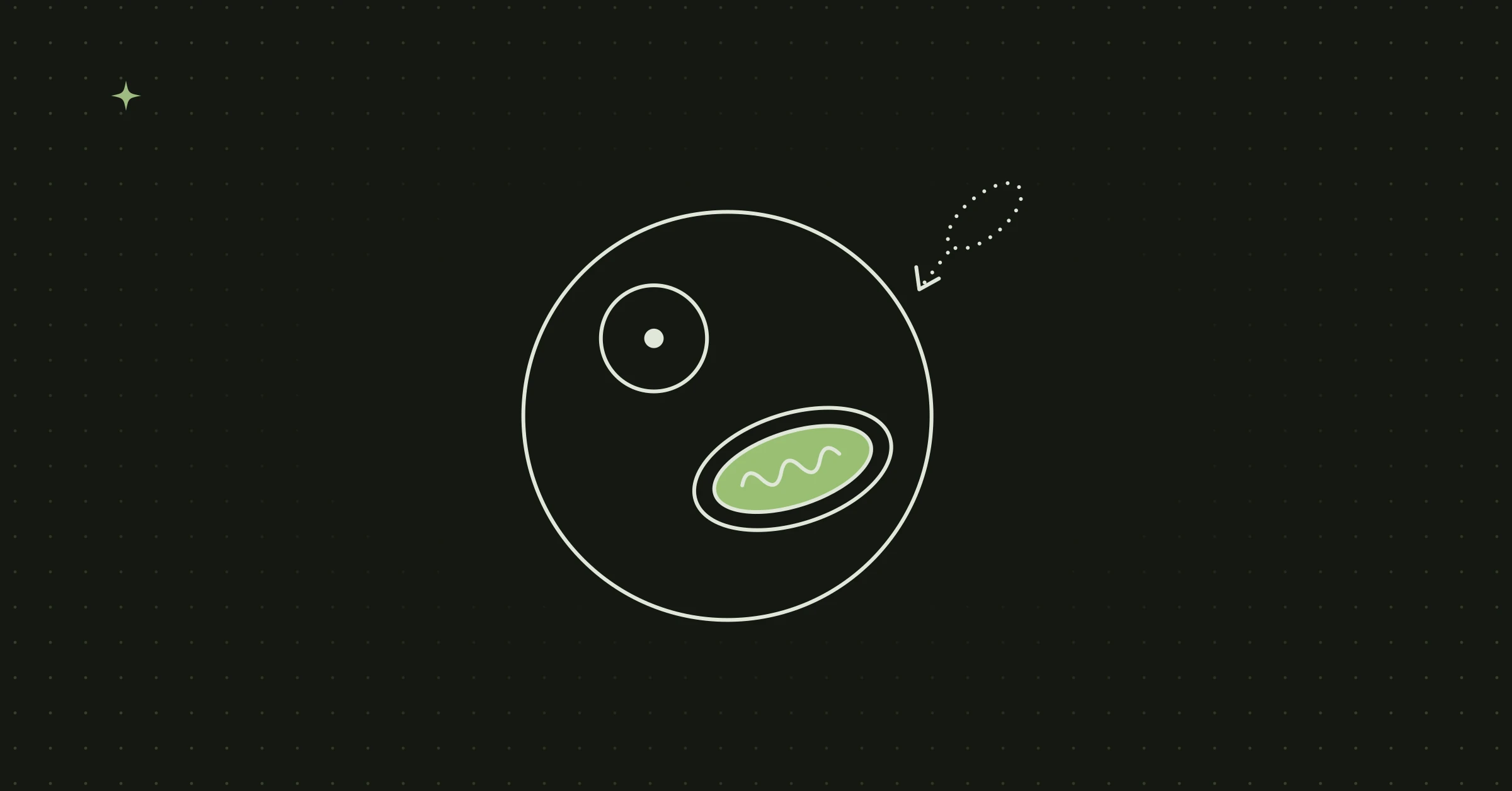
- It has two membranes. Mitochondria are wrapped in two membranes, as many bacteria are, and the inner one resembles the membrane of a bacterium more than the other membranes of the cell.
- It has its own DNA, in a ring. Human mitochondrial DNA is a circle of about 16,500 DNA building blocks with 37 genes. Bacteria also keep their genes in a ring, while the DNA in the nucleus comes in long, straight pieces.
- It builds proteins with its own ribosomes. Ribosomes are the small machines that make proteins, and those inside mitochondria resemble the ribosomes of bacteria more than those in the rest of the cell.
- It divides by splitting in two. The cell cannot build a mitochondrion from scratch; new ones form only when existing ones split, much as bacteria divide.
- Its genes have bacterial relatives. In most analyses mitochondrial genes are closest to a group of bacteria called alphaproteobacteria, and chloroplast genes sit among the cyanobacteria.
The fifth clue is the strongest, because genes record a family tree, and that tree places the mitochondrion among the bacteria rather than with its own cell’s nucleus.
The third clue answers the puzzle about deafness. Aminoglycosides, a family of antibiotics that includes gentamicin, kill bacteria by blocking their ribosomes. About 1 person in 500 carries a small change in mitochondrial DNA, called m.1555A>G, that makes their mitochondrial ribosomes even more similar to bacterial ones. In 2021 the UK medicines regulator warned that in these people the drugs can cause permanent hearing loss, sometimes even at normal blood levels of the drug.
Who was the host cell?
The host was harder to find than the guest. In 2015 Anja Spang, Thijs Ettema and their colleagues found DNA in sea-floor mud from a new group of archaea, the Lokiarchaeota, whose genes included many that had been thought to exist only in cells with a nucleus. These and related archaea are now called the Asgard archaea, and in most family trees cells with a nucleus branch off from within them.
In 2020 a Japanese team led by Hiroyuki Imachi reported that, after more than ten years of work, they had grown one of these archaea in the laboratory. Prometheoarchaeum syntrophicum is a round cell about half a thousandth of a millimetre wide that needs 14 to 25 days to double in number and grows only together with partner microbes. It has no internal compartments but grows long, branching arms, and the team proposed that such arms could have wrapped around a bacterial partner and pulled it inside, a reasoned guess rather than an observation.
What endosymbiotic theory teaches you
Evolution does not only work in small steps, because sometimes two separate lineages join and the result can do what neither could do alone. The theory also teaches a way of reasoning, because features that make no sense for a thing’s present job often make sense as leftovers from its past.
- In medicine, the bacterial past of mitochondria explains side effects that would otherwise look random. If deafness after antibiotics runs in your mother’s family, tell your doctor before you are given an aminoglycoside.
- In evolution, the merger adds a second source of novelty to the one described in Natural Selection: How It Works and Why It Matters. Natural selection then favoured the cells in which the partnership worked.
- In everyday reasoning, the test of leftovers works far from biology. If one department keeps its own software and its own rules, it was often once a separate company that was bought, although a purchase takes a day and the merger of cells took millions of years.
Where does endosymbiotic theory stop working?
The most common misunderstanding is that mitochondria are bacteria that still live in our cells. Most of the guest’s genes were lost or moved into the nucleus long ago. A human mitochondrion keeps only 37 genes, depends on proteins that the rest of the cell makes for it and cannot survive on its own.
The theory also has gaps. It does not explain how the nucleus arose, and biologists still disagree about whether the mitochondrion made the cell’s complexity possible or arrived in a cell that was already complex. A 2026 review calls the exact position of cells with a nucleus among the Asgard archaea “still a moving target”.
Lynn Margulis, who did most to win acceptance for the theory, also proposed that the tails some cells swim with came from spiral-shaped bacteria. That part was dropped for lack of evidence, and she was open about the flaws of her first version.
The paper was rejected by about fifteen scientific journals, because it was flawed; also, it was too new and nobody could evaluate it.
Learn more
Endosymbiotic theory has no single originator. In 1905 the Russian biologist Konstantin Mereschkowsky argued that chloroplasts were cyanobacteria that had entered a cell, and in the 1920s the American cell biologist Ivan Wallin made a similar case for mitochondria. Both were mostly ignored until Lynn Margulis, publishing as Lynn Sagan, gathered the evidence from cells in her 1967 paper “On the origin of mitosing cells”. Gene comparisons from the 1970s onward showed that the core of her argument was right.
“I Contain Multitudes” by Ed Yong: Summary and Review shows how bacteria still shape animal bodies today, and What Is the Microbiome? explains the looser partnership with the bacteria in your gut.
Quiz
3 questions · up to 3 points
Open a question and pick one answer. Only your first answer counts: +1 if it is right, −1 if it is wrong.
Which piece of evidence most directly shows that mitochondria descend from bacteria?
Show answer
Comparisons of their genes, which place them closest to a group of bacteria called alphaproteobacteria. Gene sequences carry a family tree. That tree puts mitochondrial genes among bacterial genes rather than among the genes of the cell's nucleus.
Why can aminoglycoside antibiotics such as gentamicin damage hearing in people who carry the m.1555A>G change in their mitochondrial DNA?
Show answer
The change makes their mitochondrial ribosomes even more like bacterial ribosomes, which these drugs are designed to block. Mitochondria still build proteins with ribosomes of the bacterial type. In carriers of this change the drug can block them in the cells of the inner ear.
A friend says that mitochondria are bacteria that still live inside our cells as separate organisms. What is wrong with this?
Show answer
Mitochondria have lost most of their genes, depend on proteins made from genes in the nucleus and cannot live outside the cell. Human mitochondrial DNA holds only 37 genes. Over a very long time the guest became a part of the cell rather than a separate organism.
Your points are saved only in this browser for now. Accounts that keep them for good are on the way.
Continue learning: "I Contain Multitudes" by Ed Yong: Summary and Review →The takeaway
Endosymbiotic theory says that mitochondria and chloroplasts began as free-living bacteria that came to live inside another cell, probably an archaeon, and became permanent parts of it. The evidence is that they still have two membranes, their own circular DNA, bacterial-type ribosomes and genes closest to bacterial genes. This bacterial past explains why some antibiotics can harm mitochondria, and that odd features are often leftovers from the past. The theory does not explain how the nucleus arose, and the identity of the host cell is still being studied.
References
- On the origin of mitosing cells. Lynn Sagan (later Lynn Margulis), Journal of Theoretical Biology 14(3), 1967
The paper that made biologists take the theory seriously, with the evidence from cells and the history of Earth's atmosphere that Margulis collected.
- The origin of symbiogenesis: An annotated English translation of Mereschkowsky's 1910 paper on the theory of two plasma lineages. Klaus V. Kowallik and William F. Martin, BioSystems, 2021
A free translation and history of Mereschkowsky's ideas, including his 1905 paper on chloroplasts and the question of who first saw mitochondria as bacteria.
- Isolation of an archaeon at the prokaryote-eukaryote interface. Hiroyuki Imachi, Masaru K. Nobu and colleagues, Nature 577, 2020
The report of the first Asgard archaeon grown in the laboratory, with photographs of its long branching arms and the proposed model of how it took in a bacterium.
- Eukaryotic Origins (Biology 2e, section 23.1). OpenStax, Rice University, OpenStax
A free university textbook chapter that sets out the evidence for the theory and the timeline of early complex cells.
- Aminoglycosides: increased risk of deafness in patients with mitochondrial mutations. Medicines and Healthcare products Regulatory Agency, Drug Safety Update, GOV.UK, 2021
The official UK warning on how a change in mitochondrial DNA makes some antibiotics dangerous for hearing, and what doctors should do.