What Is Hitchens's Razor?


5 min read≈ 1,040 words3 questions · up to 3 points
What this is about
Someone tells you that people use only ten percent of their brains and challenges you to prove them wrong. You learn which rule settles who has to prove what, where the British-American writer Christopher Hitchens first stated it, and why setting a claim aside is not the same as showing it is false.
In a nutshell· skip ahead
Hitchens's razor is the rule that a claim offered without evidence may be rejected without evidence. Whoever makes a claim has to support it, and the listener owes no disproof. Rejecting the claim only means not accepting it; it does not show that the claim is false.
A friend tells you over dinner that people use only ten percent of their brains. When you ask how anyone knows that, the friend says it is common knowledge and adds that you cannot prove it wrong either. Now you seem to owe a disproof of something nobody has supported. Do you really have to prove that a claim is false before you are allowed to doubt it?
Who has to prove a claim?
Hitchens’s razor is the rule that a claim offered without evidence may be rejected without evidence. The person who makes a claim has to support it, and the listener owes no disproof. In philosophy, a razor is a rule of thumb that “shaves away” claims or explanations you have no good reason to keep, and this one is named after the British-American writer Christopher Hitchens.
Applied to the dinner conversation, the rule works in four steps.
- A claim is made. The friend says that people use only ten percent of their brains, without naming a study, a measurement or an expert.
- The burden lies with the claimant. The burden of proof, the duty to supply reasons, belongs to the person who asserts something. The friend made the claim, so the friend has to support it.
- Without support, you may set it aside. Since no evidence was offered, you do not have to believe the claim, and you do not have to argue against it either.
- Setting aside is not disproving. You have not shown that the claim is false. You have only declined to accept it until someone gives you a reason.
In this case the claim happens to be false, because brain scans show that people use almost every part of the brain and that most of it is active nearly all the time. But finding that out was extra work, and you did not owe it to your friend. Hitchens put the rule in one sentence in a column for the magazine Slate in 2003:
what can be asserted without evidence can also be dismissed without evidence.
The reason for the rule is practical. Anyone can make up claims faster than others can test them, so if every unsupported claim had to be disproved, the people who invent claims would always set the agenda.
What Hitchens’s razor teaches you
Before you argue against a claim, ask what evidence supports it, because a claim without any has not yet earned an answer.
- Health and money. An advert says a supplement doubles your memory, or an investment promises safe returns of twenty percent a year. You do not need to disprove either one; you can ask for the study or the track record and wait.
- Work. In a meeting someone says that “customers want this feature”. The razor turns the claim into a fair question: which customers, and how do we know?
- The news and social media. A post makes a dramatic claim with no source. Sharing it, or spending an evening refuting it, both give it more weight than it has earned.
The same logic runs through older institutions. In criminal law the prosecution must prove guilt, and the accused does not have to prove innocence. In science a new effect counts as real only when the evidence supports it, not when nobody has ruled it out. The razor also fits alongside What Is Occam’s Razor?, which tells you to prefer the simpler of two explanations, while Hitchens’s razor tells you whether a claim needs an answer at all.
Does dismissing a claim mean it is false?
The most common misreading treats the razor as proof that unsupported claims are false. It is no such thing, because a claim without evidence can still be true, and many true discoveries started as claims that nobody could yet support. Treating the lack of evidence as proof of the opposite is itself a known mistake, the appeal to ignorance, and the razor only avoids its other half, the idea that a claim must be true because nobody has disproved it.
The strongest objection is that the line between “no evidence” and “weak evidence” is hard to draw. A single report, a personal experience or the word of one witness is weak evidence, but it is not nothing, and the razor is easily misused to wave such evidence away. A fair use of the razor asks whether any evidence was offered, not whether you like it.
There is also a limit in the other direction. If you dismiss a claim and then assert its opposite, you have made a new claim, and the burden now lies with you. Saying “I see no reason to believe this” needs no evidence, but saying “this is certainly false” does. When the claim is a long-standing practice rather than a sentence, What Is Chesterton’s Fence? adds a warning. A rule whose reasons nobody wrote down may still have good reasons, so it is worth finding them out before you remove it.
Learn more
Hitchens first wrote the sentence in his Slate column of 20 October 2003, about the beatification of Mother Teresa, the step before she could be named a saint. The Vatican had accepted as a miracle the healing of a Bengali woman named Monica Besra, although her own doctor said that medicine had cured her. In the same sentence Hitchens also appealed to the principle that extraordinary claims require extraordinary evidence. He repeated the line in his book God Is Not Great (2007).
The rule itself is much older, since a Latin maxim already says that what is freely asserted is freely denied. The philosopher Bertrand Russell made a similar point in 1952 with his image of a teapot circling the sun, too small to be seen by any telescope. The name “Hitchens’s razor” was given by others and spread after his death in 2011.
The astronomer Carl Sagan made the sister principle about extraordinary claims famous, and “Cosmos” by Carl Sagan: Summary and Review introduces the book in which he explains his scientific way of thinking to a wide audience. What Is Confirmation Bias? explains why it is so much easier to use the razor on other people’s claims than on your own.
Quiz
3 questions · up to 3 points
Open a question and pick one answer. Only your first answer counts: +1 if it is right, −1 if it is wrong.
According to Hitchens's razor, who has to supply evidence in a disagreement about a claim?
Show answer
The person who makes the claim. The razor places the burden of proof on the claimant. If they offer nothing, the listener may set the claim aside.
An advert says a new supplement "doubles your memory" but names no study. A friend says you cannot reject it unless you can prove it does not work. What does Hitchens's razor say?
Show answer
You may set the claim aside until the seller offers evidence for it. The seller made the claim, so the seller carries the burden of proof. Without evidence, you owe no disproof.
Which statement about Hitchens's razor is correct?
Show answer
Dismissing an unsupported claim means not accepting it, not proving it false. The razor is a rule about who must give reasons. A dismissed claim can still turn out to be true when evidence appears.
Your points are saved only in this browser for now. Accounts that keep them for good are on the way.
Continue learning: What Is Occam's Razor? →The takeaway
Hitchens's razor is the rule that a claim offered without evidence may be rejected without evidence, because the person who makes a claim has to support it. Faced with the unsupported claim that people use only ten percent of their brains, you may set it aside without disproving it. Setting a claim aside does not show that it is false, and weak evidence such as a single report is still evidence that deserves a look. Before you argue against a claim, ask what evidence supports it.
Cheat card
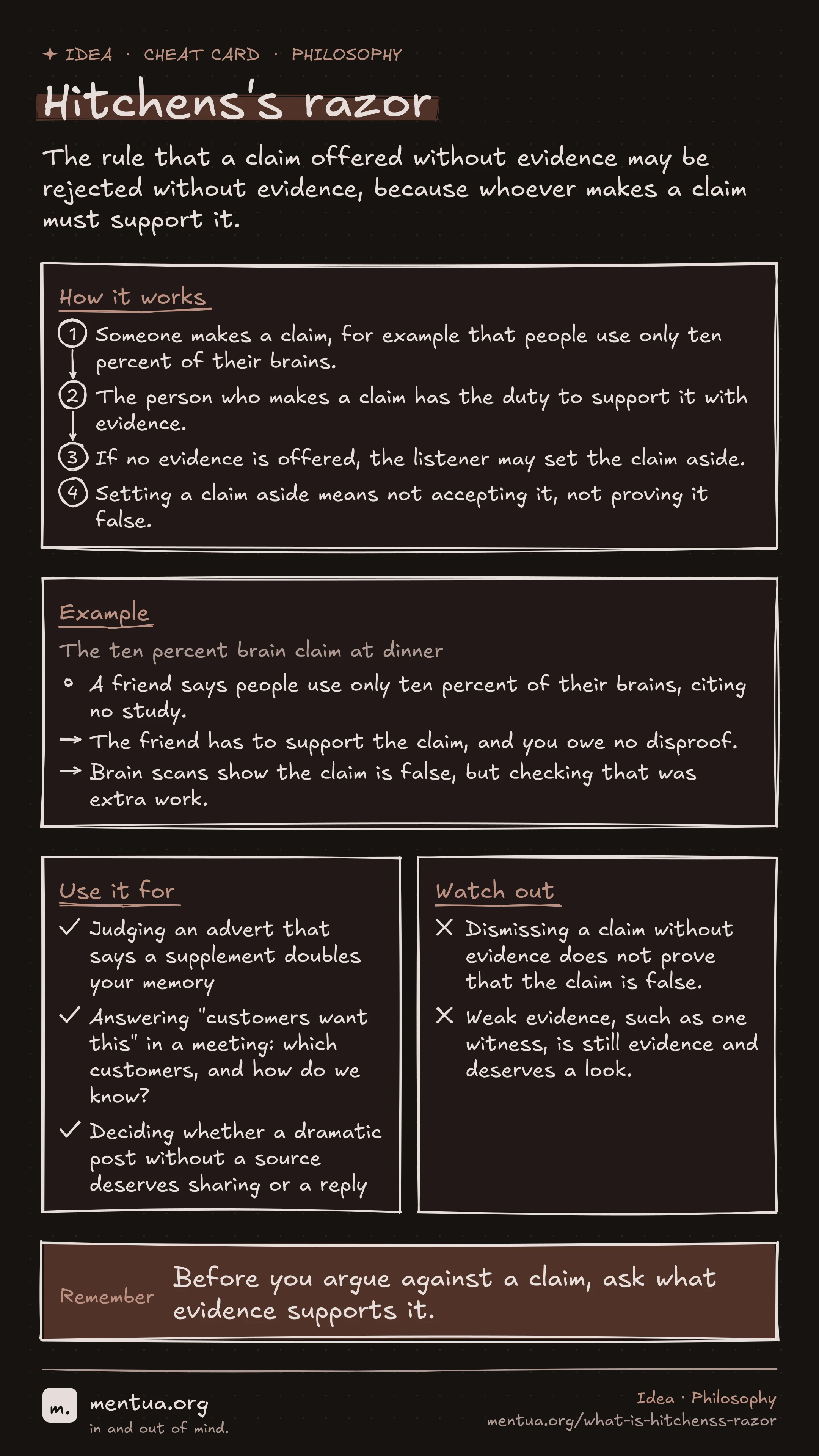
The whole idea on one page. Tap to open it full size, download it below, or test yourself against it tomorrow.
Download
- Light card · PNG image, 370 KB
- Dark card · PNG image, 373 KB
- Printable light card · PDF, searchable, 23 KB
Read the card as text
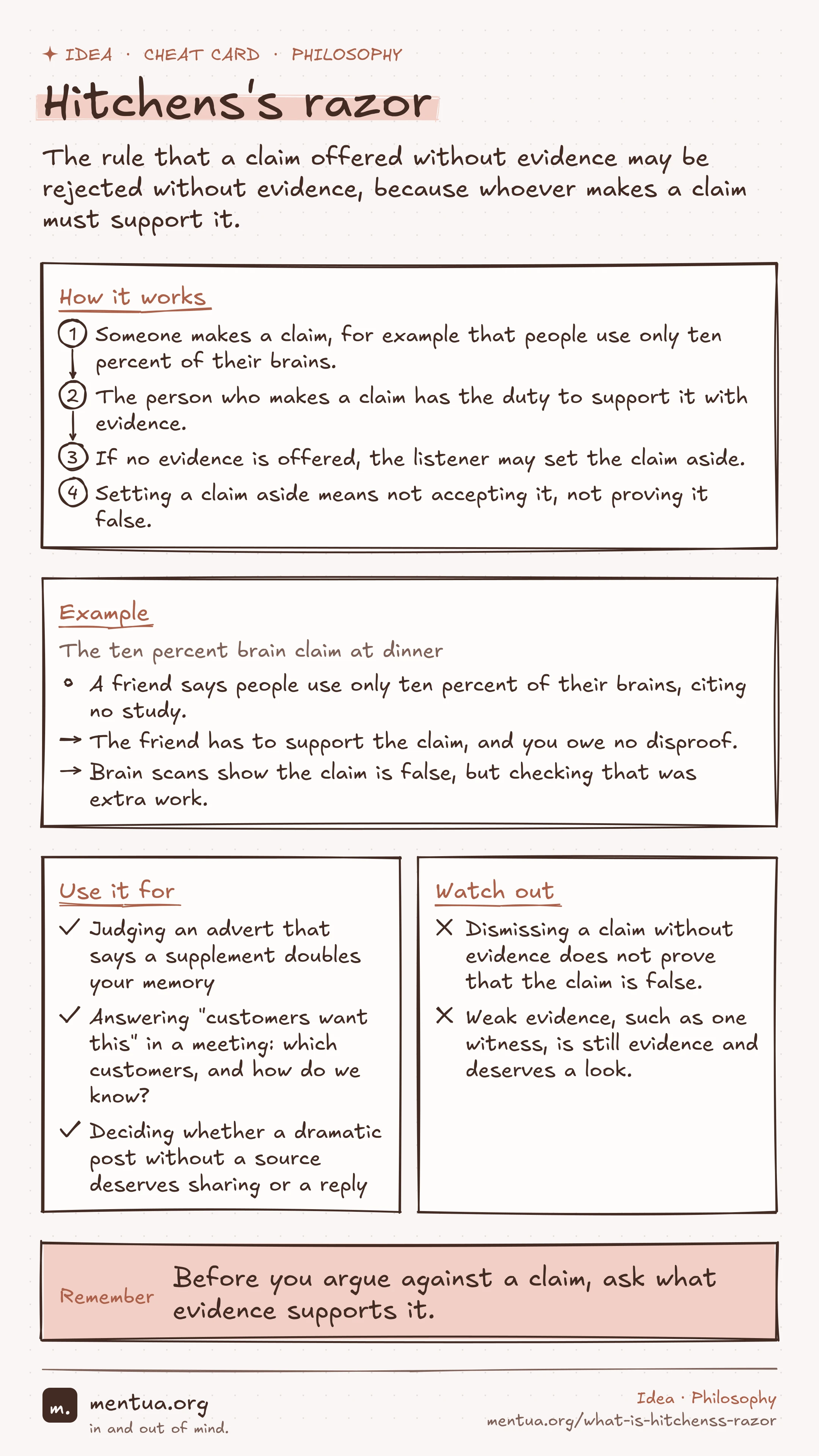
Hitchens's razor: The rule that a claim offered without evidence may be rejected without evidence, because whoever makes a claim must support it.
How it works
- Someone makes a claim, for example that people use only ten percent of their brains.
- The person who makes a claim has the duty to support it with evidence.
- If no evidence is offered, the listener may set the claim aside.
- Setting a claim aside means not accepting it, not proving it false.
Example: The ten percent brain claim at dinner
- A friend says people use only ten percent of their brains, citing no study.
- → The friend has to support the claim, and you owe no disproof.
- → Brain scans show the claim is false, but checking that was extra work.
Use it for
- Judging an advert that says a supplement doubles your memory
- Answering "customers want this" in a meeting: which customers, and how do we know?
- Deciding whether a dramatic post without a source deserves sharing or a reply
Watch out
- Dismissing a claim without evidence does not prove that the claim is false.
- Weak evidence, such as one witness, is still evidence and deserves a look.
Remember: Before you argue against a claim, ask what evidence supports it.
References
- Mommie Dearest: The pope beatifies Mother Teresa, a fanatic, a fundamentalist, and a fraud. Christopher Hitchens, Slate, 2003
The column of 20 October 2003 in which Hitchens first wrote the sentence, in a passage about the miracle claimed for Mother Teresa.
- Fallacies. Bradley Dowden, Internet Encyclopedia of Philosophy
Short definitions of the appeal to ignorance, the burden of proof and related mistakes in reasoning.
- Do People Only Use 10 Percent of Their Brains?. Scientific American, 2008
A neurologist explains why the ten percent claim is false and why it has lasted so long.