What Is the Anchoring Effect?
5 min read≈ 1,190 words3 questions · up to 3 points
What this is about
In 1974 two psychologists spun a wheel of fortune in front of their participants and then asked them a question about the United Nations that had nothing to do with the wheel. You learn what the wheel did to the answers, why the same thing happens to experienced judges and to shoppers, and how far the effect really reaches.
In a nutshell· skip ahead
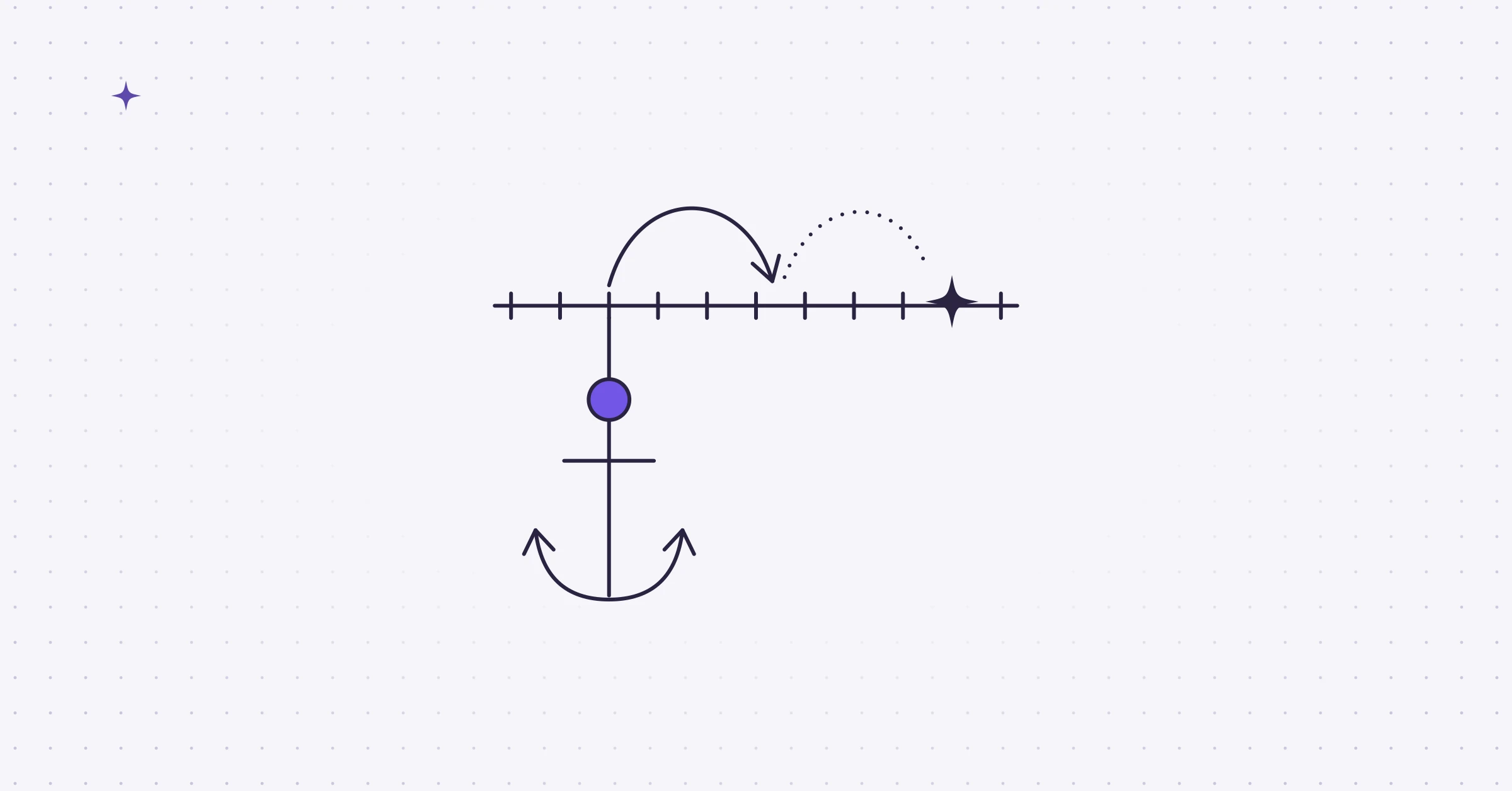
The anchoring effect is the tendency of an estimate to stay close to a number you saw just before, even when that number is irrelevant or plainly random. You start from the first number and adjust away from it, but you usually stop too early, so different starting numbers lead to different final answers.
What share of the countries in the United Nations are African? Before you answer, someone spins a wheel of fortune in front of you, and it stops at 65. You know the wheel has nothing to do with the question, so the number should not matter. In 1974 two psychologists tested whether it does.
What is the anchoring effect?
The anchoring effect is the tendency of an estimate to stay close to a number you saw just before, even when that number, the anchor, is irrelevant or plainly random. Amos Tversky and Daniel Kahneman described the effect in 1974, and their wheel-of-fortune study shows it in four steps.
- The wheel. In front of each group of participants, the researchers spun a wheel with numbers from 0 to 100. For the question about Africa, the wheel gave one group 10 and another group 65.
- The comparison. Participants first said whether the share of African countries in the UN was higher or lower than the number on the wheel.
- The estimate. Then they gave their own estimate by moving up or down from that number.
- The result. The group that saw 10 gave a median estimate of 25 percent, and the group that saw 65 gave 45 percent. Everybody could see that the number came from a wheel, but it still moved the answer by 20 percentage points.
Perhaps people did not care about the answer? Tversky and Kahneman report that paying them for accuracy did not reduce the effect.
different starting points yield different estimates, which are biased toward the initial values.
Why does a random number move your estimate?
There are two explanations, and they probably work together. The first is the one Tversky and Kahneman gave. People start from the anchor and adjust away from it, but they stop as soon as they reach a value that seems plausible, so they stay too close to where they started. They showed this without any wheel: high school students had five seconds to estimate 8×7×6×5×4×3×2×1, while another group estimated the same numbers in the order 1×2×3×4×5×6×7×8. After a few steps of multiplying, the first group had a larger number in mind than the second. Their median estimate was 2,250, compared with 512 for the ascending order, and both were far below the correct answer of 40,320.
The second explanation comes from the psychologists Thomas Mussweiler and Fritz Strack and is called selective accessibility. When you ask yourself whether the answer could be as high as 65 percent, you search your memory for reasons why it could be, so those reasons come to mind more easily when you make your final estimate. In one courtroom study, legal experts who had rolled a high sentencing demand with dice afterwards recognized words that spoke against the defendant faster than those who had rolled a low one. This one-sided search for supporting reasons is the same habit described in What Is Confirmation Bias?.
What the anchoring effect teaches you
The first number you meet sets the starting point of your thinking, whether it deserves to or not. So when a number has already been named, ask yourself where your estimate would be without it, and when you can, make your own estimate before you see anyone else’s.
- Courts. Birte Englich and Thomas Mussweiler gave German trial judges, with an average of more than 15 years of experience, the same rape case. When the prosecutor’s demand was 34 months, their sentences were almost 8 months longer than when it was 12 months, although the demand came from a computer science student playing the prosecutor. In a later study, the participants rolled loaded dice to set the demand themselves, and the anchor still worked. In another study, the prosecutor’s demand had no effect when the defense presented its demand first.
- Prices. In 2003 Dan Ariely, George Loewenstein and Drazen Prelec asked 55 business students at MIT whether they would buy products for the last two digits of their social security number. Students in the top fifth of these numbers then offered on average $56 for a cordless keyboard, while those in the bottom fifth offered $16. Almost all of them still valued the keyboard above a trackball, so their order of preference was sensible while their price levels were random.
- Negotiation and work. The same pull works when a seller names a price, an employer names a salary or you estimate a project from its first steps. Prepare your own number from evidence, such as prices of similar cars or the length of past projects, before the other number arrives.
- Groups. If everyone in a meeting hears the boss’s estimate first, all the estimates share the same anchor. Their errors then point the same way, which removes the benefit described in What Is the Wisdom of the Crowd?.
Does any number you happen to see bend your judgment?
No, and this is the most common overstatement. In the classic studies, people compared the anchor with the answer before they estimated. When David Shanks and his colleagues tested numbers that people only see in passing, without comparing them with anything, they found no reliable effect in three studies, while the standard version with a comparison question worked. So the risk is greatest when a number is part of the question itself, such as a price, a demand or a first offer.
The strongest objection is that real anchors often carry information, because a list price or a prosecutor’s demand reflects someone’s knowledge. That is true, but the experiments used numbers that people knew were random, such as a wheel, dice or their own social security number, and these still pulled the answers.
The basic effect has held up well. In Many Labs 1, a 2014 project that repeated 13 classic findings in 36 samples with 6,344 participants, all four anchoring questions showed the effect in every sample, and the authors concluded that the original study had underestimated it. The price version is less certain, because when Zacharias Maniadis, Fabio Tufano and John List revisited the experiment of Ariely and his colleagues in 2014, they found a more modest effect.
Learn more
The anchoring effect has clear parents. Amos Tversky and Daniel Kahneman named it in their 1974 paper “Judgment under Uncertainty: Heuristics and Biases” in the journal Science, as one of three mental shortcuts that people use when they judge under uncertainty. Kahneman received the Nobel Prize in economics in 2002; Tversky had died in 1996, and the prize is not given after death. Thomas Mussweiler and Fritz Strack developed the selective accessibility explanation, and Birte Englich carried the research into the courtroom.
Kahneman places anchoring among the other shortcuts of fast, automatic thinking in “Thinking, Fast and Slow” by Daniel Kahneman: Summary and Review. The same pattern of starting from yourself and adjusting too little explains What Is the Spotlight Effect?, the belief that other people notice you more than they do.
Quiz
3 questions · up to 3 points
Open a question and pick one answer. Only your first answer counts: +1 if it is right, −1 if it is wrong.
In the 1974 wheel-of-fortune study, what happened to the estimates of the share of African countries in the United Nations?
Show answer
People who saw the wheel stop at 65 gave a median of 45 percent, and people who saw 10 gave 25 percent. The wheel's number was random, and the participants could see that, but it still moved the median estimate by 20 percentage points.
You want to buy a used car and plan to make an offer. Based on research on anchoring, what is the most useful first step?
Show answer
Work out what the car is worth to you from prices of similar cars, and write that number down before you look at the seller's asking price. Your own estimate then starts from your evidence, not from the seller's number, which would otherwise pull your offer toward it.
Which statement about the limits of the anchoring effect matches the evidence in the article?
Show answer
The effect is strong when people compare a number with the answer, but there is little evidence that a number they only happen to see nearby changes their estimate. Studies of such incidental numbers found no reliable effect, while the standard version with a comparison question replicated in all 36 samples of Many Labs 1.
Your points are saved only in this browser for now. Accounts that keep them for good are on the way.
Continue learning: "Thinking, Fast and Slow" by Daniel Kahneman: Summary and Review →The takeaway
The anchoring effect means that estimates stay close to a number seen just before, because people adjust away from it too little and think mainly of reasons that fit it. In 1974, people who saw a wheel stop at 10 or 65 estimated 25 or 45 percent of UN members to be African, and experienced judges show the same pull. The effect is strong when you compare a number with the answer, not when it only appears nearby. So write down your own estimate before you hear anyone else's.
References
- Judgment under Uncertainty: Heuristics and Biases. Amos Tversky and Daniel Kahneman, Science 185 (4157), 1124–1131, 1974
The original paper that named anchoring, with the wheel of fortune and the multiplication task in the section on adjustment and anchoring.
- "Coherent Arbitrariness": Stable Demand Curves Without Stable Preferences. Dan Ariely, George Loewenstein and Drazen Prelec, Quarterly Journal of Economics 118 (1), 73–106, 2003
The social security number experiment, with a table of what each fifth of the students offered for a keyboard, wine and chocolates.
- Anchoring Effect. Thomas Mussweiler, Birte Englich and Fritz Strack, Chapter 10 in Rüdiger F. Pohl (ed.), Cognitive Illusions, Psychology Press, 2004
A readable overview by the researchers who studied anchoring in the courtroom, including the study with experienced trial judges.
- Blind or Biased? Justitia's Susceptibility to Anchoring Effects in the Courtroom Based on Given Numerical Representations. Birte Englich, Law & Policy 28 (4), 2006
A review of the courtroom studies, including the loaded dice and the finding that the anchor disappeared when the defense spoke first.
- Investigating Variation in Replicability: A "Many Labs" Replication Project. Richard A. Klein, Kate A. Ratliff, Michelangelo Vianello and others, Social Psychology 45 (3), 142–152, 2014
The large replication of 13 effects in 36 samples, in which anchoring was among the strongest and most consistent results.