What Is the Availability Heuristic?


5 min read≈ 1,190 words3 questions · up to 3 points
What this is about
Most people answer a simple question about the letter K wrongly, and they make the same kind of mistake when they judge which dangers are common. You learn what a 1973 experiment with five letters showed, why students thought accidents killed more Americans than strokes, and which parts of the research have held up.
In a nutshell· skip ahead
The availability heuristic is the mental shortcut of judging how common or likely something is by how easily examples of it come to mind. It often works, because frequent things are usually easier to remember, but it misleads when something is easy to recall for other reasons, for example because it is vivid, recent or often in the news.
Suppose you pick a word at random from an English text. Is it more likely that the word starts with the letter K, or that K is its third letter? Most people answer quickly that words starting with K are more common, and most people are wrong, because a typical English text contains about twice as many words with K in the third position. Why does such a simple question fool so many people?
Why do words that start with K seem more common?
They seem more common because they are easier to think of. The availability heuristic is the mental shortcut of judging how common or likely something is by how easily examples of it come to mind. A heuristic is a rule of thumb that gives a fast answer to a hard question. This one replaces “How often does this happen?” with the easier question “How quickly can I think of a case?”
The Israeli psychologists Amos Tversky and Daniel Kahneman tested the idea in 1973 with five letters, K, L, N, R and V. A large word count had shown that each of them is more frequent in the third position than in the first. The study shows the mechanism in four steps.
- The hard question. Each participant was asked whether a letter, for example R, appears more often as the first or as the third letter of a word, and to estimate the ratio between the two.
- The search. Nobody can count all English words in their head, so people try to recall a few examples of each kind. Words that start with R (road, rain, red) come at once, because we search memory by the beginning of a word, much like a dictionary. Words with R in the third place (care, word, hurt) are just as real but much harder to find.
- The judgment. People take the ease of the search as a measure of frequency: if examples come quickly, the class seems large.
- The result. Of 152 participants, 105 judged the first position more likely for most of the letters, and the median estimate was that each letter appeared twice as often in the first position. In fact all five letters were more frequent in the third position, and in related versions of the task, paying people for accurate answers made no difference.
The shortcut is not foolish, which is why people rely on it. Tversky and Kahneman put the balance in one sentence:
In general, availability is correlated with ecological frequency, but it is also affected by other factors.
“Ecological frequency” means how often something really happens in the world. Things you meet often are usually easy to recall, so ease is a good clue most of the time. But anything else that makes an example easy to recall, such as the way memory is searched, pushes the estimate in the same direction.
What the availability heuristic teaches you
The useful question is: “Am I judging how often this happens, or only how easily I can remember it?” When the answer is the second, look for numbers that do not depend on your memory.
The clearest real case concerns death. In a 1978 study, Sarah Lichtenstein, Paul Slovic and their colleagues asked American students and members of the League of Women Voters, a civic organization, to compare causes of death. Stroke killed about 1.85 times as many Americans as all accidents together, yet only 20% of the students and 23% of the other group judged stroke to be more frequent. Dramatic causes such as tornadoes, floods and homicide were overestimated, and quiet ones such as asthma, diabetes and stroke were underestimated. In the researchers’ count of a local newspaper over 184 days, diabetes, tuberculosis and breast cancer were never mentioned at all.
- The news. A plane crash is reported for days, so it becomes easy to recall, while the illnesses that kill most people are rarely reported. Before you judge a risk, compare it with the yearly figures for other causes.
- Money and health. You hear about the friend whose stock doubled or whose diet worked, and not about the many cases where nothing happened, the problem of missing cases described in What Is Survivorship Bias?.
- Work and studies. When you judge a colleague’s year or your own progress, the last few weeks are easiest to recall, so notes kept during the whole period give a fairer picture.
Where does the availability heuristic mislead, and where not?
The most common misreading is that the heuristic is nothing but an error. Tversky and Kahneman themselves said that ease of recall usually follows real frequency, so the shortcut is a reasonable tool that fails in predictable cases, not a habit to give up.
A second question is whether people use the examples they find or the feeling of how easy it was to find them. In 1991 Norbert Schwarz and his colleagues asked people to describe either 6 or 12 occasions on which they had behaved assertively. Those who had to find 12 rated themselves as less assertive, apparently because finding 12 examples felt hard.
This second finding has a mixed record. A 2018 review of 263 such studies found an effect of medium size, but also signs that unpublished failures had made it look up to one third larger. A 2021 study with 661 participants repeated the assertiveness task and found no effect on the ratings.
The strongest objection concerns the letter study itself. In 1998 Peter Sedlmeier, Ralph Hertwig and Gerd Gigerenzer asked people about many more letters and found that their judgments mostly followed the real proportions. Gigerenzer also argued that labels such as availability are too vague, because they do not say in advance when the shortcut will mislead and can explain almost any result afterwards. The finding about causes of death is more convincing, because there the gap between ease and frequency has a clear and measurable cause, the uneven attention of the news.
Learn more
The availability heuristic goes back to Amos Tversky and Daniel Kahneman, who named it in their 1973 paper while working at the Hebrew University of Jerusalem and the Oregon Research Institute. In 1974 they described it in Science together with two other shortcuts, representativeness and anchoring, and Kahneman received the Nobel Prize in economics in 2002 for this line of work, six years after Tversky’s death. Paul Slovic and Sarah Lichtenstein carried the idea into the study of risk, and Norbert Schwarz separated the feeling of ease from what people recall.
Kahneman shows how availability fits among the other shortcuts of fast thinking in “Thinking, Fast and Slow” by Daniel Kahneman: Summary and Review. The second shortcut from the 1974 paper is explained in What Is the Anchoring Effect?. For the same problem applied to the state of the world, read “Factfulness” by Hans Rosling: Summary and Review, where frightening events make the world seem more dangerous than it is.
Quiz
3 questions · up to 3 points
Open a question and pick one answer. Only your first answer counts: +1 if it is right, −1 if it is wrong.
In Tversky and Kahneman's 1973 study, what did most people say about letters such as K and R, and what was true?
Show answer
Most said the first position, but all five letters were more common in the third. 105 of 152 participants favored the first position for most letters, although all five letters appear more often in the third position.
After several news reports about shark attacks, Leo feels that swimming in the sea has become dangerous. What would the availability heuristic suggest he check?
Show answer
Whether the attacks come to mind because of many reports, and what the real number of attacks per year is. The shortcut misleads when something is easy to recall for a reason other than how often it happens, such as news coverage, so the real numbers are the test.
Which statement about the availability heuristic is correct?
Show answer
It usually works, because common things are easier to recall, and fails when ease has another cause. Tversky and Kahneman wrote that availability is generally linked to real frequency. The errors come from other things that make examples easy to recall, such as vividness or the way memory is searched.
Your points are saved only in this browser for now. Accounts that keep them for good are on the way.
Continue learning: "Thinking, Fast and Slow" by Daniel Kahneman: Summary and Review →The takeaway
The availability heuristic is the shortcut of judging how common something is by how easily examples come to mind. In 1973, most people judged that K appears more often as the first letter of a word than as the third, because first letters are easier to search, although the third position is twice as common. Later studies found that letter judgments are often accurate and that some ease effects do not replicate. Before you judge a risk by the cases you remember, ask why they come to mind and check the real numbers.
Cheat card
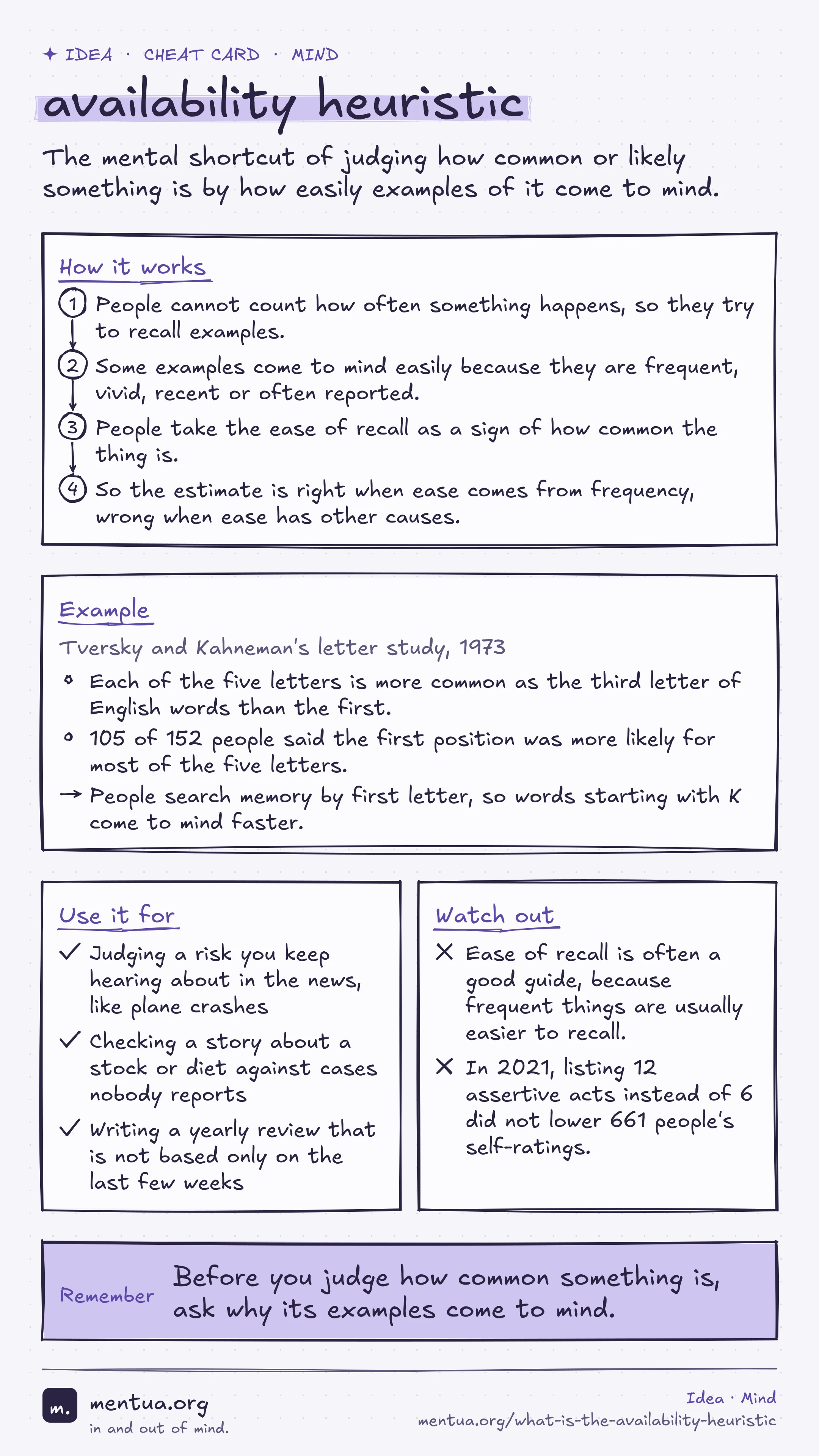
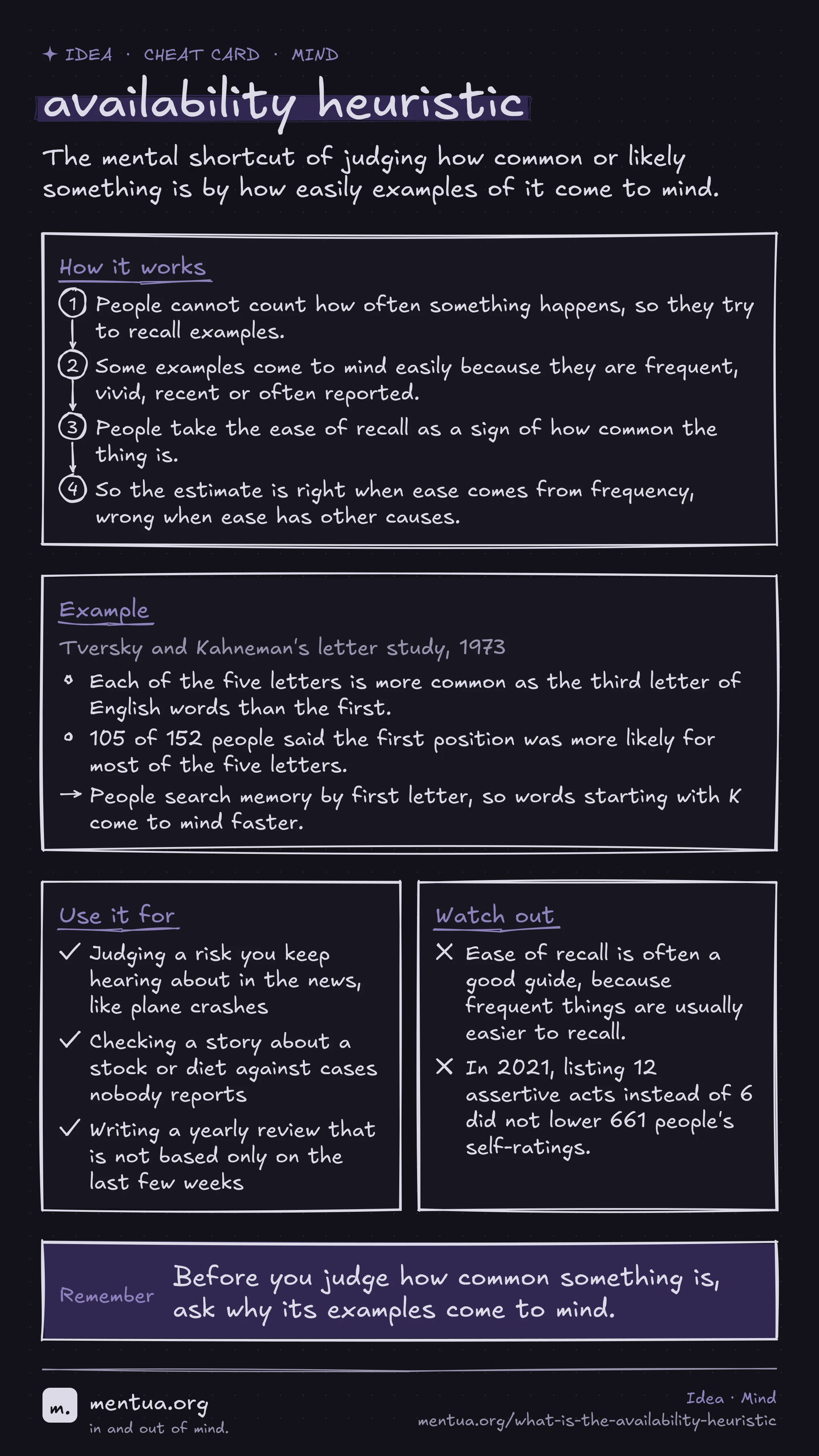
The whole idea on one page. Tap to open it full size, download it below, or test yourself against it tomorrow.
Download
- Light card · PNG image, 397 KB
- Dark card · PNG image, 404 KB
- Printable light card · PDF, searchable, 24 KB
Read the card as text
availability heuristic: The mental shortcut of judging how common or likely something is by how easily examples of it come to mind.
How it works
- People cannot count how often something happens, so they try to recall examples.
- Some examples come to mind easily because they are frequent, vivid, recent or often reported.
- People take the ease of recall as a sign of how common the thing is.
- So the estimate is right when ease comes from frequency, wrong when ease has other causes.
Example: Tversky and Kahneman's letter study, 1973
- Each of the five letters is more common as the third letter of English words than the first.
- 105 of 152 people said the first position was more likely for most of the five letters.
- → People search memory by first letter, so words starting with K come to mind faster.
Use it for
- Judging a risk you keep hearing about in the news, like plane crashes
- Checking a story about a stock or diet against cases nobody reports
- Writing a yearly review that is not based only on the last few weeks
Watch out
- Ease of recall is often a good guide, because frequent things are usually easier to recall.
- In 2021, listing 12 assertive acts instead of 6 did not lower 661 people's self-ratings.
Remember: Before you judge how common something is, ask why its examples come to mind.
References
- Availability: A heuristic for judging frequency and probability. Amos Tversky and Daniel Kahneman, Cognitive Psychology 5 (2), 207–232, 1973
The original paper that named the heuristic, with the letter study (Study 3) and the experiment with lists of famous and less famous names.
- Judged frequency of lethal events. Sarah Lichtenstein, Paul Slovic, Baruch Fischhoff, Mark Layman and Barbara Combs, Journal of Experimental Psychology: Human Learning and Memory 4 (6), 551–578, 1978
The full text of the study in which people judged 41 causes of death, including the stroke and accident comparison and the newspaper count.
- Does Ease Mediate the Ease-of-Retrieval Effect? A Meta-Analysis. Evan Weingarten and J. Wesley Hutchinson, Psychological Bulletin 144 (3), 227–283, 2018
A review of 263 studies that list few or many examples, with the size of the effect and the evidence of publication bias.
- Are judgments of the positional frequencies of letters systematically biased due to availability?. Peter Sedlmeier, Ralph Hertwig and Gerd Gigerenzer, Journal of Experimental Psychology: Learning, Memory, and Cognition 24 (3), 754–770, 1998
The record and abstract of the study that repeated the letter task with more letters and found judgments that mostly followed the real proportions.