What Is the Golden Ratio, and Is It Really in Art?
5 min read≈ 1,200 words3 questions · up to 3 points
What this is about
Books and videos draw a spiral over the Parthenon and the Mona Lisa and say that one number is the secret of beauty. You learn what that number is and why it keeps appearing in mathematics, how to test whether a building or painting really uses it, which artists used it on purpose, and what experiments say about whether people prefer it.
In a nutshell· skip ahead
The golden ratio, about 1.618, is the ratio you get when you cut a line so that the whole line relates to the longer part as the longer part relates to the shorter one. It is real and important in geometry, but most claims that famous buildings and paintings were designed with it do not survive careful measurement.
Search for “golden ratio” and you will keep seeing the same pictures, such as the front of the Parthenon in Athens inside a rectangle or the Mona Lisa’s face inside a spiral. The message is that one number, about 1.618, is a hidden law of beauty in great art. So what is this number, and did the Greeks and Leonardo da Vinci really build their works on it?
What is the golden ratio?
The golden ratio is the number you get when you cut a line into two parts so that the whole line relates to the longer part exactly as the longer part relates to the shorter part. The number is (1 + √5) / 2, about 1.618, and mathematicians write it with the Greek letter phi, φ.
You can find the number in three steps.
- Call the shorter part 1 and the longer part x. The whole line is then x + 1.
- Write down the rule. The whole relates to the longer part as the longer part to the shorter one, so (x + 1) / x = x / 1.
- Solve it. Multiplying both sides by x gives x² = x + 1, and the positive solution is x = (1 + √5) / 2 = 1.6180339….
The same rule makes the number turn up in other places. The Fibonacci numbers are the sequence in which each number is the sum of the two before it: 1, 1, 2, 3, 5, 8, 13, 21, 34, 55. If you divide each one by the one before it, you get 1.6, 1.625, 1.615, 1.619 and 1.6176, so the ratios close in on 1.618 from both sides.
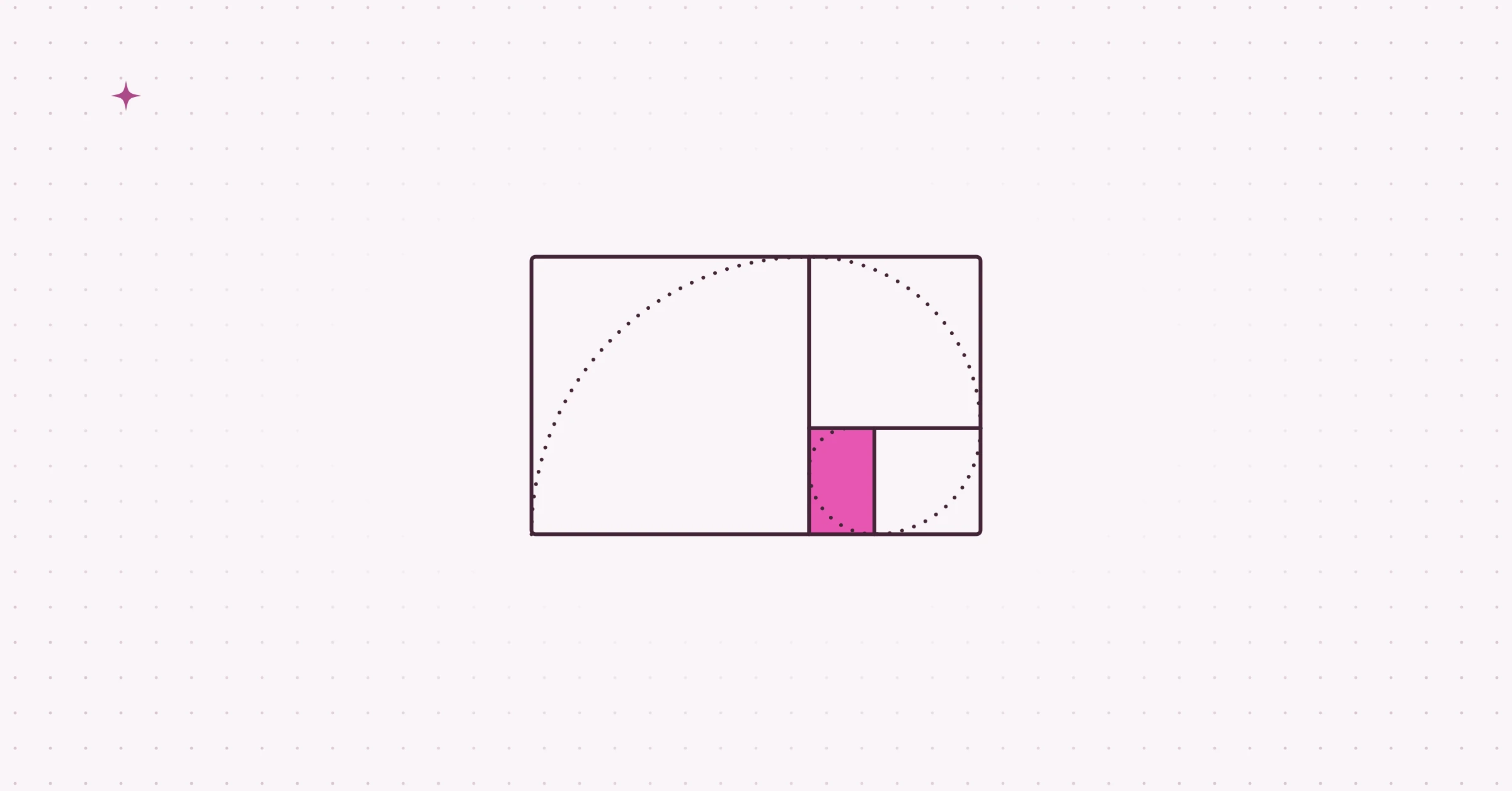
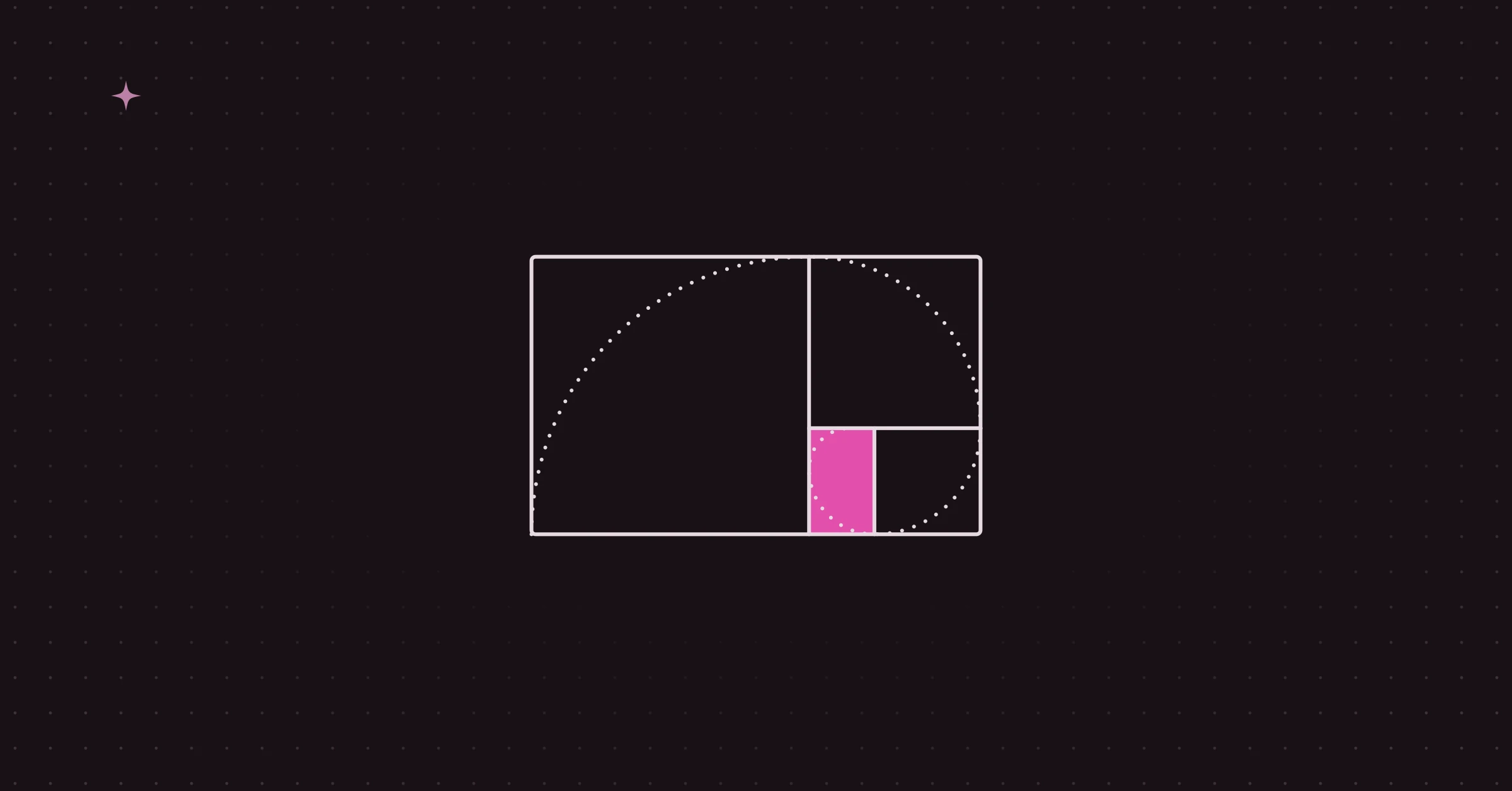
The rule also gives the golden rectangle, whose sides are in the ratio 1.618 to 1. If you cut a square off one end, the piece that is left is again a smaller golden rectangle, and so on forever.
A straight line is said to have been cut in extreme and mean ratio when, as the whole line is to the greater segment, so is the greater to the less.
Euclid, who wrote the Elements around 300 BC, needed this cut to construct the regular pentagon, the dodecahedron and the icosahedron. He says nothing about beauty.
Is the golden ratio really in the Parthenon?
Many books say that the front of the Parthenon, built in Athens between 447 and 432 BC, fits exactly into a golden rectangle. The astrophysicist Mario Livio checked this in his 2002 book The Golden Ratio with measurements from an architecture textbook: 101 feet 3.75 inches wide and 45 feet 1 inch high, a ratio of about 2.25. Measured up to the top of the roof, using 59 feet from another source, it is about 1.72. Neither is 1.618, and in 1992 the mathematician George Markowsky pointed out that the popular drawings leave parts of the building outside the rectangle.
The Parthenon shows why such claims are so easy to make. A building or painting offers dozens of points to measure from, such as the base or the top step, the top of the columns or the top of the roof. Each pair of distances gives a ratio, and with enough pairs some of them will land near 1.6 by chance, especially if 1.5 or 1.7 counts as “close enough”. So the method that finds the golden ratio in the Parthenon would find it in almost any building.
The Mona Lisa fails for a different reason. Leonardo drew the illustrations for De divina proportione, a book on the ratio by his friend, the mathematician Luca Pacioli, printed in Venice in 1509. But no document shows that Leonardo used the ratio on purpose, and nobody agrees where the rectangle around the face should start and end.
Some artists did use the ratio on purpose. The architect Le Corbusier published the Modulor in 1948, a scale of measures for buildings based on a man 1.83 meters tall, in which each step is about 1.618 times the one before. Salvador Dalí painted The Sacrament of the Last Supper in 1955 on a canvas of about 167 by 267 centimeters, a ratio of 1.60, with a large dodecahedron above the table. We know this from the artists, not from measuring afterwards.
What the golden ratio teaches you
The golden ratio teaches you to ask, whenever someone finds a pattern in measurements, how the points were chosen and how close counts as a match.
- Data in the news. A study that compares many groups and outcomes will find some striking result by chance, so ask whether the comparison was planned in advance. Bayes’ Theorem, Explained shows how to weigh a surprising fit against how often chance would produce it.
- Your own design work. For a page or a photograph, 1.618 is one useful proportion among several, such as 1.5, so let your eyes judge the result. Rick Rubin makes a similar point about artistic rules in “The Creative Act” by Rick Rubin: Summary and Review: a rule is a place to start, and you should also test its opposite.
Do people really find the golden ratio beautiful?
Many people believe that we prefer golden proportions by instinct, but the experiments give a much weaker answer. In the 1860s the German physicist and psychologist Gustav Fechner showed people ten rectangles and asked which one they liked best. According to Livio, 76% of the choices fell on three rectangles with ratios of 1.75, 1.62 and 1.50, with the most votes for the golden one.
But the choices were spread across a range rather than fixed on 1.618, and later work found that the result depends on the method. In 1974 the psychologist Michael Godkewitsch argued that the preference came from the golden rectangle’s position in the middle of the range of rectangles shown. In 1980 Chris McManus judged that there is “moderately good evidence” for a preference, and a 1995 review by Christopher Green concluded that careful studies show an effect that still needs explaining.
So people may lean a little toward rectangles between about 1.5 and 1.75, but nothing shows that 1.618 itself is a law of beauty. The mathematics of the golden ratio is real, while the idea that it is the secret of great art is mostly a story told after the fact.
Learn more
The golden ratio has no single discoverer, because Greek mathematicians studied it before Euclid wrote down the definition. Pacioli called it the “divine proportion” because he saw in it qualities fitting for God, such as the fact that no ratio of whole numbers can express it, and the German name “golden section” first appears in print around 1835. The claim that it is the key to beauty in the human body and in art comes mainly from the German writer Adolf Zeising, whose widely read book on human proportions appeared in 1854. Fechner’s experiments were among the first scientific tests of such claims.
What Is Occam’s Razor? explains why chance, which needs fewer assumptions, should be preferred to a hidden plan until a document shows the plan.
Quiz
3 questions · up to 3 points
Open a question and pick one answer. Only your first answer counts: +1 if it is right, −1 if it is wrong.
What does it mean to cut a line in the golden ratio?
Show answer
The whole line relates to the longer part exactly as the longer part relates to the shorter part. This is Euclid's definition of the 'extreme and mean ratio', and solving it gives the number (1 + √5) / 2, about 1.618.
A website says a famous poster follows the golden ratio, and shows lines drawn between the top of a head, an elbow and the edge of a sign. What is the best first question to ask?
Show answer
Were the measuring points chosen before the measuring, or picked afterwards because they gave 1.6? With enough possible points, some pair of distances will come out near 1.6 by chance, so a fit only counts if the points were fixed in advance or the designer documented the plan.
Which statement about the golden ratio in art is best supported?
Show answer
Some modern artists used it on purpose, but claims about the Parthenon and the Mona Lisa are not supported by measurements or documents. Le Corbusier built his Modulor on it and Dalí sized a painting by it, while the Parthenon's measured ratios are not close to 1.618 and no document shows that Leonardo used it.
Your points are saved only in this browser for now. Accounts that keep them for good are on the way.
Continue learning: Bayes' Theorem, Explained →The takeaway
The golden ratio, about 1.618, comes from cutting a line so that the whole relates to the longer part as the longer part relates to the shorter. It appears in pentagons and in the ratios of Fibonacci numbers, and some modern artists, such as Le Corbusier and Dalí, used it on purpose. Claims about the Parthenon or the Mona Lisa mostly fail, because the measuring points are chosen after the fact, and experiments show at most a weak preference. Before you trust a pattern in measurements, ask how the points were chosen.
References
- The golden ratio and aesthetics. Mario Livio, Plus Magazine, University of Cambridge, 2002
An astrophysicist's short and careful account of the Mona Lisa claim, the artists who really used the ratio and the preference experiments from Fechner onward.
- Euclid's Elements, Book VI, Definition 3. Euclid, ed. D. E. Joyce, Clark University
The original definition of the 'extreme and mean ratio', with notes on where Euclid uses it: for the pentagon, the icosahedron and the dodecahedron.
- The Golden Ratio. J. J. O'Connor and E. F. Robertson, MacTutor History of Mathematics, University of St Andrews, 2001
The history of the ratio in mathematics, from the Greeks to Pacioli, Kepler and the Fibonacci numbers, and the puzzle of where the name 'golden section' comes from.
- All that Glitters: A Review of Psychological Research on the Aesthetics of the Golden Section (background). Christopher D. Green, York University, 1995
A psychologist's history of the idea that the ratio is beautiful, with Pacioli, Zeising and Fechner, written as background to his review in the journal Perception.