What Is the Lindy Effect?


5 min read≈ 1,190 words3 questions · up to 3 points
What this is about
In 1969 a young American stood at the Berlin Wall and wondered how long it would stand, with only its age to go on. You learn how that single number can give a sensible forecast, why the reasoning works for books and technologies but not for people or milk, and why even things that grow weaker each year can show the effect.
In a nutshell· skip ahead
The Lindy effect is the observation that for some things, such as books, ideas and technologies, the longer they have already lasted, the longer they will probably last. A fair first guess is that such a thing will last about as long again. It does not hold for things that wear out, such as people or food.
In the summer of 1969, J. Richard Gott, a young American who had just graduated from Harvard, visited the Berlin Wall, which had divided the city since 1961. He wondered how long it would stand, and he knew only one thing that could help: the Wall was eight years old. Can the age of something, and nothing else, tell you how long it will last?
How can age alone predict how long something will last?
The Lindy effect is the observation that for some things, such as books, ideas and technologies, the longer they have already lasted, the longer they will probably last. The best single guess is that such a thing will last about as long again. Gott’s reasoning at the Wall, published in the journal Nature in 1993, shows where this guess comes from.
- One fact. The Wall was eight years old, and Gott saw no reason why his visit should fall at a special moment in its life.
- A random moment. If the visit fell at a random point in the Wall’s life, there was a 50 percent chance that it fell in the middle half, between one quarter and three quarters of the way through.
- The range. If a quarter of the Wall’s life had passed, three times eight, so 24 more years, were left. If three quarters had passed, only a third of eight, about 2.7 years, were left. So the Wall had a 50 percent chance of standing between 2.7 and 24 more years.
- The best single guess. The visit was as likely to fall in the first half of the Wall’s life as in the second, so the Wall had an even chance of lasting more than another eight years.
The Wall came down in November 1989, twenty years later and inside Gott’s range. One case proves little, so Gott also tested the method on the 44 Broadway plays running in New York on the day his paper appeared. By 2016, 42 had closed, every one inside the wider range that his method gives with 95 percent confidence.
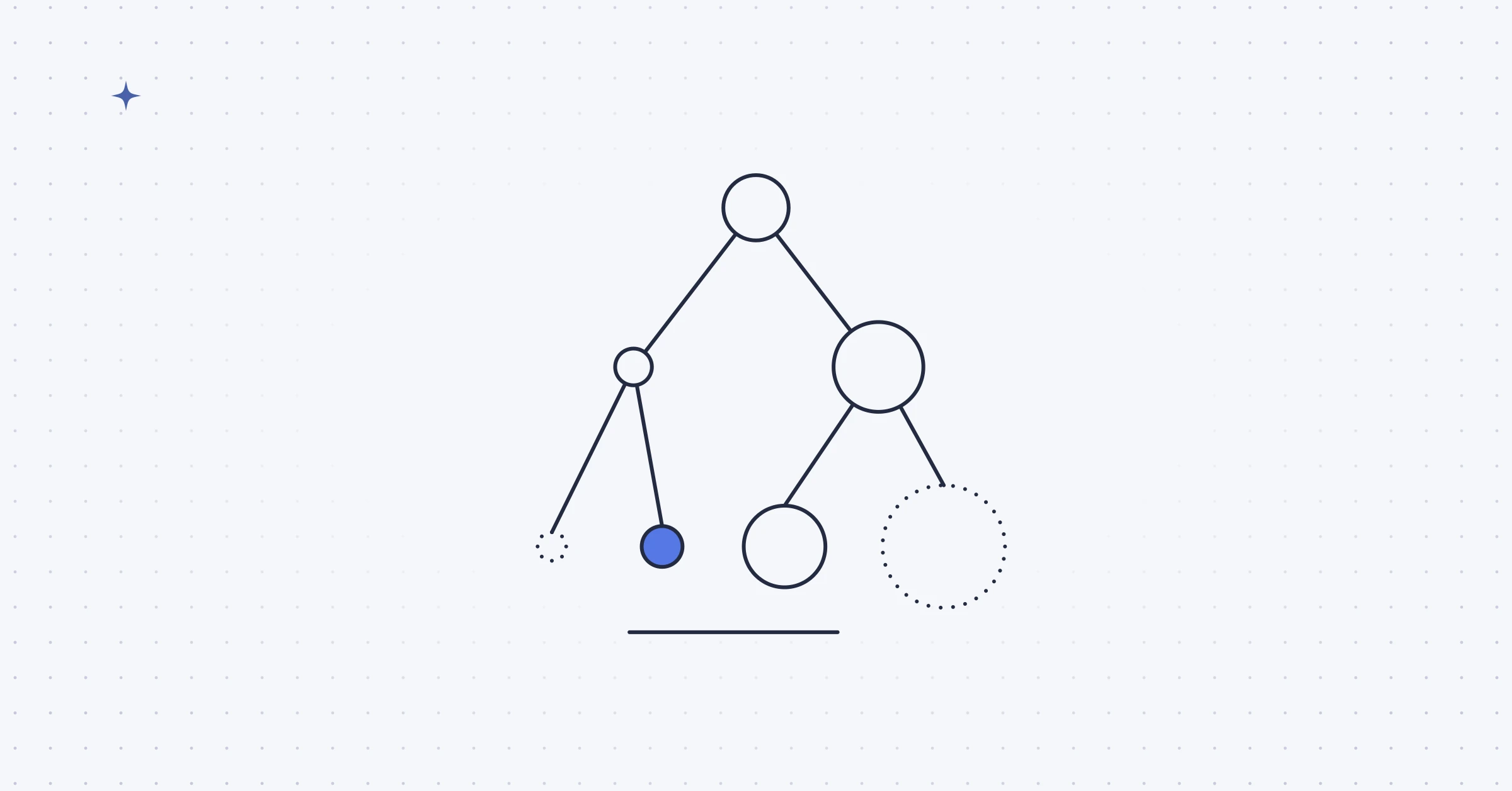
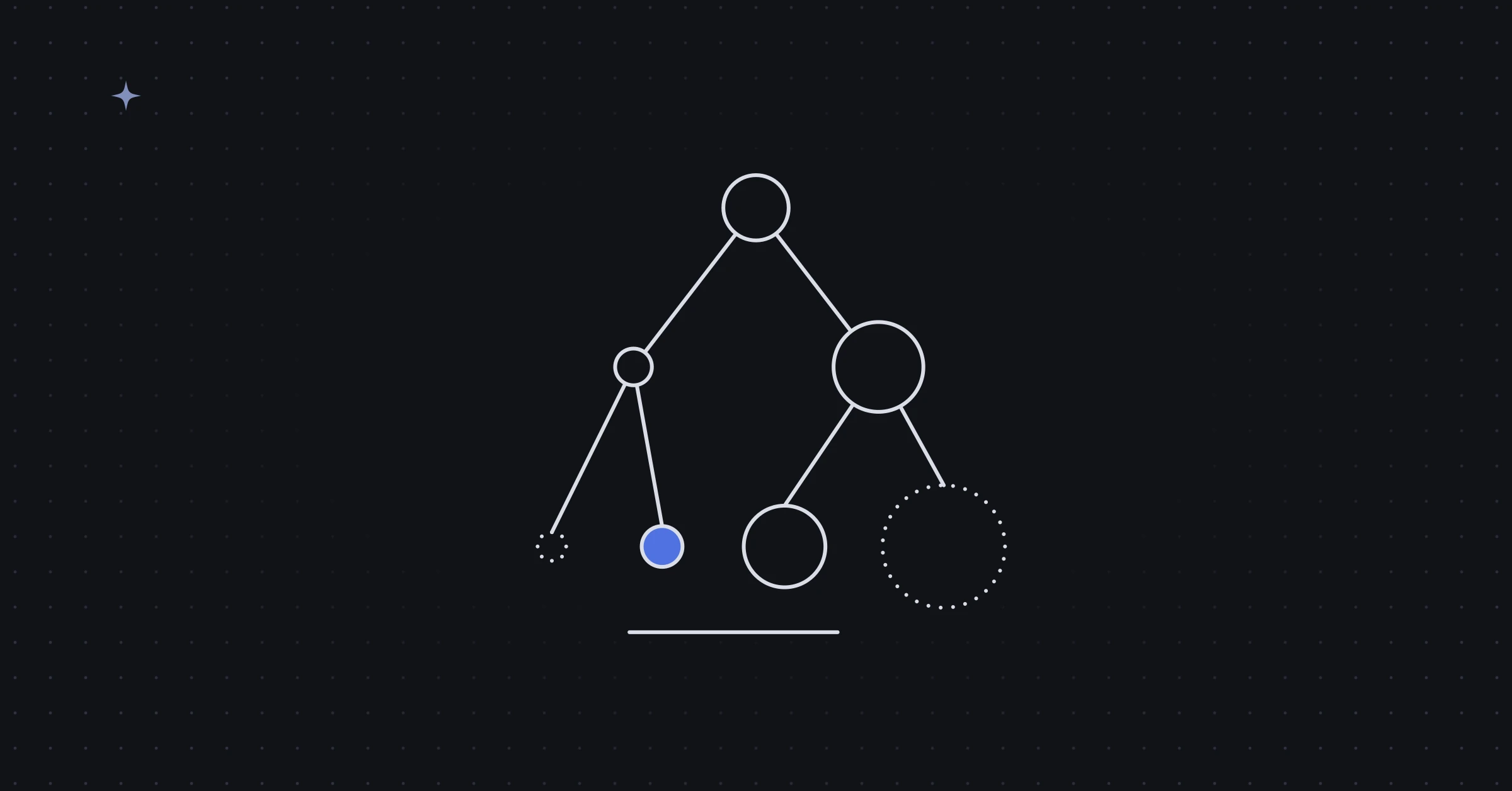
You might ask why anything should work like this. The Oxford philosopher Toby Ord, who worked out the mathematics in 2023, describes two ways it can happen, and neither needs the old thing to become stronger with age. The first is winnowing, the early loss of the fragile members of a group. If many books disappear soon after they come out, a book still printed after a century has shown that it is not one of those. The second is evidence, because every year without failure is information that makes a long life more likely, the kind of updating explained in Bayes’ Theorem, Explained.
A radioactive atom of a known type has no memory, since its chance of decaying next year is the same however old it is, so no single type of atom shows the Lindy effect. A radioactive atom of unknown type does show it, because the longer it has survived, the more likely it is to belong to a long-lived type. Ord concludes that even things that grow weaker every year can show the effect, as long as their group mixes robust and fragile members.
What the Lindy effect teaches you
When you have to choose between something old and something new and know little else, the old one has passed a test that the new one has not yet taken.
- Reading. A book still read after fifty years has a good chance of being read in fifty more, while this year’s bestseller has passed no such test, so old books are the safer choice when your reading time is short.
- Work. When a team chooses a file format or a programming language, one used for thirty years is more likely to be supported in ten years than one launched last year. The newer one may still be better, but you take on a risk with it.
- Advice and customs. A rule about money or health followed for centuries has survived generations of testing. That does not prove it right, but, as What Is Chesterton’s Fence? explains, it is a reason to find out why it lasted before you drop it.
Economists meet the same mathematics. Ord shows that Martin Weitzman’s argument of 1998, that distant benefits should be discounted at a lower rate when we are unsure which rate is right, uses the same calculation.
Where does the Lindy effect fail?
The Lindy effect fails for things that wear out, such as people, food and cars. A woman of 90 has lived ten times as long as a girl of 9 but has far fewer years left, because after middle age a person’s yearly risk of dying rises steeply. The writer and former trader Nassim Nicholas Taleb, who made the idea widely known, draws the line between such things and the rest:
For the nonperishable, every additional day may imply a longer life expectancy.
Ord shows that this line is too simple. Many insects and frogs die mostly young, so for much of their lives an older animal has more time ahead than a younger one, although each animal is perishable.
The common misreading treats the Lindy effect as a promise that old things will last. It is only a best guess, and Gott’s 50 percent range was meant to miss half the time, so an old book can still go out of print next year.
The strongest objection is that the guess works only when age is all you know, and as soon as you know more, that knowledge should win. Moore’s law, the doubling of transistors on a chip about every two years, had held for about forty years when chips could no longer get faster without getting too hot. As What Is Moore’s Law? describes, the physics of heat said more about the trend’s future than its age did.
Learn more
The idea has several parents rather than a single inventor. Its name comes from Lindy’s, a New York restaurant where comedians met. In June 1964 the writer Albert Goldman reported their rule in The New Republic: a comedian with a weekly television show soon uses up his material, while one who appears only now and then can last into old age. The mathematician Benoit Mandelbrot turned this into the claim that a career lasts, on average, as long again as it has lasted, and named it “Lindy’s law” in The Fractal Geometry of Nature (1982). Taleb extended it to books and technologies in Antifragile, and Gott reached the same guess without using the name.
Ord’s paper “The Lindy Effect” is free to read and connects all these versions. Taleb’s Antifragile (Affiliate Link) places the idea in his larger argument about things that gain from stress. What Is Survivorship Bias? shows the other side of winnowing, because studying only what survived can teach you the wrong lessons.
Quiz
3 questions · up to 3 points
Open a question and pick one answer. Only your first answer counts: +1 if it is right, −1 if it is wrong.
In 1969 the Berlin Wall was eight years old. Which range did Gott give it a 50 percent chance of falling into?
Show answer
Between about 2.7 and 24 more years. If the visit fell in the middle half of the Wall's life, between a quarter and three quarters had passed, so between a third of eight and three times eight years were left.
A programming language has been in wide use for 30 years, and a new one was launched two years ago. Knowing nothing else, what does the Lindy effect suggest?
Show answer
The older language will probably still be in use after the newer one has gone. For things that do not wear out, a longer past suggests a longer future, so the 30-year-old language has the better chance of lasting.
Why does the Lindy effect not apply to human lifespans?
Show answer
Because after middle age a person's yearly risk of dying rises steeply, so more years lived means fewer left. The effect needs a risk of failure that does not climb fast with age. People wear out, so a 90-year-old has fewer years left than a 9-year-old.
Your points are saved only in this browser for now. Accounts that keep them for good are on the way.
Continue learning: What Is Survivorship Bias? →The takeaway
The Lindy effect is the observation that for some things, such as books, ideas and technologies, the longer they have already lasted, the longer they will probably last. It works because fragile members of a group fail early and each year of survival is evidence of a long life. In 1969 a young American visitor gave the eight-year-old Berlin Wall an even chance of standing another 2.7 to 24 years, and it fell after 20. The effect fails for things that wear out, such as people, so use age as your first guess of what is left only when age is all you know.
Cheat card
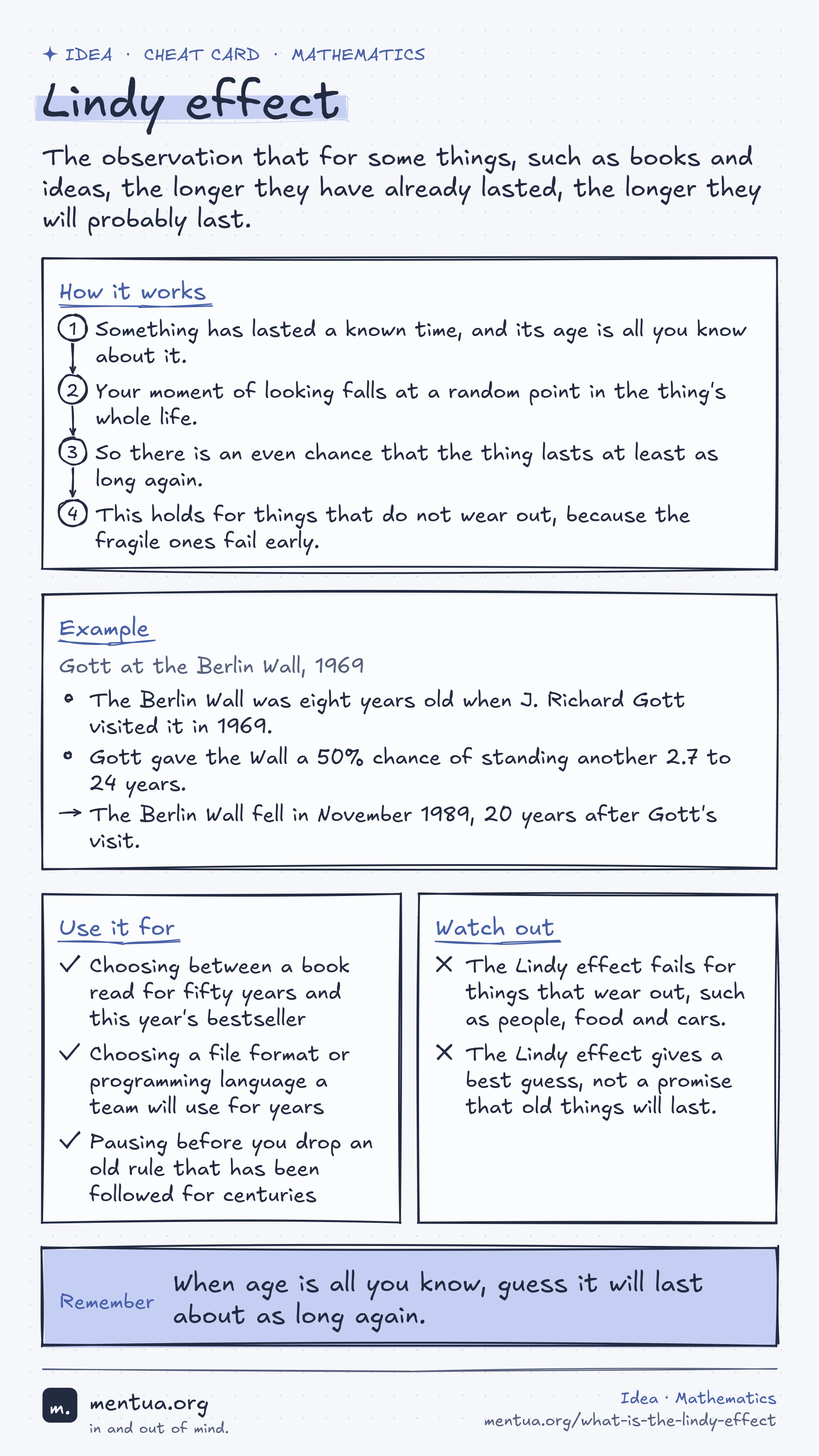
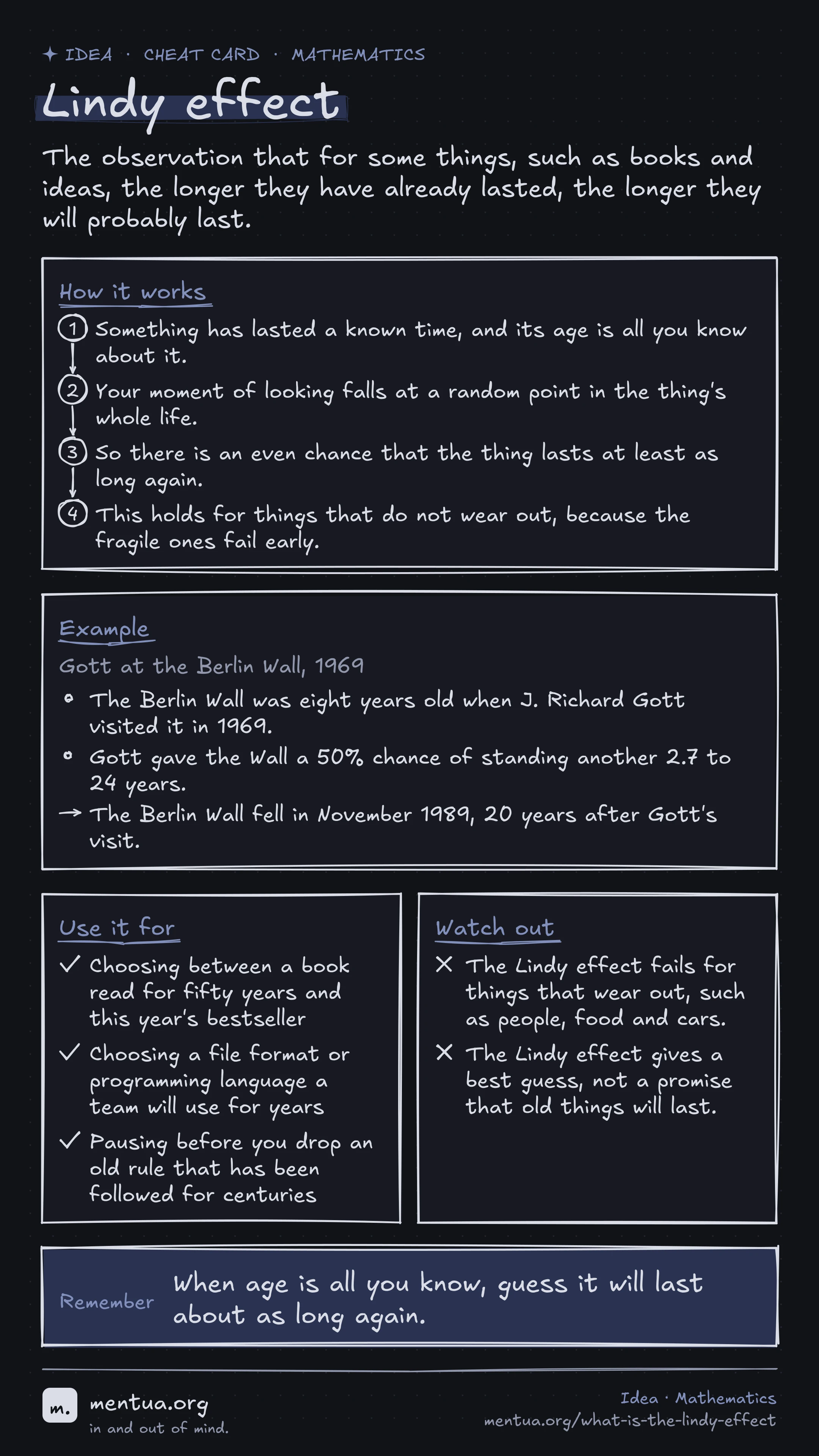
The whole idea on one page. Tap to open it full size, download it below, or test yourself against it tomorrow.
Download
- Light card · PNG image, 378 KB
- Dark card · PNG image, 382 KB
- Printable light card · PDF, searchable, 25 KB
Read the card as text
Lindy effect: The observation that for some things, such as books and ideas, the longer they have already lasted, the longer they will probably last.
How it works
- Something has lasted a known time, and its age is all you know about it.
- Your moment of looking falls at a random point in the thing's whole life.
- So there is an even chance that the thing lasts at least as long again.
- This holds for things that do not wear out, because the fragile ones fail early.
Example: Gott at the Berlin Wall, 1969
- The Berlin Wall was eight years old when J. Richard Gott visited it in 1969.
- Gott gave the Wall a 50% chance of standing another 2.7 to 24 years.
- → The Berlin Wall fell in November 1989, 20 years after Gott's visit.
Use it for
- Choosing between a book read for fifty years and this year's bestseller
- Choosing a file format or programming language a team will use for years
- Pausing before you drop an old rule that has been followed for centuries
Watch out
- The Lindy effect fails for things that wear out, such as people, food and cars.
- The Lindy effect gives a best guess, not a promise that old things will last.
Remember: When age is all you know, guess it will last about as long again.
References
- The Lindy Effect. Toby Ord, arXiv 2308.09045, 2023
A clear mathematical study of the effect, its history from Goldman to Taleb, the mechanisms that produce it, and where it fails, free to read.
- Implications of the Copernican principle for our future prospects. J. Richard Gott III, Nature 363, 315–319, 1993
Gott's paper with the reasoning he first used at the Berlin Wall, the 95 percent rule and his forecasts for Broadway plays.
- Lindy's Law. Albert Goldman, The New Republic, 13 June 1964, pp. 34–35, 1964
A scan of the original television column about the comedians at Lindy's that gave the idea its name.