What Is the Mpemba Effect?
5 min read≈ 1,030 words3 questions · up to 3 points
What this is about
A schoolboy in Tanzania put his ice-cream mix into the freezer while it was still boiling and found it frozen before a classmate's cold one. You learn why that result is not as impossible as it sounds, which causes have been proposed, and why the most careful experiments have found so little of it.
In a nutshell· skip ahead
The Mpemba effect is the claim that water which starts out hotter can, under the same conditions, freeze sooner than water which starts out colder. It is possible in principle, because hot water can change while it cools, for example by evaporating. Careful experiments, however, rarely find it, and whether it exists depends on how freezing is defined.
At a school in Tanzania, a group of pupils were making ice cream, and space in the freezer was short. One pupil, Erasto Mpemba, was afraid of losing the last free place, so he put his milk-and-sugar mix into the freezer while it was still boiling, instead of letting it cool first. An hour and a half later his mix had frozen, while a classmate’s mix, which had gone in cold, had not. Can something hot really freeze before something cold?
Can hot water freeze faster than cold water?
The Mpemba effect is the claim that water which starts out hotter can, under the same conditions, freeze sooner than water which starts out colder. It sounds impossible at first, because the hot sample has further to go. The puzzle becomes clearer when you follow Mpemba’s two ice-cream mixes step by step.
- The hot mix has to catch up. On its way down, the boiling mix must pass through the temperature at which the cold mix started. If the two mixes were identical at that moment, the hot one would still be behind, and it could never freeze first.
- So the hot mix must have changed. The effect is possible only if the hot sample is no longer the same as the cold one when it reaches that temperature. The laws of heat are not broken; the two samples are no longer identical.
- There are several ways it can change. Hot liquid loses some of its water as steam, so less is left to freeze. It also loses some of its dissolved air, and its flow inside the container is different, with warm water rising and cool water sinking faster. A hot container can even melt the frost under it in the freezer and so sit in closer contact with the cold shelf.
- Freezing itself is unpredictable. Water often cools below 0 °C without turning to ice, which is called supercooling. The moment the first ice crystal forms depends on small details such as dust or scratches in the container, so one of two samples can freeze minutes earlier by chance.
When the Royal Society of Chemistry held a competition in 2012 for the best explanation, the winning entry combined four of these factors: evaporation, dissolved gases, the flow of the water, and supercooling. No single cause has been agreed on.
The idea is far older than Mpemba. Aristotle already wrote, in the 4th century BCE, that water which has been warmed first freezes more quickly:
Hence many people, when they want to cool hot water quickly, begin by putting it in the sun.
What the Mpemba effect teaches you
Before you argue about whether a surprising effect is real, ask exactly what was measured, because a small change in the definition can create the effect or make it disappear.
- Science news. When a headline says that something counterintuitive has been “proven”, it helps to ask how the result was measured and whether others have repeated it. The Mpemba effect has been reported many times, yet the reports rarely survive careful tests.
- Work and studies. Many disputes, about whether a method works or a product sells better, turn out to be disputes about what counts as success. Writing down the measure before you look at the results avoids much of the confusion.
- Your kitchen. Filling ice-cube trays with hot water to save time is not supported by the evidence, and some of the water is lost as steam on the way.
Physicists have also given the idea a new life. In 2020 Avinash Kumar and John Bechhoefer showed that a microscopic bead moving in water could, under conditions they designed, settle into its cold state much faster from a hotter start. Their effect is reproducible and follows from theory, but it concerns a single particle held by carefully shaped forces from a laser, not a tray of ice cubes. What Is Entropy? explains the background idea of systems settling towards equilibrium.
Does the Mpemba effect really exist?
The common belief that hot water always freezes faster is wrong. In most tests, cold water reaches 0 °C first, as you would expect, and the reported exceptions are rare and hard to repeat.
The most careful test so far came in 2016 from the fluid dynamicists Henry Burridge and Paul Linden. They cooled water under tightly controlled conditions and concluded, in their own words, “somewhat sadly”, that there is no evidence of meaningful observations of the effect. They also showed how easily one could be faked, because placing the thermometer just 1 cm too high or too low produced data that looked like the Mpemba effect. Among all the earlier studies they reviewed, only Mpemba and Osborne’s original data showed the cooling time falling as the starting temperature rose.
The strongest objection to this conclusion concerns the definition. Burridge and Linden measured the time until the water reached 0 °C, while Mpemba and Osborne recorded when freezing began. Since supercooling makes the moment of first ice so variable, a hot sample can sometimes start to freeze first even when it does not cool faster, so the honest answer depends on the question. Under carefully controlled conditions hot water does not cool to 0 °C faster, and claims that it freezes first remain weak and disputed.
Learn more
The effect is named after Erasto Mpemba, who kept asking teachers and friends about his ice cream until a visiting lecturer from the university in Dar es Salaam, the physicist Denis Osborne, took the question seriously. Osborne tested it with his students, and the two published their results in 1969 in the journal Physics Education under the title “Cool?”. Before them, Aristotle, the English philosopher Francis Bacon and the French philosopher René Descartes had all described the same idea. Since 1969 the effect has been tested in many experiments, with conflicting results.
The Mpemba effect is one of several surprising things water can do. What Is Sonoluminescence? describes another, in which tiny bubbles in water flash with light when they are hit by sound. What Is Confirmation Bias? explains why people who expect a surprising result tend to find it.
Quiz
3 questions · up to 3 points
Open a question and pick one answer. Only your first answer counts: +1 if it is right, −1 if it is wrong.
Why is the Mpemba effect not ruled out by the simple fact that hot water has further to cool?
Show answer
Because hot water can change while it cools, for example by losing water as steam. If the two samples were identical at that moment, the hot one would still be behind. Evaporation, lost gases or different flow can make them differ.
A friend says you should fill ice-cube trays with hot water so that the cubes are ready sooner. What does the evidence in the article suggest?
Show answer
Cold tap water is the safer choice, because careful tests rarely show hot water freezing first. The 2016 study found no reliable sign of the effect in carefully controlled conditions, and hot water also loses some of its volume to evaporation.
Why do researchers disagree about whether the Mpemba effect is real?
Show answer
Because they measure different things, such as the time to reach 0 °C or the time until the first ice appears. The 2016 study measured the time to reach 0 °C, while Mpemba and Osborne recorded when freezing began. Supercooling makes the second much more variable.
Your points are saved only in this browser for now. Accounts that keep them for good are on the way.
Continue learning: What Is Sonoluminescence? →The takeaway
The Mpemba effect is the claim that water starting hotter can freeze sooner than water starting colder, which is possible only if the hot water changes while it cools, through evaporation, lost gases or a different pattern of flow. It is named after a Tanzanian schoolboy whose boiling ice-cream mix froze before a cold one. A careful study in 2016 found no reliable sign of it, and moving a thermometer by 1 cm could fake one. When a surprising effect is reported, first ask exactly what was measured.
Cheat card
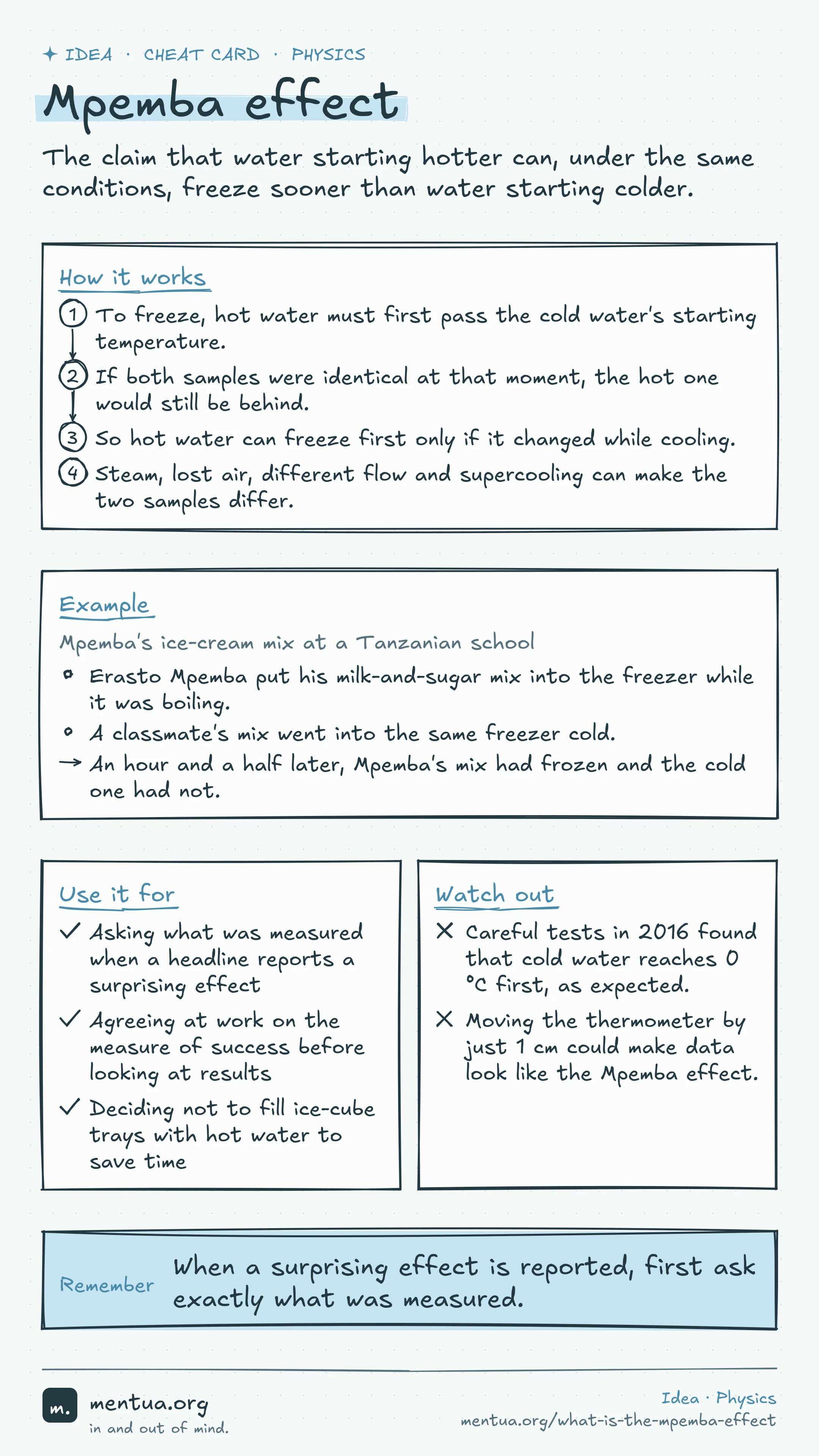
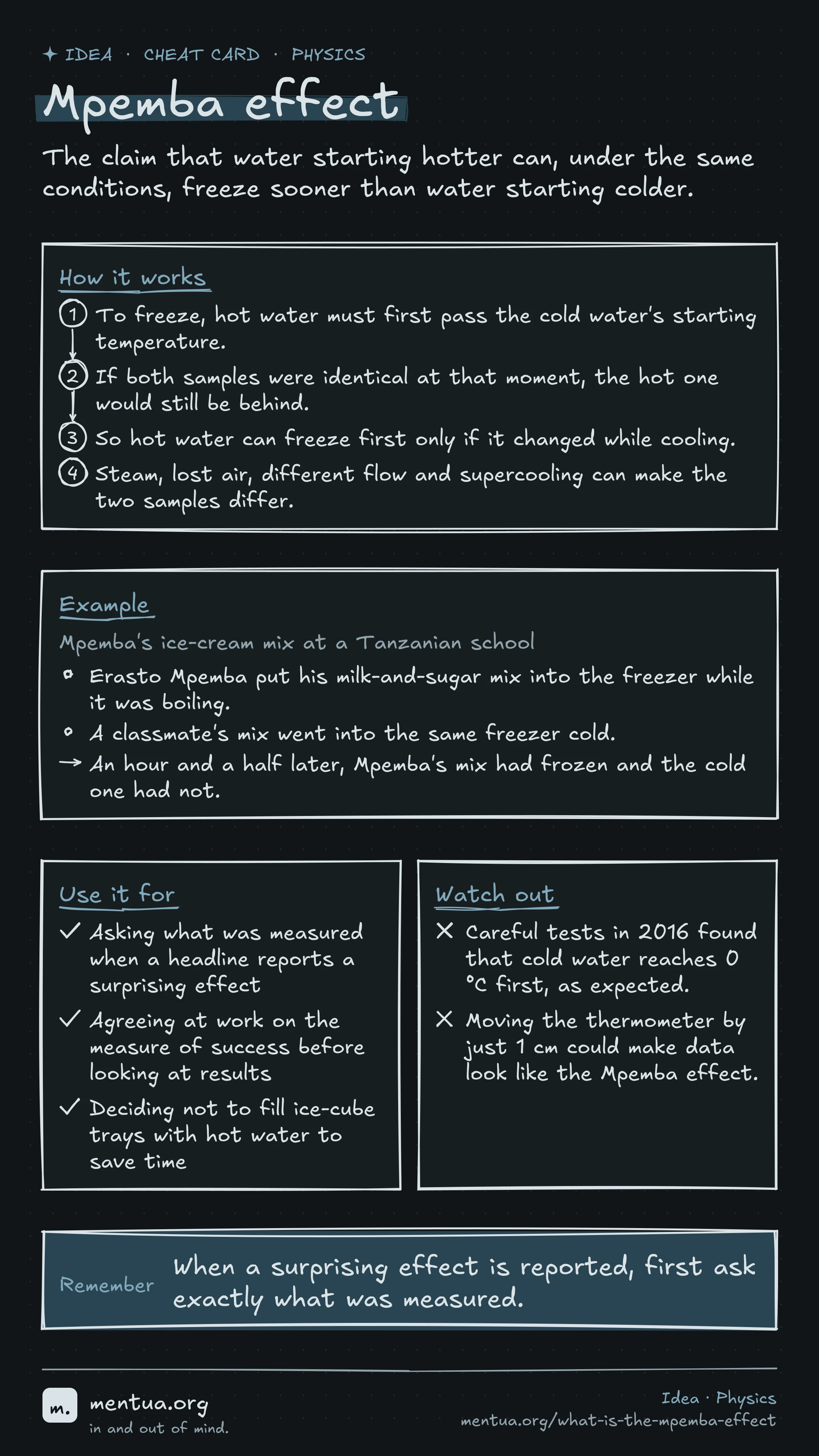
The whole idea on one page. Tap to open it full size, download it below, or test yourself against it tomorrow.
Download
- Light card · PNG image, 363 KB
- Dark card · PNG image, 371 KB
- Printable light card · PDF, searchable, 23 KB
Read the card as text
Mpemba effect: The claim that water starting hotter can, under the same conditions, freeze sooner than water starting colder.
How it works
- To freeze, hot water must first pass the cold water's starting temperature.
- If both samples were identical at that moment, the hot one would still be behind.
- So hot water can freeze first only if it changed while cooling.
- Steam, lost air, different flow and supercooling can make the two samples differ.
Example: Mpemba's ice-cream mix at a Tanzanian school
- Erasto Mpemba put his milk-and-sugar mix into the freezer while it was boiling.
- A classmate's mix went into the same freezer cold.
- → An hour and a half later, Mpemba's mix had frozen and the cold one had not.
Use it for
- Asking what was measured when a headline reports a surprising effect
- Agreeing at work on the measure of success before looking at results
- Deciding not to fill ice-cube trays with hot water to save time
Watch out
- Careful tests in 2016 found that cold water reaches 0 °C first, as expected.
- Moving the thermometer by just 1 cm could make data look like the Mpemba effect.
Remember: When a surprising effect is reported, first ask exactly what was measured.
References
- Cool?. Erasto B. Mpemba and Denis G. Osborne, Physics Education 4 (3), 172–175, 1969
The original paper, with Mpemba's account of the ice cream and Osborne's first experiments.
- Questioning the Mpemba effect: hot water does not cool more quickly than cold. Henry C. Burridge and Paul F. Linden, Scientific Reports 6, 37665, 2016
A history of the claim from Aristotle onwards, a review of earlier experiments and careful new measurements, freely readable.
- Exponentially faster cooling in a colloidal system. Avinash Kumar and John Bechhoefer, Nature 584, 64–68, 2020
A reproducible Mpemba-like effect for a tiny particle in water, under conditions designed in the laboratory.