What Is the Planning Fallacy?
5 min read≈ 1,200 words3 questions · up to 3 points
What this is about
Students often know that their papers take longer than planned, yet a group of thesis students in Canada still gave estimates that were far too short. You learn what a 1994 study of these students found, why knowing your plan in detail makes the forecast worse, and a simple method that governments now use to estimate large projects.
In a nutshell· skip ahead
The planning fallacy is the tendency to predict that your own task will take less time, cost less and go more smoothly than similar tasks have gone in the past, even when you know those earlier tasks ran late. It happens because people picture the steps of their own plan and leave out the delays that usually interrupt plans.
Thirty-seven psychology students at the University of Waterloo in Canada were in the final semester of their honours thesis course when an interviewer phoned them and asked a simple question: when will you hand it in? In a classroom survey by the same researchers, students said they had finished about two thirds of their earlier projects later than expected. So why would their thesis estimates turn out any better?
Why do we expect our own projects to go faster than they do?
The planning fallacy is the tendency to predict that your own task will take less time, cost less and go more smoothly than similar tasks have gone in the past, even when you know those earlier tasks ran late. Daniel Kahneman and Amos Tversky gave it its name in 1979, and the Waterloo study, published in 1994 by Roger Buehler, Dale Griffin and Michael Ross, is one of the clearest measurements of it.
The thesis study had four steps.
- The best guess. Each student was asked to predict as accurately as possible when they would submit the thesis. The average answer was 33.9 days from the day of the call.
- Two more guesses. The students also predicted the date if everything went as well as it possibly could (27.4 days on average) and if everything went as badly as it possibly could (48.6 days).
- The real date. The coordinator of the thesis course recorded when each thesis arrived. For the 33 students who finished, the average was 55.5 days, about three weeks later than their best guess.
- The result. Only 29.7% of the students finished by their best guess, and only 48.7% finished by the date they had given for the case where everything went wrong.
That last number is the surprising one: more than half the students missed a deadline meant to include every possible problem, near the end of a project they knew well.
Why does knowing your project well not protect you? In a third study, the researchers asked students to think aloud while they predicted when they would finish a school assignment. About 74% of their thoughts were about the future, mostly about how they planned to do the work, while only about 7% were about their own past experience and 3% were about possible problems.
Kahneman called this the inside view: you look at the details of your own plan and imagine how it will unfold. A plan only contains the steps you intend to take, so it leaves out the illness, the extra work and the other interruptions that you cannot foresee one by one but that almost always arrive. When the students did think about earlier delays, they explained them as caused by outside events that were unlikely to happen again, so their past experience seemed irrelevant to the new task.
What the planning fallacy teaches you
The useful question before any deadline is not “How long will my plan take?” but “How long did tasks like this really take, for me or for people like me?” Kahneman called this second way of thinking the outside view: you start from the real results of similar tasks, which already include the usual delays, and only then adjust for what makes your case different.
- Studies. If your last three essays each took twice as long as planned, use that record to set the start date of the next one, instead of a new and more careful plan.
- Home and work. A move, a kitchen renovation or a software feature has a track record. Asking people who have done the same thing gives you a better date than adding up the steps on your list.
- Public projects. The Sydney Opera House was estimated in 1957 to be finished in early 1963 for 7 million dollars, and a reduced version opened in 1973 at a cost of 102 million.
The planner Bent Flyvbjerg turned the outside view into a method for large projects called reference class forecasting. You choose a group of finished projects similar to yours (the reference class), look at how far their costs and times went beyond the first estimate, and place your project within that range. In his data, rail projects cost on average 44.7% more than forecast and roads 20.4% more. In 2004 the British Department for Transport and the Treasury began to use the method to adjust the budgets of large transport projects.
Where does the idea stop working?
The most common misreading is that everything is always late, so you should be as pessimistic as possible. The thesis study shows why this does not work: the worst-case guesses were less optimistic, but they were no more accurate than the best guesses, because they missed the real date by about the same number of days on average. Still, students who predicted a longer time really did take longer. The error is a steady shift toward the short side, not random noise, which is why data from similar tasks can correct it.
The planning fallacy is also about your own tasks. In the fifth study of the 1994 paper, observers who predicted how long other students would take made more use of those students’ past experience and actually overestimated their completion times. A friend’s or a manager’s estimate of you can therefore err in the other direction.
For large public projects, psychology is not the whole story. Flyvbjerg argues that low cost estimates are often given on purpose because they help a project win approval, which he calls strategic misrepresentation. An outside view corrects both causes, but it only works when a fair reference class exists, and for something truly new there may be none. Many later studies, reviewed by Buehler and his colleagues in 2010, found the effect again. Most of them concern students and everyday tasks, and the size of the delay varies a lot between kinds of task.
Learn more
The planning fallacy goes back to Daniel Kahneman and Amos Tversky, two Israeli psychologists, who named it in a 1979 paper on how experts make forecasts and recommended starting each forecast from data on similar cases. Kahneman later told how his own team began writing a high school curriculum in Israel and expected to need 18 to 30 months. A curriculum expert on the team admitted that about 40% of similar teams had given up and that none had finished in less than seven years, and the team finished eight years later. Buehler, Griffin and Ross measured the effect in five studies in 1994, and Flyvbjerg brought the outside view into project planning.
Kahneman’s own account of the curriculum project and the outside view is in “Thinking, Fast and Slow” by Daniel Kahneman: Summary and Review. Kahneman’s team continued long after the warning, and What Is the Sunk Cost Fallacy? explains why people keep investing in a late project because of what they have already spent. A first estimate can also pull later ones toward it, which What Is the Anchoring Effect? describes.
Quiz
3 questions · up to 3 points
Open a question and pick one answer. Only your first answer counts: +1 if it is right, −1 if it is wrong.
In the 1994 study by Buehler, Griffin and Ross, how did students' thesis estimates compare with the time they really needed?
Show answer
They expected about 34 days and needed about 56, and fewer than half finished by their worst-case date. This is the main result of the first study: the average best guess was 33.9 days, the real average 55.5 days, and only 48.7% finished by the date they gave for the case where everything went badly.
Maya plans to renovate her kitchen and wants a realistic date for the end of the work. What would help her most?
Show answer
Asking several people who renovated similar kitchens how long their work actually took. This is the outside view: it starts from the real results of similar projects, which already include the delays that a step-by-step plan leaves out.
Which statement about the planning fallacy is correct?
Show answer
It is about your own plans, and observers in the 1994 research even overestimated how long others would take. In the fifth study, observers used past experience more and predicted longer times than the actors, so the bias is about how people judge their own tasks.
Your points are saved only in this browser for now. Accounts that keep them for good are on the way.
Continue learning: "Thinking, Fast and Slow" by Daniel Kahneman: Summary and Review →The takeaway
The planning fallacy is the tendency to expect your own task to finish sooner and cost less than similar tasks did before, because you picture your plan and ignore how long such tasks usually take. In a 1994 study, thesis students expected to need 34 days and needed 56, and fewer than half finished even by their worst-case date. Large projects also run late because low estimates help win approval, and other people may overestimate your time. Before you set a deadline, check how long similar tasks really took.
Cheat card
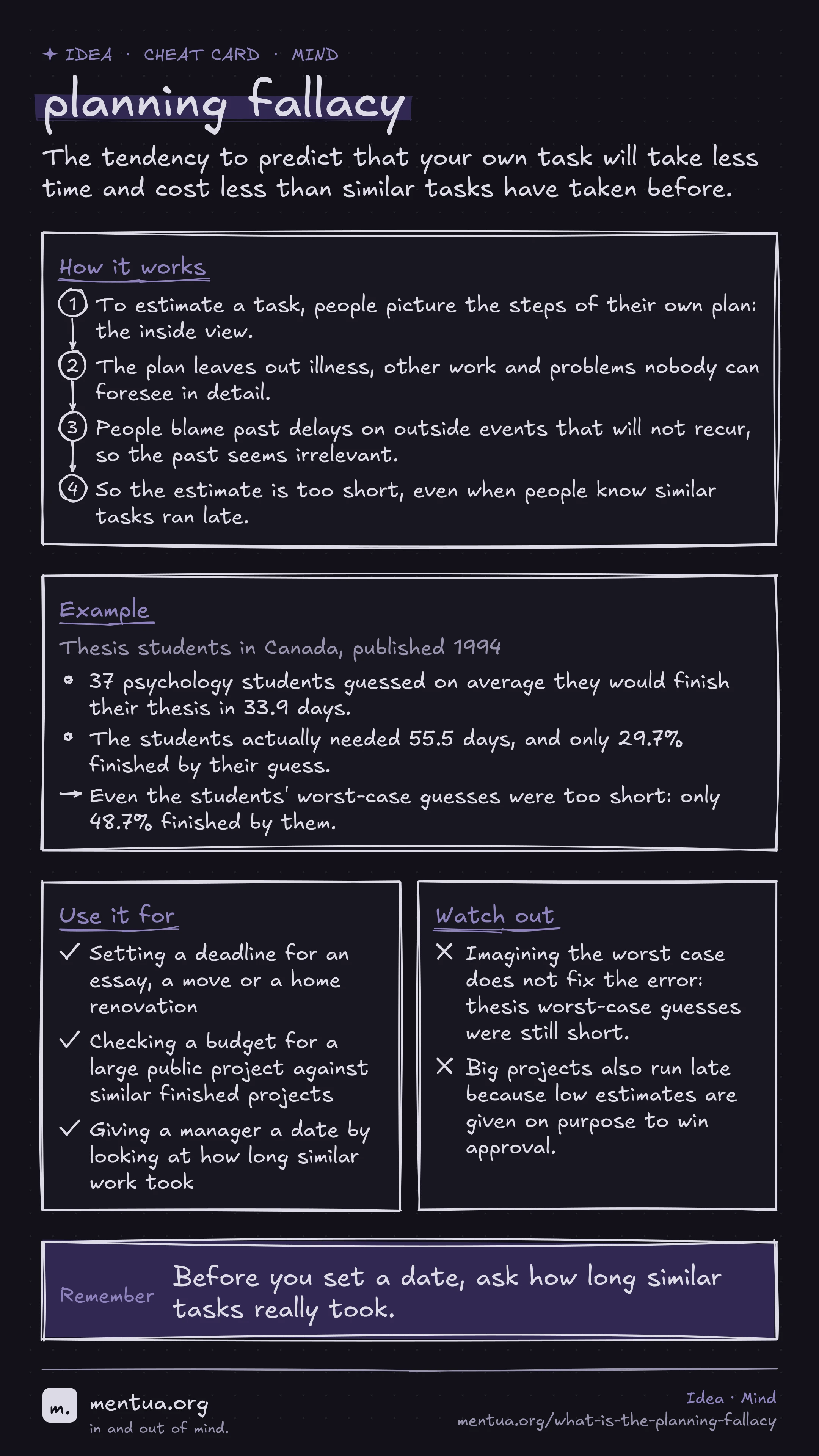
The whole idea on one page. Tap to open it full size, download it below, or test yourself against it tomorrow.
Download
- Light card · PNG image, 397 KB
- Dark card · PNG image, 403 KB
- Printable light card · PDF, searchable, 24 KB
Read the card as text
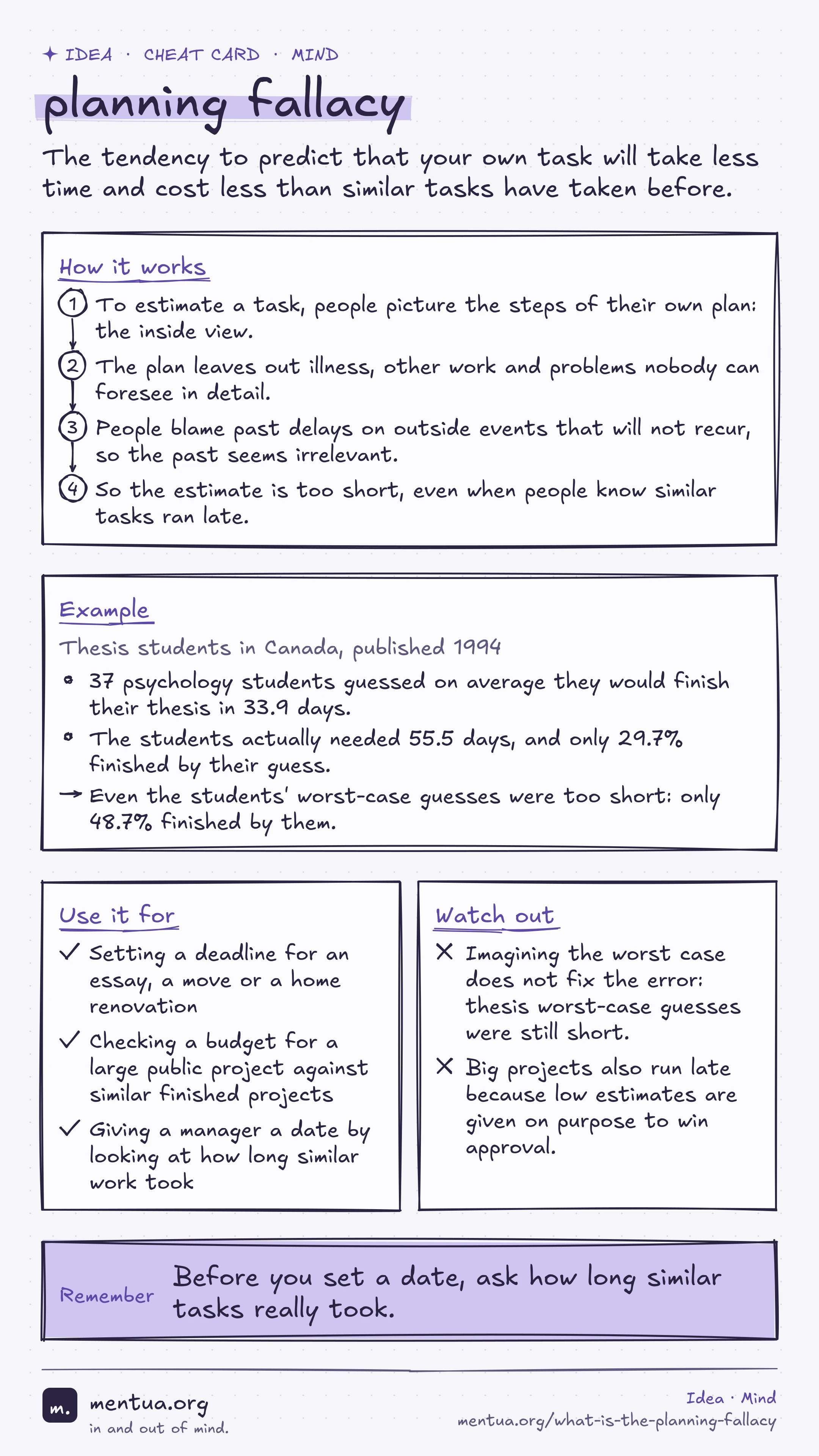
planning fallacy: The tendency to predict that your own task will take less time and cost less than similar tasks have taken before.
How it works
- To estimate a task, people picture the steps of their own plan: the inside view.
- The plan leaves out illness, other work and problems nobody can foresee in detail.
- People blame past delays on outside events that will not recur, so the past seems irrelevant.
- So the estimate is too short, even when people know similar tasks ran late.
Example: Thesis students in Canada, published 1994
- 37 psychology students guessed on average they would finish their thesis in 33.9 days.
- The students actually needed 55.5 days, and only 29.7% finished by their guess.
- → Even the students' worst-case guesses were too short: only 48.7% finished by them.
Use it for
- Setting a deadline for an essay, a move or a home renovation
- Checking a budget for a large public project against similar finished projects
- Giving a manager a date by looking at how long similar work took
Watch out
- Imagining the worst case does not fix the error: thesis worst-case guesses were still short.
- Big projects also run late because low estimates are given on purpose to win approval.
Remember: Before you set a date, ask how long similar tasks really took.
References
- Exploring the "Planning Fallacy": Why People Underestimate Their Task Completion Times. Roger Buehler, Dale Griffin and Michael Ross, Journal of Personality and Social Psychology 67 (3), 366–381, 1994
The five original studies, including the honours thesis survey, the think-aloud study and the observers who predicted other people's times.
- Intuitive prediction: Biases and corrective procedures. Daniel Kahneman and Amos Tversky, Judgment under Uncertainty: Heuristics and Biases, Cambridge University Press, 414–421, 1982
The reprint of the 1979 paper that named the planning fallacy and proposed starting a forecast from data on similar cases.
- From Nobel Prize to Project Management: Getting Risks Right. Bent Flyvbjerg, Project Management Journal 37 (3), 5–15, 2006
A free text on cost overruns in transport projects, the three steps of reference class forecasting and its first use by the British government in 2004.
- The Planning Fallacy. Roger Buehler, Society for Personality and Social Psychology, Character & Context blog, 2019
A short summary by the lead author of the 1994 study of what later research found and which remedies help.