What Is the Dichotomy of Control?
The Stoic idea that splits life into what is up to you and what is not: how it works, where it came from, and why aiming beats hitting.

In short
The dichotomy of control is the Stoic idea that some things are up to you and everything else is not. Up to you are your judgments, your intentions and your actions. Other people, results, your body and your reputation are not. Epictetus taught that you find calm and act well when you put your effort and your standards only on the first group.
Two students take the same exam. Both studied hard, and both get a question on a topic the teacher never covered. In the end they get the same grade. The first student is angry all weekend and goes over every answer again and again. The second student is disappointed for one evening and then starts on the next subject. Why do two people react so differently to the same result? A Greek philosopher who lived almost 2,000 years ago gave an answer that many people still use today.
What is up to us, and what is not
The answer is called the dichotomy of control. A dichotomy is a division into two parts. The idea is that everything in life belongs to one of two groups. Some things are up to you, and everything else is not. You find calm, and you act well, when you put your effort and your standards only on the first group.
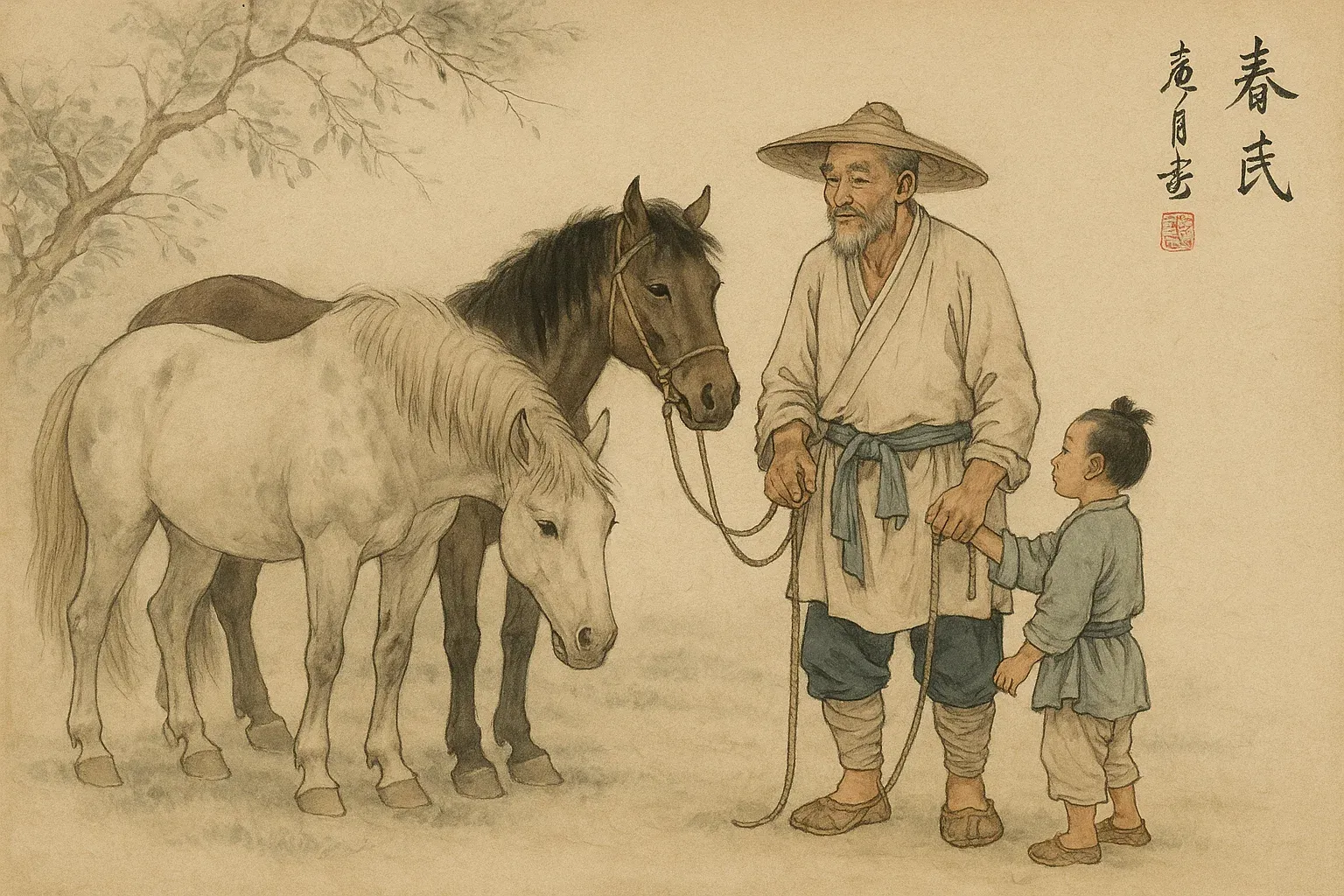
The idea comes from Epictetus, a philosopher of the Stoic school who taught in Greek. He put it at the very start of his handbook. Up to us, he said, are our opinions, our goals, and what we want or try to avoid. In short, everything that is our own action is up to us. Not up to us are our body, our property, our reputation and our position in society. In short, everything that is not our own action. Epictetus called the first group eph’ hêmin, which is Greek for “up to us”.
Now we can sort the exam into the two groups.
| Up to the student | Not up to the student |
|---|---|
| How many weeks to study | Which questions the teacher sets |
| Which chapters to study | How strictly the marker grades |
| Whether to practise with old exams | How well the rest of the class does |
| How much to sleep the night before | Whether a cold arrives on the morning of the exam |
| How calmly to react to a strange question |
The grade is in the second column. It comes from both columns together, but the student only controls the first one.
Epictetus drew a strict conclusion from this. If you treat the things in the second column as your own, you will feel blocked and upset, and you will blame gods and people. If you treat only the first column as your own, nobody can force you or stop you.
Now go back to the two students. The first student made his mood depend on the grade, and the grade was in the teacher’s hands. The second student made her mood depend on her preparation, which was in her own hands. She still wanted a good grade. She just did not let the grade decide whether her weekend was ruined.
Where the idea comes from: Epictetus
Epictetus had a personal reason to ask what truly belongs to us. For a large part of his life, he did not even own himself. He was born around 55 CE in Hierapolis, a Greek city in what is now south-western Turkey. As a boy he came to Rome as a slave. His owner was Epaphroditus, a powerful former slave who had worked for the emperor Nero.
While Epictetus was still a slave, he studied with the Stoic teacher Musonius Rufus. Later he was freed. Around the year 89, the emperor Domitian sent all philosophers away from Rome. Epictetus moved to Nicopolis in north-western Greece and opened a school there.
Epictetus did not write anything himself. His student Arrian wrote down his lectures, which we know as the Discourses. Arrian also collected the most important points in a short handbook, the Enchiridion. The first sentence of this handbook states the dichotomy of control.
The Stoics also had a favourite picture for this attitude. The Roman writer Cicero recorded it in his dialogue On Ends. Imagine an archer. Everything that makes good archery is up to the archer: the training, the stance and the aim. But whether the arrow hits also depends on the wind, and the target may move. So the archer’s real goal is to shoot as well as possible. Hitting the target is something the archer prefers, but it is not the measure of success. Cicero put it like this:
the actual hitting of the mark would be in our phrase ‘to be chosen’ but not ‘to be desired.’
The old translation sounds strange today. It means that the archer is right to aim at a hit and to prefer it. But the archer’s success does not depend on the hit.
How people use it: from a prison camp to a job interview
People have tested the idea in much harder situations than an exam. On 9 September 1965, the American pilot James Stockdale was shot down over North Vietnam. He spent the next seven years in the prison known as the “Hanoi Hilton”. Four of these years he spent alone in a cell, and two of them in leg irons.
Stockdale was the highest-ranking officer among the prisoners, so he wrote rules of behaviour for the others. According to the ethics center of the U.S. Naval Academy, which is named after him, these rules drew largely on Epictetus’ handbook. The guards controlled almost everything in Stockdale’s life. What stayed up to him was how he behaved, and he made that his whole task.
Most uses are much more ordinary. Here are three situations that many readers know.
- Nerves before a performance. Worry usually focuses on the second column, such as what the interviewer will think or whether the audience will like your talk. You can move your attention to the first column instead: your preparation, your first sentence, the questions you will ask. This does not guarantee success. But it gives your nervous energy something useful to do.
- Conflicts with other people. You cannot make a friend say sorry or make a parent understand you. You can decide what you say, how honest you are, and what you will do if nothing changes. Many arguments go in circles because both people try to control the other person’s reaction.
- Bad news. The news is full of events you cannot change. They create strong feelings but little action. Try sorting each worry into two groups. Up to you are how you vote, what you give, and how you treat the people affected. Everything else is not up to you. The first group is short, and you can act on it.
The same idea appears outside philosophy. Cognitive behavioural therapy, a common form of talk therapy, teaches people to separate a situation from the way they interpret it. The Serenity Prayer, a short prayer used in many support groups, asks for the courage to change what can be changed and the calm to accept what cannot. Epictetus would have recognised both.
Does it mean you should stop caring about results?
No. This is the most common misunderstanding. The archer still wants to hit, and the student still wants a good grade. But wanting a result is different from making your well-being depend on it. A Stoic prefers health to illness and success to failure, and works hard for both. The Stoic only refuses to let them decide whether life is going well.
Where the idea is too simple
The idea has three weak points. The first is the strongest objection. Most important things do not fit into either column. Your grade, your health and your friendships are neither fully up to you nor fully out of your hands. What you do shapes them, but it does not decide them.
For this reason, the philosopher William Irvine suggested a trichotomy of control in his book A Guide to the Good Life (2009). A trichotomy is a division into three parts. Irvine added a middle group for things you can influence but not decide, such as winning a tennis match. His advice for this group is to replace goals about results with goals about your own behaviour. Your goal is then “play as well as I can” instead of “win the match”. This is very close to Cicero’s archer. So the ancient Stoics probably already handled the middle group through the way they set their goals.
The second weak point is political. If you accept what you cannot change, do you stop trying to change things? Read carefully, the idea says the opposite. It puts all your effort into the part of the world you can move, and that includes speaking up, working with others and voting. What it removes is the anger that comes from demanding that the rest of the world obey you. Still, people sometimes use the idea as an excuse to do nothing. Watch out for this misuse when you meet it.
The third weak point is that the line between the two columns is less clear than Epictetus suggests. Psychology shows that sleep, mood and habit shape even our judgments and wishes. So “up to me” is often a matter of practice, not a simple switch. The Stoics would agree. They treated the dichotomy as an exercise for every day, not as an insight you understand once.
Go deeper
Epictetus’ handbook is short enough to read in an afternoon. Its first section is the source of everything in this piece, and the free text is linked in the references. For a modern and readable introduction, the best next step is William Irvine’s A Guide to the Good Life (Affiliate Link). It explains the trichotomy and includes practical exercises.
To see the idea at work in one person’s mind, read “Meditations” by Marcus Aurelius: Summary and Review. The emperor learned from Epictetus’ teaching and practised it again and again in his private notebook. If you prefer the idea in small daily portions, read Book Summary of “The Daily Stoic” by Ryan Holiday. It shows how the same principle runs through a year of Stoic readings.
The takeaway
Before a test, a talk or a hard conversation, write down the parts that are up to you and judge yourself only by those. Then you can care about the outcome without being ruled by it.
Test yourself
Answer from memory first, then open the answer.
1.According to Epictetus, which of these is up to you: your reputation, your health, or your judgment about an insult?
Show answer
Only your judgment about the insult. Reputation depends on what other people think, and health depends on your body and on chance; both can be influenced, but neither is fully up to you.
2.What does Cicero's archer show about how a Stoic should treat outcomes?
Show answer
The archer's real task is to aim as well as possible. Hitting the target is worth preferring, but it is not the goal by which the archer is judged, because wind and chance can always intervene.
3.You are applying for an internship. How would you turn 'get the internship' into a goal that is up to you?
Show answer
Replace it with goals you fully control: research the company properly, tailor the application, prepare answers to likely questions and ask for feedback afterwards. You still prefer to be accepted, but you measure yourself by the preparation and the conduct, not by the decision.
References
- Epictetus. William O. Stephens, Internet Encyclopedia of Philosophy
Epictetus' life as a slave and teacher, and his key concepts, including what is 'up to us'.
- The Enchiridion. Epictetus, The Internet Classics Archive, MIT
The full handbook online; the dichotomy of control is its first section.
- De Finibus Bonorum et Malorum, Book III. Cicero, LacusCurtius, University of Chicago
Latin and the Loeb English translation; the archer analogy is in section 22.
- Vice Admiral James Bond Stockdale. Stockdale Center for Ethical Leadership, U.S. Naval Academy
Stockdale's captivity in Hanoi and the role of Epictetus in his rules for fellow prisoners.