"QED" by Richard Feynman: Summary and Review
10 min read≈ 2,260 words5 questions · up to 5 points
What this is about
Why does a sheet of glass reflect about 4 percent of the light that falls on it, and why does a thicker sheet sometimes reflect four times as much? You learn how Richard Feynman answers this and much more with a single rule about little arrows, what his four lectures cover, and why readers find this short book harder than its size suggests.
The book in three sentences· skip ahead
QED argues that the behaviour of light and electrons, from mirrors and lenses to chemistry, follows from one strange rule. Every way an event can happen gets a little arrow, the arrows are added, and the squared length of the final arrow is the probability. Feynman teaches the rule with glass and mirrors, extends it to electrons with three basic actions, and admits what the theory still cannot explain.
QED: The Strange Theory of Light and Matter
- Author
- Richard P. Feynman
- Published
- 1985
- Publisher
- Princeton University Press (Princeton Science Library, 2014), with an introduction by A. Zee
- Length
- 190 pages
- Best for
- Curious readers who want to learn how quantum physics really calculates something, and who are willing to read slowly and follow diagrams.
Richard Feynman promised a general audience something most popular science books avoid: to explain the actual working rules of quantum electrodynamics, the theory of how light and electrons behave, without pretending they make sense. QED: The Strange Theory of Light and Matter came out in 1985 and grew from four public lectures. Feynman first gave them as the Sir Douglas Robb lectures at the University of Auckland in New Zealand in 1979, and then as the first Alix G. Mautner Memorial Lectures at the University of California, Los Angeles, in 1983. Ralph Leighton transcribed the lectures and edited them into a book.
Feynman had shared the 1965 Nobel Prize in Physics with Julian Schwinger and Sin-Itiro Tomonaga for building this very theory, so the book is the inventor explaining his own tool.
What kind of book this is
The book has four chapters, one per lecture: “Introduction”, “Photons: Particles of Light”, “Electrons and Their Interactions” and “Loose Ends”. It runs to about 150 pages of text, with many small figures. The current Princeton edition adds an introduction by the physicist Anthony Zee, written in 2006. Zee explains that Feynman went against the usual advice for popular books, which is to give readers a feeling of understanding and a few words to repeat at parties. In his acknowledgment, Feynman complains that such books reach simplicity by describing something distorted, and he sets himself the task of explaining the real theory instead.
That task shapes everything. Feynman does not tell you why nature behaves as it does, because, he says at once, no one knows. He tells you how it behaves, precisely enough that you can calculate some results yourself.
While I am describing to you how Nature works, you won’t understand why Nature works that way.
This review follows his argument in seven ideas.
Light is made of particles (“photons”), and detectors prove it
The first chapter starts by settling an old question: light comes in photons, small lumps that always arrive whole. Feynman compares them to raindrops and describes a detector so sensitive that very dim light makes it click, one photon at a time. The clicks never come in halves, and every instrument sensitive enough to detect weak light has found the same lumps. So for Feynman, light behaves like particles, and the familiar wave picture is something to be explained, not assumed.
Then he sets the puzzle that runs through the whole book. When light falls on a sheet of glass, about 4 photons in 100 are reflected from the surface and the rest pass through. If each photon is whole, how does one photon “decide” whether to bounce back? Feynman shows that simple explanations, which look for something special in the glass or in the photon, fail as soon as you change the thickness of the glass.
Every way an event can happen gets a “little arrow”
Feynman’s answer is the central idea of the book: for every way an event can happen, you draw a little arrow, which physicists call a probability amplitude. You add the arrows for all the different ways, placing them nose to tail, and the square of the length of the final arrow is the probability of the event. He makes the direction of each arrow concrete with an imaginary clock hand that turns while the photon travels, so a longer trip gives an arrow that points in a different direction.
All we do is draw little arrows on a piece of paper
The rule solves the glass puzzle, because reflection can happen in two ways, from the front surface or from the back surface, and each way gets an arrow. As the glass gets thicker, the arrow for the back surface turns further, and the two arrows sometimes point the same way and sometimes opposite ways. This is why the reflection rises and falls with thickness, from almost nothing to about 16 percent, which is four times the 4 percent of a single surface. Ordinary probabilities could never do this, because they only add, while arrows can cancel.
Feynman uses the same two arrows to explain the colours of soap bubbles and thin films of oil, because the thickness at which the arrows add up is different for each colour of light.
Zee adds a useful note for readers who know some mathematics: the arrows are complex numbers, a point that Feynman makes only in a footnote. You do not need to know this to follow the book, but it tells you that the “simple” arrows are the real machinery of quantum theory and not a cartoon of it.
Light takes every path, and most of them cancel
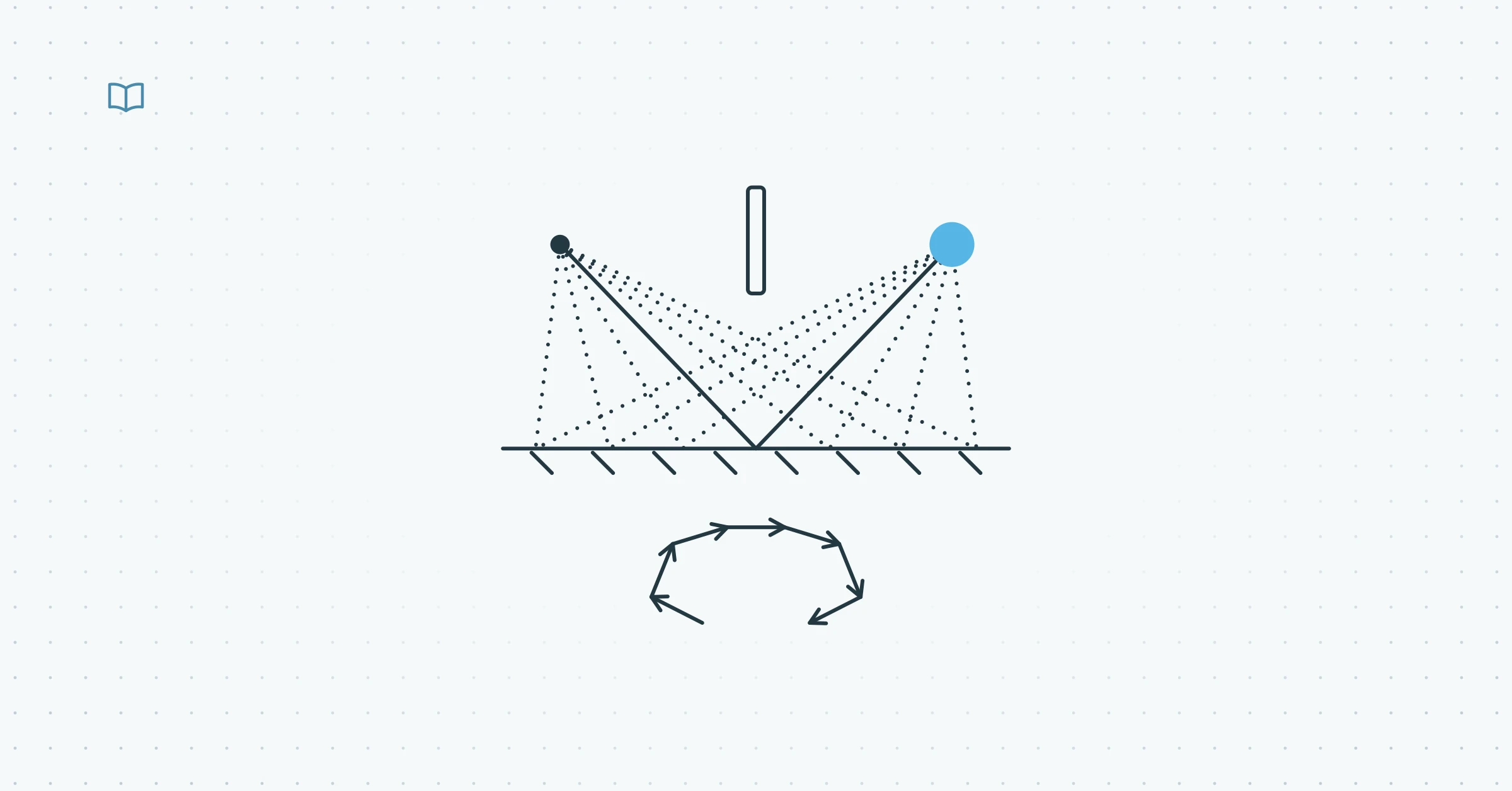
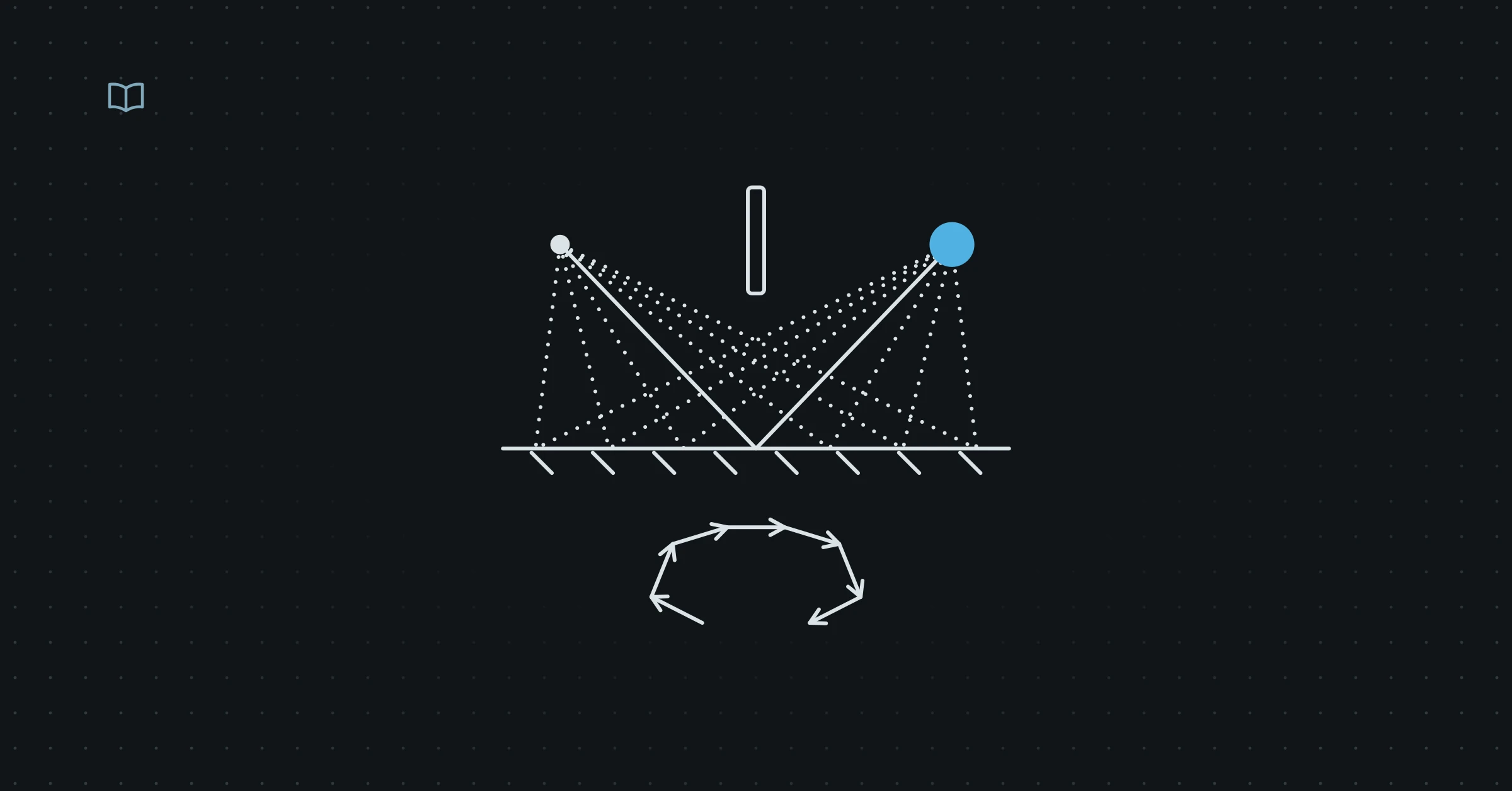
The second chapter uses the same rule to rebuild ordinary optics, and here the book is at its most surprising. When you see a lamp in a mirror, Feynman says, light reaches your eye from every part of the mirror, not only from the point where the angle in equals the angle out. Each path gets an arrow. The paths near the shortest one take almost the same time, so their arrows point almost the same way and add up. The paths near the edges differ more from each other, so their arrows turn in circles and cancel.
Feynman proves this with a test you could try. If you scrape away the strips at the edge of the mirror whose arrows point the wrong way, the remaining strips suddenly reflect light strongly in a new direction. That is a diffraction grating, a surface with fine regular lines that sends different colours of light in different directions. The same reasoning explains why light seems to travel in straight lines and how a lens focuses. Zee singles out the lens as a favourite: glass slows the light on the short paths just enough that all the arrows turn by the same amount and add up at one point.
Electrons follow the same rules, with three basic actions
The third chapter brings in matter. Electrons obey the same arrow rules as photons, and Feynman reduces all of quantum electrodynamics to three basic actions. A photon goes from one place and time to another, an electron goes from one place and time to another, and an electron emits or absorbs a photon. Every process, from light bouncing off glass to the chemistry of atoms, is built from combinations of these three actions, each with its own arrow.
To keep track of the combinations, Feynman draws simple pictures of straight and wiggly lines, the diagrams that now carry his name. Here the book returns to the puzzle of chapter 1. Feynman had already warned that a photon in glass interacts with electrons throughout the glass, not just on the surface. Now he shows that the combined arrows of all those electrons add up to the same result as the two arrows of the front and back surfaces, so the simple rule from chapter 1 was right for a deeper reason. Feynman also admits that for real atoms the diagrams would contain so many lines that they would be a complete mess, and physicists use other methods there.
The theory agrees with experiment to an extraordinary degree
Feynman’s reason for trusting such a strange rule is that it works better than any other theory in physics. His main example is the magnetic strength of the electron, which QED calculates in steps of more and more complex diagrams, and which experiments measure directly. Feynman compares the agreement between the two numbers to measuring the distance from Los Angeles to New York, more than 3,000 miles, to within the width of a human hair.
The comparison is a little generous. The physicist Dan Styer has worked out that the accuracy of the time was closer to a millimetre over that distance, about ten human hairs. He also points out that Feynman’s story of the calculation, in which two “independent” groups made the same arithmetic mistake, does not quite match what happened. The main point stands, though, and has grown stronger: by 2012 theory and experiment agreed more than 600 times better than when Feynman wrote.
QED has a weak spot: “a dippy process” and a number nobody can explain
The last chapter turns from success to doubt, and this honesty is one of the book’s best qualities. Calculations in QED at first give infinite answers, because an electron can interact with itself at zero distance. Physicists remove these infinities with a procedure called renormalization, which replaces some calculated values with the measured mass and charge of the electron. Feynman, who helped develop it, calls it “a dippy process” and says that this kind of trick has kept anyone from proving that the theory is mathematically consistent.
He then points to a second open question. The strength with which an electron emits or absorbs a photon, the coupling constant, is a pure number of about 1/137. The theory needs it, but it cannot say where it comes from, and no one has derived it from anything deeper. Feynman calls this one of the greatest mysteries of physics, using a stronger word than “great”.
The same pattern may describe the other forces
The final pages leave QED and look at the rest of physics as it stood in the early 1980s. Feynman sketches how quarks and gluons in the atomic nucleus and the weak force behind some radioactive decay seem to follow rules of the same kind, with arrows and diagrams, though with harder details. He asks why the theories look so similar and offers three answers: physicists may only be able to think of the same idea again and again, nature may really repeat itself, or the forces may be aspects of one thing. He does not choose between them, and he gives gravity, the force that fits least well, only a page.
This section is short and lighter than the rest, with some teasing of Murray Gell-Mann, Feynman’s rival at Caltech.
How it differs from other books on modern physics
QED belongs to a small group that Zee calls “extra-difficult popular physics books”, between a textbook and a normal popular book. Three comparisons show what that means.
- Stephen Hawking’s A Brief History of Time (1988) covers far more ground, from the Big Bang to black holes, but mostly describes results rather than showing how they are calculated. Zee tells of a colleague and himself failing to make sense of one of its sentences, and contrasts it with QED, where every sentence makes sense if you think about it. Read the review of A Brief History of Time if you want the wider picture.
- Carlo Rovelli’s The Order of Time (2017) is also written by a physicist about his own field, but it is lyrical and philosophical, while Feynman refuses to interpret anything. The review of The Order of Time shows a book that asks what physics means; QED only asks what it does.
- Feynman’s own The Character of Physical Law (1965), from his Messenger Lectures at Cornell University in 1964, covers physics in general and gives quantum mechanics one lecture. It is easier and broader. QED is narrower and goes much deeper into one theory.
What makes QED unique is the method. Zee compares it to teaching someone to multiply 564 by 253 by filling 564 jars with 253 pebbles each and counting them. You will not calculate efficiently this way, but you will understand exactly what the calculation means.
Where it falls short
The book has three weaknesses. The first is difficulty. The prose is relaxed and funny, but the ideas pile up, and a reader who misses one step in the arrow rules is lost in the next chapter. Zee warns readers to think about each sentence before moving on, and he notes that Feynman explains less and less from scratch as the book goes on. In chapter 3, the rules for how electrons move are mostly stated, and you have to take his word for them.
The second weakness is a few exaggerations. Feynman says the uncertainty principle is not needed when you use arrows. Zee calls this “a bit of an exaggeration”, because the arrow method is mathematically equivalent to the usual formulations of quantum mechanics and contains the uncertainty principle. The story of the magnetic moment calculation is simplified, as Styer shows, and the hair comparison is generous by a factor of about ten.
The third weakness is age. The last chapter describes particle physics as it stood in the early 1980s, and it leaves out everything since, including the detection of the Higgs boson in 2012. The QED part has not aged at all, but the outlook has.
Which edition and format to choose
Choose the Princeton paperback with Zee’s introduction and read it in print, with a pencil. The argument lives in the figures: chains of arrows, mirrors divided into strips, diagrams with wiggly lines. A print copy lets you go back to them while you read, and a fixed-layout ebook on a large tablet works too. No Audible edition was found, and an audio version would lose most of the figures. If you want to hear Feynman’s voice, the 1979 Auckland lectures exist as video recordings. Do not worry if the last two chapters are harder going. As Zee says, even if you only get through the first two chapters, you will have learned a lot.
Quiz
5 questions · up to 5 points
Open a question and pick one answer. Only your first answer counts: +1 if it is right, −1 if it is wrong.
According to Feynman, how do you get the probability of an event in quantum electrodynamics?
Show answer
Draw an arrow for each way it can happen, add the arrows nose to tail, and square the final arrow's length. This is the central rule of the book. The arrows can point in different directions, so adding them can make the final arrow longer or shorter.
Why does the share of light reflected by a sheet of glass change when the sheet gets thicker, in Feynman's account?
Show answer
The arrows for reflection from the front and the back surface turn by different amounts, so they sometimes add up and sometimes cancel. The arrow for the back surface turns more as the glass gets thicker. Depending on the angle between the two arrows, reflection runs from about 0 to about 16 percent.
What does Feynman say about the light that reaches your eye from a mirror?
Show answer
Light comes from every part of the mirror, but the arrows from the edges cancel, leaving the part near the usual reflection point. The arrows for paths near the shortest path point almost the same way and add up. If you scrape away the right strips at the edges, the edges reflect too, which is how a diffraction grating works.
What does Feynman say about renormalization, the method used to remove infinite results from QED calculations?
Show answer
He calls it a 'dippy process' and suspects that it keeps physicists from proving that the theory is mathematically consistent. Feynman helped invent the method and was proud of the theory's precision, but in the last lecture he openly calls the trick unsatisfying.
What does this review suggest about how to read QED?
Show answer
Read it slowly in print, follow every diagram with a pencil, and expect the first two chapters to teach you the most. The arrows and figures carry the argument, and Zee's introduction warns that you must think about each sentence before moving on.
Your points are saved only in this browser for now. Accounts that keep them for good are on the way.
Continue learning: "A Brief History of Time" by Stephen Hawking: Summary and Review →The takeaway
QED by Richard Feynman explains quantum electrodynamics, the theory of light and electrons, with one rule: each way an event can happen gets a 'little arrow', and the squared length of the sum of the arrows gives the probability. With it he explains partial reflection, mirrors, lenses and electrons, and shows the theory's record precision and its unsolved problems. The book is short but hard, so read it slowly with a pencil. When you meet a strange result, ask which possibilities add up and which cancel out.
Key quotes
“All we do is draw little arrows on a piece of paper”
“It's one of the greatest damn mysteries of physics”
“It is the physics that is bizarre, not the presentation.”
Should you read it?
Read it if
- You want to understand what physicists mean by probability amplitudes, and to use them yourself on simple cases such as reflection from glass.
- You are tired of popular books that only say quantum physics is strange and want to see the actual rules.
- You are a student thinking about physics and want to see what quantum field theory is about before you study it.
Skip it if
- You want a broad, relaxed tour of modern physics; this book stays with one theory and asks for close attention on every page.
- You want the history of quantum theory, or a discussion of what it means philosophically; Feynman refuses to interpret it.
- You want up-to-date particle physics; the last chapter on quarks and unification dates from the early 1980s.
As an Amazon Associate, mentua.org earns from qualifying purchases. It costs you nothing and never shapes the verdict.
References
- QED: The Strange Theory of Light and Matter. Richard P. Feynman, introduction by A. Zee, Princeton University Press
The publisher's page for the Princeton Science Library edition described in this review.
- Introduction to the 2006 Edition. A. Zee
A physicist's honest guide to the book: why it is hard, what the arrows really are, and where Feynman exaggerates.
- QED: The Strange Theory of Light and Matter (review). Al Hibbs, Engineering & Science (Caltech), March 1986, 1986
A one-page review from the year after publication that sums up the arrow method and its limits.
- Calculation of the anomalous magnetic moment of the electron. Dan Styer, Oberlin College, 2012
Corrects the book's history of the famous calculation and gives today's far more precise values.