"The Structure of Scientific Revolutions" by Thomas Kuhn: Summary and Review

10 min read≈ 2,130 words5 questions · up to 5 points
What this is about
Almost everyone has heard the phrase "paradigm shift", but few people know what the physicist and historian who made it famous actually claimed about how science works. You learn the main ideas of Thomas Kuhn's book in his own terms, how he revised them seven years later, and what his strongest critics objected to. You also learn which edition to buy and which parts to read first.
The book in three sentences· skip ahead
Kuhn argues that a mature science spends most of its time in "normal science", solving puzzles inside a shared framework he calls a paradigm. Results that do not fit pile up until the field falls into crisis, and a revolution replaces the old paradigm with a new one that cannot be fully measured by the old standards. Science still progresses, Kuhn says, but as better puzzle-solving, not as a steady march toward a final truth.
The Structure of Scientific Revolutions
- Author
- Thomas S. Kuhn
- Published
- 1962
- Publisher
- University of Chicago Press, 50th anniversary (fourth) edition with an introductory essay by Ian Hacking, 2012
- Length
- 264 pages
- Best for
- Readers who want to understand where the idea of a paradigm shift comes from and how science changes its basic assumptions.
In 1962 an American physicist turned historian argued that science does not grow by adding one fact to another. Instead, it moves through long periods of routine work that are broken, from time to time, by revolutions after which scientists see their subject in a new way. Thomas Kuhn was finishing a doctorate in theoretical physics at Harvard when he helped teach a college course on physical science for non-scientists, and reading old scientific texts for it changed his career.
The Structure of Scientific Revolutions first appeared as a short monograph in the International Encyclopedia of Unified Science. The series was edited by Otto Neurath, Rudolf Carnap and Charles Morris, leading figures of logical empiricism, which is the movement whose view of science the book is often said to have undermined.
By its 50th anniversary the book had sold about 1.4 million copies, and it made “paradigm” and “paradigm shift” everyday words. In 1970 Kuhn added a long Postscript that answers his critics and narrows his key term, and the 50th anniversary edition of 2012 adds an introduction by the philosopher Ian Hacking. Kuhn’s main ideas follow here in the order of his argument, then the revision, the critics and the question of which edition to read.
A mature science starts when a “paradigm” unites the field
Kuhn’s first claim is that a field becomes a mature science when its members accept a shared paradigm, which he first defines as a recognized scientific achievement that for a time gives a community its model problems and solutions. Before that point, in what he calls the pre-paradigm period, every researcher starts from scratch, collects facts more or less at random and argues with rival schools about basic questions. Kuhn’s example is the study of electricity in the eighteenth century, where each school explained a different set of effects and none could explain them all.
A paradigm ends this situation because it tells researchers which facts matter, which problems are worth solving and what counts as a solution. Newton’s Principia, Lavoisier’s chemistry and Franklin’s theory of electricity each played this role in their fields. Kuhn’s point is that the paradigm comes first, and the rules and definitions that textbooks later state are drawn from it afterwards.
Most research is “normal science”, the patient solving of puzzles
Once a paradigm is in place, most scientists spend their careers on what Kuhn calls normal science: research that extends and sharpens the paradigm instead of questioning it. He compares this work to solving a puzzle, because the paradigm guarantees that a solution exists, and the scientist’s skill lies in finding it. Measuring a constant more precisely, applying a theory to a new case or making theory and experiment fit more closely are typical normal-science tasks.
Mopping-up operations are what engage most scientists throughout their careers.
Kuhn does not say this to belittle scientists. He argues that the narrow focus is what makes mature science so productive, because a community that does not debate its foundations every day can study nature in great detail. The price is that normal science does not look for new kinds of phenomena, and when a puzzle resists solution, the failure counts against the scientist, not against the paradigm.
Discoveries begin with an “anomaly”, a result the paradigm did not lead anyone to expect
This narrow focus is also what produces discoveries, which begin with an anomaly: a result that violates what the paradigm says should happen. Because normal science tells scientists exactly what to expect, they notice when something goes wrong, so the precision of a paradigm makes it a sensitive detector of its own failures.
Discovery commences with the awareness of anomaly, i.e., with the recognition that nature has somehow violated the paradigm-induced expectations that govern normal science.
Kuhn’s case studies are the discovery of oxygen in the 1770s and of X-rays in 1895. In both cases, he argues, a discovery was a process that took time, because scientists had to change their expectations before they could see what was in front of them. He supports this with a psychological experiment by Jerome Bruner and Leo Postman, in which people were shown playing cards for a moment, including a red six of spades. Most people at first reported a normal card, and only after longer exposures did they notice that something was wrong.
The same tendency to see what we expect is the subject of What Is Confirmation Bias?, and Kuhn treats it as part of how science works, not only as an error.
Anomalies grow into a “crisis”, but no paradigm is dropped without a replacement
When anomalies pile up or one of them touches the core of the theory, a field enters what Kuhn calls a crisis. His main example is astronomy before Copernicus, where the Ptolemaic system needed more and more corrections to match the observed positions of the planets. In a crisis, rules loosen, rival versions of the theory multiply, and some scientists start to discuss the philosophical foundations of their field.
Kuhn adds a claim that surprised many readers: scientists do not reject a paradigm because it fails a test. Every paradigm has unsolved problems, and many anomalies are eventually solved inside it, so a single failure proves little. According to Kuhn, the decision to reject one paradigm is always also the decision to accept another, because to work without any paradigm would be to stop doing science in that field.
A revolution replaces the paradigm, and rival paradigms are “incommensurable”
A scientific revolution, in Kuhn’s sense, is a change in which an older paradigm is replaced, in whole or in part, by an incompatible new one. His examples include the move from Ptolemy to Copernicus, from phlogiston to oxygen chemistry and from Newton to Einstein. Kuhn compares the choice between paradigms with the choice between rival political institutions, because the two sides do not agree on the rules by which the choice should be made.
He calls this situation incommensurability, a word borrowed from mathematics for quantities that have no common measure. Rival paradigms differ in which problems they think are important, in what counts as a good solution, and even in what key words mean: “mass” means something different for Newton and for Einstein. So the arguments of each side assume what they are trying to prove, and the choice depends on persuasion as well as evidence. Kuhn describes the change of allegiance as a kind of conversion that argument cannot force, and he notes that some scientists never make it.
This resistance is the human side of a scientific revolution, and Why Changing Your Mind Feels Like Losing, and Why It Costs Less Than You Think looks at the same reluctance to change your mind in everyday life.
After a revolution, scientists “work in a different world”
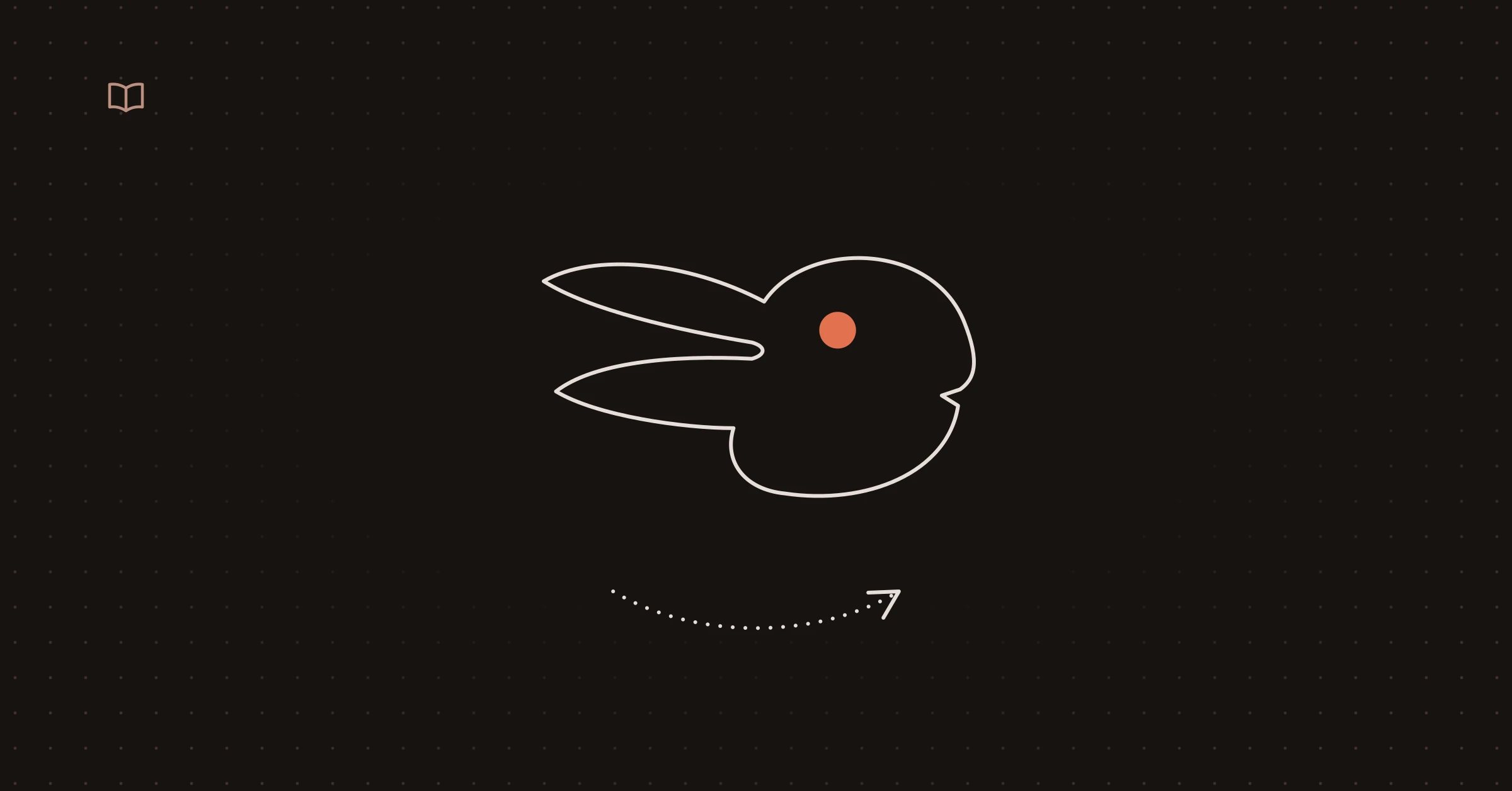
Kuhn’s boldest section argues that a change of paradigm changes what scientists perceive, which he compares to a gestalt switch: the sudden change in a drawing that can be seen either as a duck or as a rabbit. Where Aristotle saw a heavy body falling with difficulty, Galileo saw a pendulum, although both men were looking at a swinging stone.
What a man sees depends both upon what he looks at and also upon what his previous visual-conceptual experience has taught him to see.
Kuhn is careful about how far this goes: he writes that the world does not change with a paradigm, but the scientist afterwards works in a different world. Readers still argue about what that sentence means, and Kuhn spent much of his later career trying to state it more precisely.
Textbooks hide revolutions, and progress has no final goal
Revolutions, Kuhn argues, are usually invisible to later scientists, because textbooks rewrite the history of their field so that it looks like a straight line leading to the current theory. That is why scientists, and the public, tend to see science as the steady accumulation of truths, although the history Kuhn describes is full of breaks.
The last section asks the obvious question: if science changes its standards in each revolution, does it progress at all? Kuhn’s answer is yes, in the sense that later paradigms solve more puzzles more precisely, but he suggests giving up the idea that each change brings science closer to a final truth. He compares this with Darwin’s evolution, which also has no goal set in advance: science moves away from earlier, weaker states of knowledge instead of toward a fixed endpoint.
The 1969 Postscript turns the paradigm into a “disciplinary matrix” and “exemplars”
The Postscript is Kuhn’s answer to his critics, and it is required reading, because it repairs the book’s key term. Kuhn admits that one sympathetic reader had found the word “paradigm” used in at least twenty-two different ways. That reader was the philosopher Margaret Masterman, whose essay of 1970 counted at least twenty-one senses and sorted them into three groups.
Kuhn’s solution is to split the word in two. The broad sense, everything a scientific community shares, he renames the disciplinary matrix: its symbolic generalizations such as f = ma, its models and metaphysical commitments, its values, and its exemplars. The narrow sense he calls exemplars: the concrete problem-solutions that students meet in laboratories, examinations and at the ends of chapters in textbooks. By working through the inclined plane and the pendulum, a physics student learns to see a new problem as like one already solved.
Kuhn called shared examples the central element of what he now saw as the most novel and least understood aspect of his book, and the change moves his emphasis from world views to how scientific training works.
How it differs from Popper and other accounts of science
The book is best read against The Logic of Scientific Discovery by Karl Popper (English edition 1959), the most influential rival account when Kuhn wrote. For Popper, a scientist proposes bold theories and tries to refute them, and science advances by eliminating error. Kuhn’s reply is that most research does not test the paradigm at all. Popper replied in 1970 that the normal scientist, as Kuhn describes him, is someone to feel sorry for, and that normal science is a danger to science.
Imre Lakatos, Popper’s colleague at the London School of Economics, tried to build a middle position with his “research programmes”, which have a protected core but can be judged as progressive or degenerating. He charged that Kuhn made theory change a matter for “mob psychology”. Paul Feyerabend’s Against Method (1975) went the other way and argued that science follows no fixed method at all. Compared with both, Kuhn’s book is more historical: its evidence is cases from physics and chemistry, not logical analysis. For a fair survey of all these positions, Alan Chalmers’s What Is This Thing Called Science? (first edition 1976) is the better starting point.
Where it falls short
The book’s greatest weakness is the vagueness of its central term, which Kuhn himself conceded in the Postscript. The word “paradigm” spread far beyond science, into business and politics, partly because it was flexible enough to mean almost anything.
The second weakness is the charge of relativism. If paradigms partly set their own standards, critics asked, how can the choice between them be rational? Kuhn answered that scientists share values, which in a 1977 essay he listed as accuracy, consistency, scope, simplicity and fruitfulness, and that these values guide the choice without fixing it like a rule. The simplicity of What Is Occam’s Razor? is one of them. Many philosophers accept this answer only in part, and the book does not explain how strong the incommensurability is meant to be.
Finally, the historical evidence is drawn almost entirely from physics and chemistry before about 1930. Whether biology, medicine or today’s large research teams follow the same pattern is a question the book cannot answer.
Which edition to read
Read the second edition of 1970 or a later one, never the first, because the first lacks the Postscript. The 50th anniversary edition of 2012 is the best choice, because Hacking’s introduction explains the key terms and how the book has aged. The main text runs to about 170 pages and the Postscript to about 35 more, and the ebook works well, but the print edition makes it easier to move between the main text and the Postscript. An unabridged audiobook read by Dennis Holland exists in some Audible stores, but the dense historical examples are hard to follow by ear.
Do not skip the Postscript, and if time is short, read sections I to III, VI, IX, X and the Postscript first.
Quiz
5 questions · up to 5 points
Open a question and pick one answer. Only your first answer counts: +1 if it is right, −1 if it is wrong.
What does Kuhn mean by "normal science"?
Show answer
Research that solves puzzles inside an accepted paradigm, without trying to find new kinds of phenomena or to overturn the framework. Kuhn calls this work "mopping-up": scientists extend and sharpen the paradigm, and a failure to solve a puzzle counts against the scientist, not against the paradigm.
In Kuhn's account, why do scientists not drop a paradigm as soon as an experiment contradicts it?
Show answer
Because every paradigm has unsolved problems, and scientists give up a paradigm only when a rival is ready to take its place. Kuhn argues that rejecting one paradigm is always also accepting another. Without a replacement, giving up the paradigm would mean giving up research in that field.
Two groups of physicists disagree about which theory is better, and each judges the other by its own standards. Which of Kuhn's terms describes this situation?
Show answer
Incommensurability: rival paradigms differ in their problems, standards and the meaning of key words, so no neutral test settles the choice. Kuhn argues that the defenders of rival paradigms are always partly at cross-purposes, which is why persuasion and shared values decide the choice.
In the 1969 Postscript, what did Kuhn call the deepest sense of "paradigm"?
Show answer
Exemplars: the concrete problem-solutions that students learn in laboratories, exams and textbook exercises. Kuhn called shared examples the central element of the most novel and least understood part of his book. Students learn how to see new problems by working through shared examples.
How does this review suggest you read The Structure of Scientific Revolutions?
Show answer
In print or as an ebook, in the second or a later edition, with the Postscript read right after the main text. The Postscript corrects the most confusing part of the book, the many senses of "paradigm", and the notes and examples are easier to follow on the page.
Your points are saved only in this browser for now. Accounts that keep them for good are on the way.
Continue learning: What Is Occam's Razor? →The takeaway
The Structure of Scientific Revolutions argues that science alternates between normal science, which solves puzzles inside a shared paradigm, and revolutions, which replace the paradigm after anomalies have produced a crisis. Rival paradigms are partly incommensurable, so the choice between them depends on shared values and persuasion, not on a single test. Kuhn later explained that a paradigm is above all a set of model problem-solutions. Read the second or later edition with its Postscript, and ask of any field which examples its members learned to copy.
Key quotes
“There is no standard higher than the assent of the relevant community.”
“Later scientific theories are better than earlier ones for solving puzzles in the often quite different environments to which they are applied.”
Should you read it?
Read it if
- You use or hear the phrase "paradigm shift" and want to know what it originally meant and how much it really claims.
- You are curious how scientists decide between rival theories when no single experiment settles the question.
- You work in a research field and want to see your own training, textbooks and standards from the outside.
Skip it if
- You want a balanced introduction to the whole philosophy of science; this is one strong thesis, and a survey book covers its rivals better.
- You want a popular history of great discoveries; Kuhn uses episodes from history as evidence for an argument, not as stories.
- You need only the basic idea of normal science and revolution; a good summary gives you that, although the Postscript is worth reading in full.
As an Amazon Associate, mentua.org earns from qualifying purchases. It costs you nothing and never shapes the verdict.
Ideas from this book
References
- The Structure of Scientific Revolutions: 50th Anniversary Edition. Thomas S. Kuhn, introductory essay by Ian Hacking, University of Chicago Press, 2012
The publisher's page for the current edition, which includes the Postscript and Hacking's introduction.
- Thomas Kuhn. Alexander Bird, Stanford Encyclopedia of Philosophy
A careful overview of Kuhn's ideas, the Postscript's revision of "paradigm" and the debates about incommensurability.
- Criticism and the Growth of Knowledge. Imre Lakatos and Alan Musgrave (eds.), Cambridge University Press, 1970
The volume from the 1965 London colloquium, with the critical essays by Popper, Lakatos and Margaret Masterman and Kuhn's reply.
- Paradigms Regained. Ian Hacking, Los Angeles Review of Books, 2012
An excerpt from Hacking's introduction to the 50th anniversary edition.