What Are Rai Stones?


5 min read≈ 1,200 words3 questions · up to 3 points
What this is about
On a small Pacific island, a family was counted as rich because of a stone that nobody had seen for generations. You learn how the island's giant stone money worked, why a stone could change owners without moving, and why the economist Milton Friedman compared it with the gold in a New York vault. You also learn what the famous stories about it get wrong.
In a nutshell· skip ahead
Rai stones are large stone discs that the people of Yap, an island group in the western Pacific, used as money for big social payments. They were cut on Palau, about 400 kilometres away, and valued for their size, quality and the danger of bringing them home. A stone changed owners by public agreement, so it never had to move.
In 1903 the American anthropologist William Henry Furness spent about two months on Yap, a small group of islands in the western Pacific. His guide, Fatumak, told him about a family in a nearby village that everyone agreed was rich, although nobody, not even the family itself, had ever seen its wealth. The wealth was a huge stone wheel that had lain at the bottom of the sea for two or three generations. How can a stone that nobody can see or touch make a family rich?
How could a stone change owners without moving?
Rai stones are the large stone discs, each with a hole in the middle, that the people of Yap used as money for big social payments. A stone belonged to whoever the community agreed owned it, so even a stone too heavy to carry could change owners without being moved. Furness, who called them fei, reported stones up to twelve feet, about 3.6 metres, across.
Yapese crews sailed about 400 kilometres to the islands of Palau to get them. They cut the discs out of a fine white limestone with hand tools, and brought them home by canoe and raft. The sunken stone shows how ownership worked.
- The stone is lost. An ancestor of the family was towing an unusually large stone home from Palau on a raft when a storm came up, and the men cut the raft loose to save their lives.
- The crew gives evidence. Back on Yap, the men all said that the stone was magnificent and was lost through no fault of its owner.
- The community decides. People agreed that the accident did not change the stone’s value, since it had been cut into the proper form.
- The record outlives the object. For generations the family counted as rich, and the stone could still pay for things.
This was less strange on Yap than it sounds, because large stones that changed owners often stayed where they were anyway. Furness reported that the new owner was content with the plain acknowledgment of ownership, without even a mark on the stone, so the shared memory of the villages did the work that a written register does for us.
A stone’s value depended on its size, its quality and the effort and danger of getting it. From 1872 to 1901 the Irish-American trader David O’Keefe carried Yapese crews and their stones on his ships in return for copra (dried coconut). Cora Lee Gillilland, a historian of money at the Smithsonian Institution, concludes that this lowered the cultural value of rai, because more and larger stones could now be made. This is close to what economists call inflation: when money becomes easier to produce, each piece is worth less.
What rai stones teach you
Money and property are records that other people accept, so whoever can change the record can change your wealth, even when nothing physical moves. The useful question is where the record is kept and who has to agree before it changes.
Germany, which ruled Yap from 1899, learned this through rai. When the chiefs ignored orders to repair the footpaths, officials painted a black cross on the most valuable stones to claim them. The people, now poorer, repaired the paths, and the crosses were removed.
The economist Milton Friedman set this beside an American story. In 1932 and 1933 the Bank of France feared that the United States would leave the gold standard, its promise to exchange dollars for a fixed amount of gold. So it asked the Federal Reserve Bank of New York to turn its dollars into gold, and officials put the bars in separate drawers of their own vault, marked as French. Newspapers reported a “loss of gold”, and Friedman counted this among the causes of the American banking panic of 1933, although no gold had left the building.
What both examples … illustrate is how important “myth,” unquestioned belief, is in monetary matters.
The same logic applies to your own wealth.
- Your bank balance. When you pay by card, no coins travel anywhere: only two entries in the banks’ records change.
- A frozen account. A bank or a court can freeze an account without touching any money, and the owner is poorer at once.
- A home. In most countries you own a flat because a land register says so, and selling it changes the register, not the building.
Who Vouches for a Copy? Why Every Information Revolution Is About Trust explains who keeps such records and why people trust them.
Were rai stones really the money of Yap?
The popular picture of islanders buying their groceries with stone wheels is wrong. Gillilland notes that families fed themselves from their own land and did not normally use the valuable rai for daily needs. Rai paid house builders, rewarded dance groups and covered compensation and funerals, and a stone had no fixed price, because what it could buy depended on who gave it, who received it and the occasion.
A record kept only in memory can also be disputed. In 1960 a man named Pong sold a stone to the National Bank of Detroit for 125 dollars, and another man, Choo, sued because the stone was his. The court set out the stone’s history of gifts and payments and decided for Choo in 1961, yet the bank’s own history of the same stone names different people.
The strongest objection is that most of what the world knows about rai comes from foreigners who used Yap to make their own point. Furness heard the sunken-stone story second-hand, and it changed as it was retold: Friedman placed the stone “some 100 or so miles away”, while Furness had written of “a few hundred feet of water off shore”. Father Salesius, a missionary on Yap, reported that officials painted the letters “B.A.”, for the German district office, and not a cross.
In 2022 the researcher Jo Lindsay Walton argued that Western authors, from Furness to Friedman to those who compare rai with Bitcoin, have bent Yap’s customs to fit their lessons. The core of the story holds, because Gillilland’s sources show stones changing owners without moving. Rai are no longer made: a Japanese survey counted 13,281 stones on Yap in 1929, about half were left by 1965, and today Yap uses the US dollar.
Learn more
Rai stones have no single inventor. They grew out of Yapese custom, and nobody knows when the quarrying on Palau began. Furness’s book The Island of Stone Money (1910) made them famous. Gillilland’s The Stone Money of Yap (1975) is still the most careful survey, and Friedman’s 1991 essay became the first chapter of his book Money Mischief.
What Were Tally Sticks? shows a different record, a split stick that proved a debt to the English Crown, while a rai proved ownership with no debtor. “Sapiens” by Yuval Noah Harari: Summary and Review argues more broadly that money works because many people believe in it at the same time.
Quiz
3 questions · up to 3 points
Open a question and pick one answer. Only your first answer counts: +1 if it is right, −1 if it is wrong.
How did a large rai stone usually change owners on Yap?
Show answer
People accepted that it had a new owner, and the stone stayed where it was. Furness reported that the new owner was content with the plain acknowledgment of ownership, without even a mark on the stone. The community's shared knowledge was the record.
A court freezes a company's bank account during a dispute. No money leaves the bank. Which event on Yap is most like this?
Show answer
German officials marked valuable stones as government property until the paths were repaired. In both cases nothing physical moves, but the record of who may use the wealth changes, and the owners are poorer at once.
What is wrong with the popular picture of people on Yap buying their daily food with stone wheels?
Show answer
Families mostly fed themselves from their own land, and rai were kept for big social payments. Gillilland notes that families did not normally use the valuable rai for daily needs. Rai paid for houses, dances, compensation and funerals, and their value depended on the people and the occasion.
Your points are saved only in this browser for now. Accounts that keep them for good are on the way.
Continue learning: What Were Tally Sticks? →The takeaway
Rai stones are large stone discs that people on Yap used as money for big social payments, and a stone changed owners when the community agreed that it had, so even a huge stone never had to move. A family stayed rich for generations from a stone lying on the sea floor, because everyone accepted that it was theirs. Rai were not everyday cash, and a record kept only in memory could be disputed. Before you count something as yours, ask where the record of ownership is kept and who can change it.
Cheat card
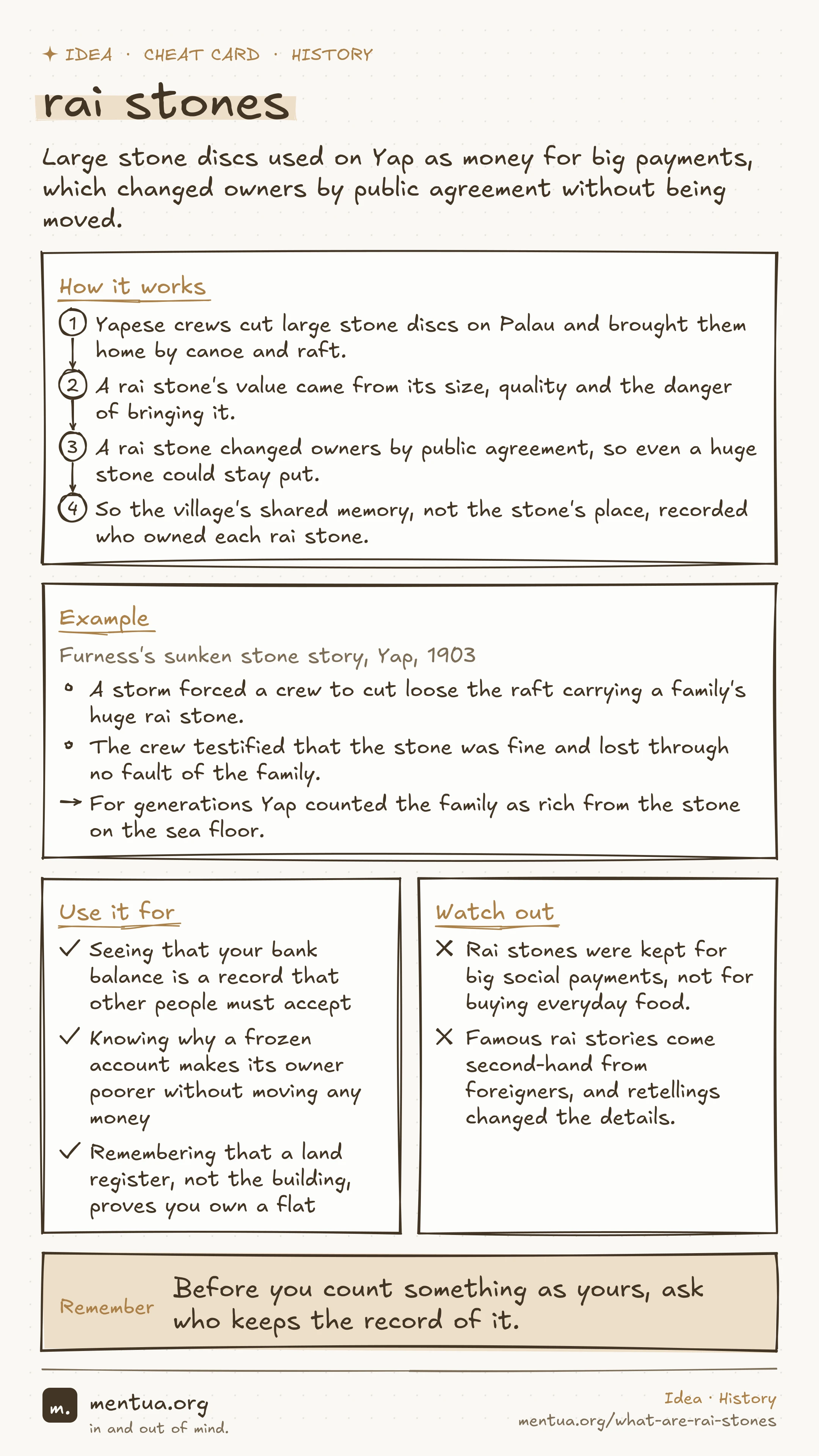
The whole idea on one page. Tap to open it full size, download it below, or test yourself against it tomorrow.
Download
- Light card · PNG image, 398 KB
- Dark card · PNG image, 404 KB
- Printable light card · PDF, searchable, 24 KB
Read the card as text
rai stones: Large stone discs used on Yap as money for big payments, which changed owners by public agreement without being moved.
How it works
- Yapese crews cut large stone discs on Palau and brought them home by canoe and raft.
- A rai stone's value came from its size, quality and the danger of bringing it.
- A rai stone changed owners by public agreement, so even a huge stone could stay put.
- So the village's shared memory, not the stone's place, recorded who owned each rai stone.
Example: Furness's sunken stone story, Yap, 1903
- A storm forced a crew to cut loose the raft carrying a family's huge rai stone.
- The crew testified that the stone was fine and lost through no fault of the family.
- → For generations Yap counted the family as rich from the stone on the sea floor.
Use it for
- Seeing that your bank balance is a record that other people must accept
- Knowing why a frozen account makes its owner poorer without moving any money
- Remembering that a land register, not the building, proves you own a flat
Watch out
- Rai stones were kept for big social payments, not for buying everyday food.
- Famous rai stories come second-hand from foreigners, and retellings changed the details.
Remember: Before you count something as yours, ask who keeps the record of it.
References
- The Island of Stone Money: Uap of the Carolines. William Henry Furness III, J. B. Lippincott, Philadelphia (scan at the Internet Archive), 1910
The original book; chapter 7, "Money and Currency", tells the sunken-stone story and the German fine on pages 96–100.
- The Stone Money of Yap: A Numismatic Survey. Cora Lee C. Gillilland, Smithsonian Studies in History and Technology 23, Smithsonian Institution Press, 1975
The most careful survey: early accounts, quarrying on Palau, how rai were used and valued, and the 1961 court case over a stone sold to Detroit.
- The Island of Stone Money. Milton Friedman, Hoover Institution, Working Papers in Economics E-91-3, 1991
Friedman's short essay that sets Furness's stories beside the French gold in a New York vault in 1932–33.
- Bitcoin and stone money: Anglophone use of Yapese economic cultures, 1910–2020. Jo Lindsay Walton, Finance and Society 8 (1), 42–66, 2022
A critical history of how Western writers, from Furness to Friedman and Bitcoin fans, have retold Yap's money to make their own points.