What Is Compound Interest?


6 min read≈ 1,350 words3 questions · up to 3 points
What this is about
A sum that grows by 7 percent a year looks slow at first and then becomes very large. You learn how interest on interest works, step by step with one example, and a quick rule to estimate how fast money doubles. You also learn why it matters for debts and fees, and what a calculator does not tell you.
In a nutshell· skip ahead
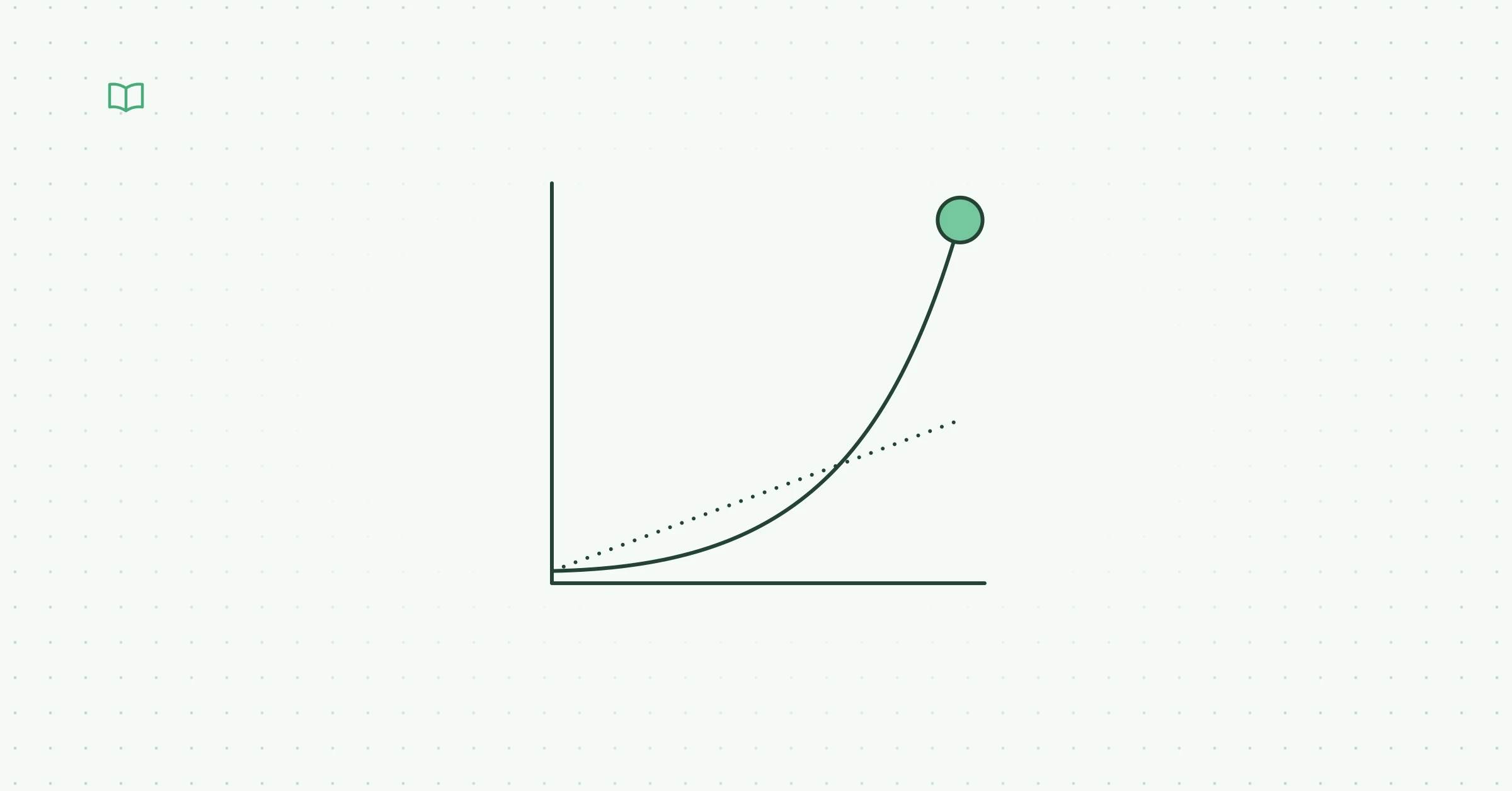
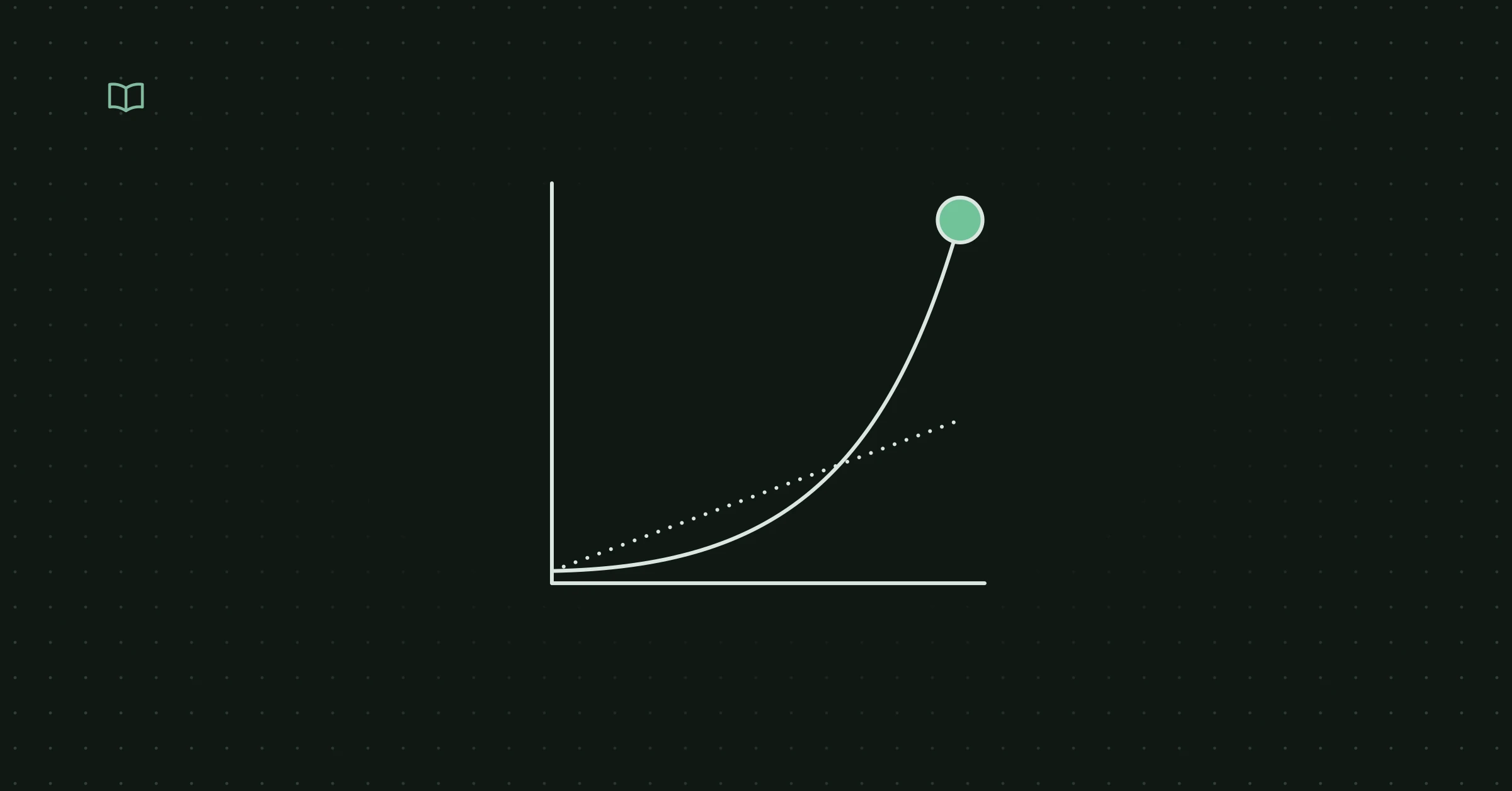
Compound interest is interest that you earn on earlier interest as well as on the money you started with. Because each year's interest is added to the sum, the next year's interest is larger. Money growing by a fixed percentage therefore doubles again and again in the same time, so most of the growth comes late.
Imagine you put €10,000 into an account that pays 7 percent interest a year. You leave it there for 40 years and never add or take out any money. A quick estimate goes like this. 7 percent of €10,000 is €700, and 40 times €700 is €28,000, so you end with about €38,000. The real answer is almost €150,000. Where do the other €112,000 come from?
Why does money grow faster than a quick estimate says?
The difference comes from compound interest. This is interest that you earn on earlier interest as well as on the money you started with. The quick estimate above uses simple interest, where interest is paid only on the money you started with. Simple interest adds the same €700 every year. Compound interest adds a little more each year, because the sum it is calculated on keeps growing.
We can follow the account year by year.
- In the first year, you earn 7 percent of €10,000. That is €700, so the account holds €10,700.
- In the second year, you earn 7 percent of €10,700. That is €749. The extra €49 is interest on last year’s interest.
- In the third year, you earn 7 percent of €11,449, which is about €801.
Each step adds only a few euros more than the last one. That is why compound interest feels slow at first. But the small differences build on each other. The table shows the two methods side by side.
| After | Simple interest | Compound interest |
|---|---|---|
| 0 years | €10,000 | €10,000 |
| 10 years | €17,000 | €19,672 |
| 20 years | €24,000 | €38,697 |
| 30 years | €31,000 | €76,123 |
| 40 years | €38,000 | €149,745 |
Look at the compound column. The sum roughly doubles every ten years. It goes from €10,000 to about €20,000, €39,000, €76,000 and €150,000. Growth by a fixed percentage of itself always works like this. It is called exponential growth, and you can recognize it by its fixed doubling time.
Now look at the last line. In the last ten years the account grows by about €74,000. That is more than it grew in the first 30 years together, which was about €66,000. So most of the result comes in the last years. Someone who takes the money out after 30 years misses the largest part.
You may ask how to find the doubling time without a table. The rule of 72 gives a good estimate. Divide 72 by the interest rate in percent. At 7 percent, 72 ÷ 7 is about 10.3 years. The exact value is 10.2 years. At 9 percent, money doubles in about 8 years. At 2 percent, it takes about 35 years.
What compound interest teaches you
The main lesson is about time. When something grows by a percentage of itself, the length of time matters more than the size of the start. So ask a useful question before many decisions. Does this grow on itself, and for how many years will it keep growing?
The question changes how several everyday choices look.
- Starting early. Ben invests the same €10,000 at 7 percent, but ten years later than in our example, so it grows for 30 years instead of 40. He ends with about €76,000, half of €150,000. Waiting ten years costs one doubling, and one doubling is half the result.
- Fees. A fund that charges 1 percent a year turns a 7 percent return into 6 percent. After 40 years, €10,000 becomes about €103,000 instead of €150,000. A fee that looks small takes almost a third of the final sum, because the fee compounds too.
- Debt. Compound interest works the same way when you owe money. Credit card debt at 20 percent a year doubles in less than four years if nothing is paid back. The rule of 72 gives 3.6 years. For a borrower, a short doubling time means the debt grows very fast.
The same logic appears outside finance. A population that grows by 2 percent a year doubles in about 35 years. In the early phase of an epidemic, case numbers can double every few days. In each case the question is the same. What is the percentage, and how long can it go on?
People who work with money know that time does most of the work. The writer Morgan Housel points out that Warren Buffett, one of the most successful investors in history, earned the large majority of his fortune after the age of 65. In his book The Psychology of Money, the figures are $81.5 billion of $84.5 billion. Buffett invested well, but he also bought his first shares as a boy and kept investing for more than 70 years.
Why do people underestimate it, and where does the rule stop working?
The most common mistake is the one from the opening. People picture growth as a straight line, adding the same amount every year. Researchers call this exponential growth bias. In a 2009 study, the economists Victor Stango and Jonathan Zinman found that households with a stronger bias tend to borrow more and save less. They underestimate both what their savings will become and what their loans really cost. The study shows a link between the bias and these choices. It does not prove that the bias alone causes them.
The fix is easy to say. Do not estimate compound growth in your head. Use the rule of 72 or a calculator.
The opposite mistake is to trust the calculator too much. The example has three limits.
The first limit is that real investments do not pay the same 7 percent every year. Stock markets rise and fall, and an average return hides the bad years. A loss of 50 percent needs a gain of 100 percent to get back to the start. Compounding only works on money that is not lost.
The second limit is inflation, the general rise in prices. If prices rise by 2 percent a year, a 7 percent return buys only about 5 percent more each year. After 40 years, the €150,000 buys about as much as €68,000 today. That is still almost seven times the start, but it is much less than the headline number.
The third limit is that nothing grows by a fixed percentage forever. Populations run out of food and space, and epidemics run out of people to infect. A company cannot grow faster than the economy around it for very long. Exponential growth describes a phase, not a law of nature. This is the strongest objection to the popular “magic of compounding” story. The math is exact, but steady growth for decades is an assumption, and often a weak one.
Learn more
Compound interest has no single inventor, because lenders used it long before anyone wrote about it. A clay tablet from Babylon, dated to about 2000 to 1700 BC, seems to ask how long it takes a loan to double at compound interest. In 1494 the Italian mathematician Luca Pacioli wrote down the rule of 72 in his textbook Summa de arithmetica, without a proof. In 1683 the Swiss mathematician Jacob Bernoulli asked what happens if interest is added more and more often. The answer led him to the number later called e, about 2.718, one of the most important constants in mathematics.
A famous saying calls compound interest “the eighth wonder of the world” and credits Albert Einstein. There is no evidence that he said it. The earliest known version is an advertisement for a savings and loan company in Cleveland, Ohio, from 1925.
If you want to see how compounding shapes real money decisions, read “The Psychology of Money” by Morgan Housel: Summary and Review. Housel argues that patience and avoiding ruin matter more than finding the best return. The same idea also applies to progress in the world. “Same as Ever” by Morgan Housel: Summary and Review explains why slow improvements that compound over years are easy to miss, while sudden disasters get all the attention.
Quiz
3 questions · up to 3 points
Open a question and pick one answer. Only your first answer counts: +1 if it is right, −1 if it is wrong.
What makes compound interest different from simple interest?
Show answer
Interest is also paid on the interest earned in earlier years. With compound interest, each year's interest is added to the sum. The next year's interest is calculated on this larger sum.
Anna invests €10,000 at 7 percent a year for 40 years. Ben invests the same sum at the same rate but starts ten years later and stops at the same time. About how much does Ben have at the end?
Show answer
About half of what Anna has. At 7 percent, money doubles about every ten years. Ben misses one doubling, so he ends with about €76,000 instead of about €150,000.
Someone estimates that €10,000 at 7 percent for 40 years grows to about €38,000. What is the mistake?
Show answer
They added the same €700 every year and forgot interest on interest. €38,000 is the result of simple interest. With compounding the sum reaches almost €150,000. Treating growth as a straight line is a common error called exponential growth bias.
Your points are saved only in this browser for now. Accounts that keep them for good are on the way.
Continue learning: "The Psychology of Money" by Morgan Housel: Summary and Review →The takeaway
Compound interest means you earn interest on earlier interest as well as on your original money, so a sum growing by a fixed percentage doubles in a fixed time. At 7 percent, €10,000 doubles about every ten years and reaches almost €150,000 after 40 years, while simple interest gives only €38,000. The rule of 72 estimates the doubling time. Real returns vary and inflation reduces them, but the main lesson holds: start early, and keep fees and high-interest debt small.
References
- The emergence of compound interest. C. G. Lewin, British Actuarial Journal, vol. 24, e34, 2019
A history of compound interest from a Babylonian clay tablet to modern actuarial tables, free to read.
- The number e. J. J. O'Connor and E. F. Robertson, MacTutor History of Mathematics, University of St Andrews, 2001
How Jacob Bernoulli met the number e in 1683 while studying interest that is added continuously.
- Exponential Growth Bias and Household Finance. Victor Stango and Jonathan Zinman, Journal of Finance, vol. 64, no. 6, pp. 2807–2849, 2009
The study that links the habit of treating exponential growth as linear to borrowing more and saving less.
- Quote Origin: The Eighth Wonder of the World Is Compound Interest. Garson O'Toole, Quote Investigator, 2019
Why there is no evidence that Albert Einstein praised compound interest, and where the saying comes from.