What Is Goodhart's Law?


5 min read≈ 1,110 words3 questions · up to 3 points
What this is about
In 1902 the French rulers of Hanoi paid people for every rat tail they brought in, and the number of tails rose while the city kept its rats. You learn why the same thing happens to exam results, hospital waiting times and sales figures, where the famous sentence about measures and targets really comes from, and how to set a goal without fooling yourself.
In a nutshell· skip ahead
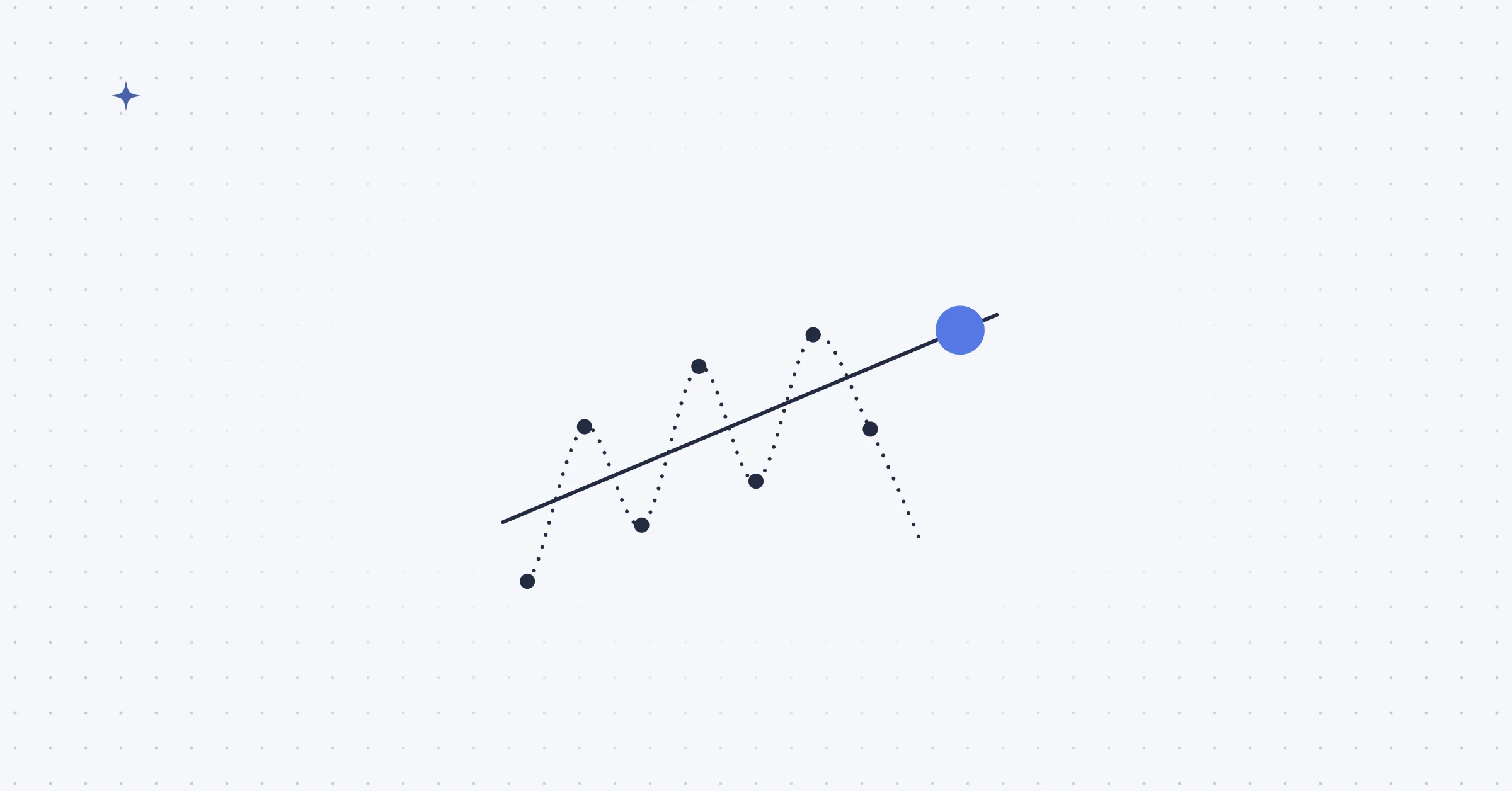
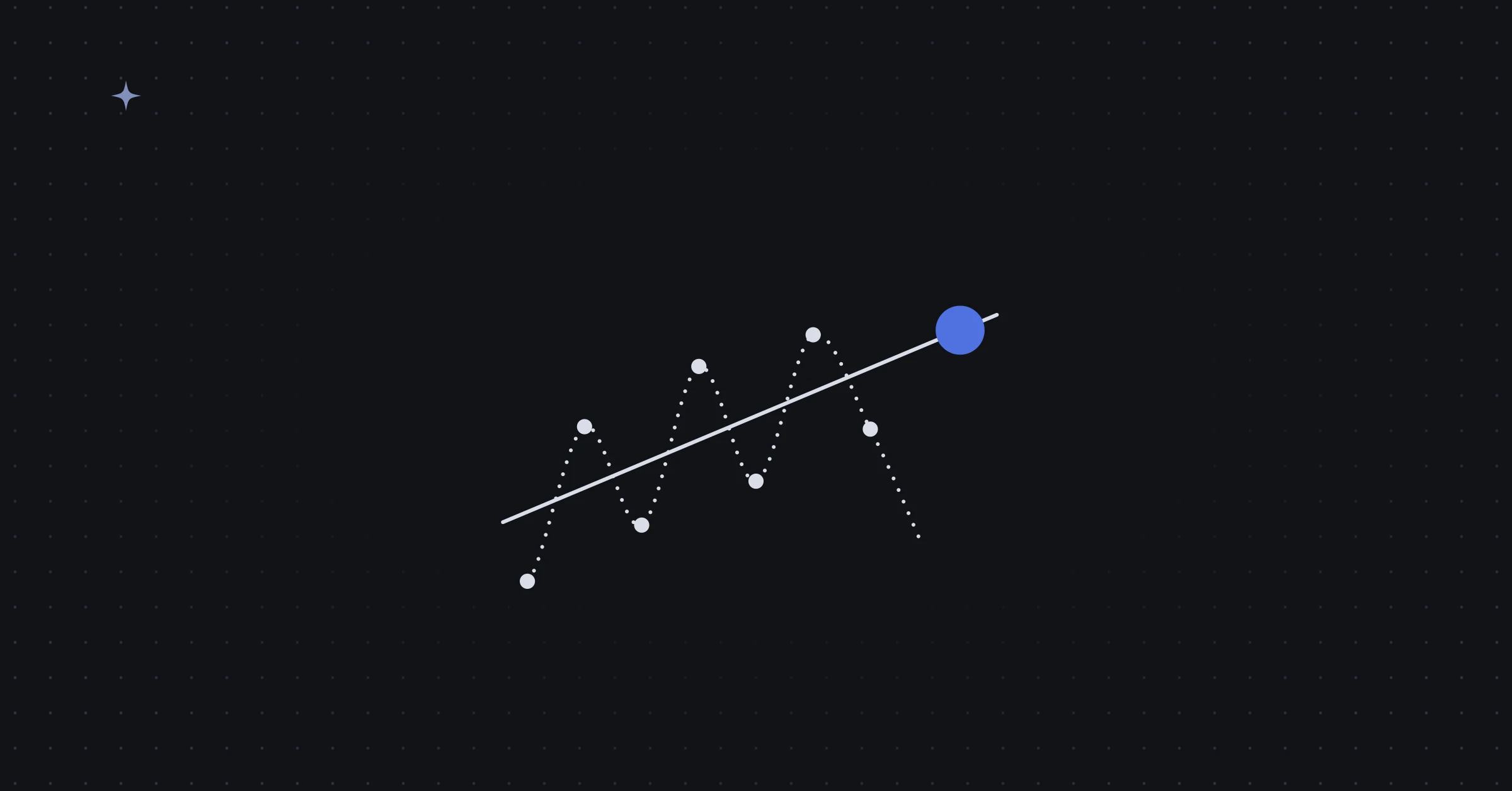
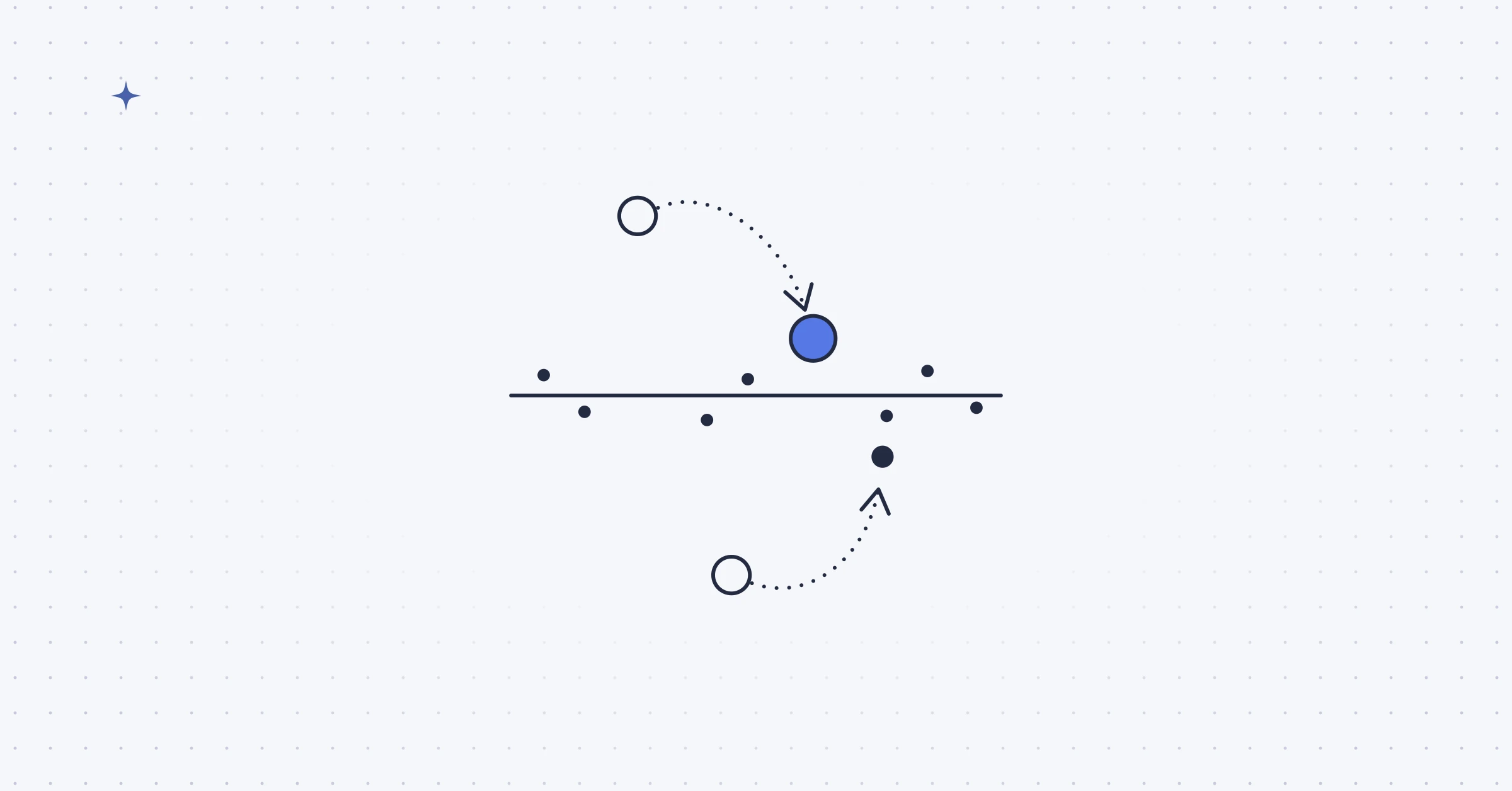
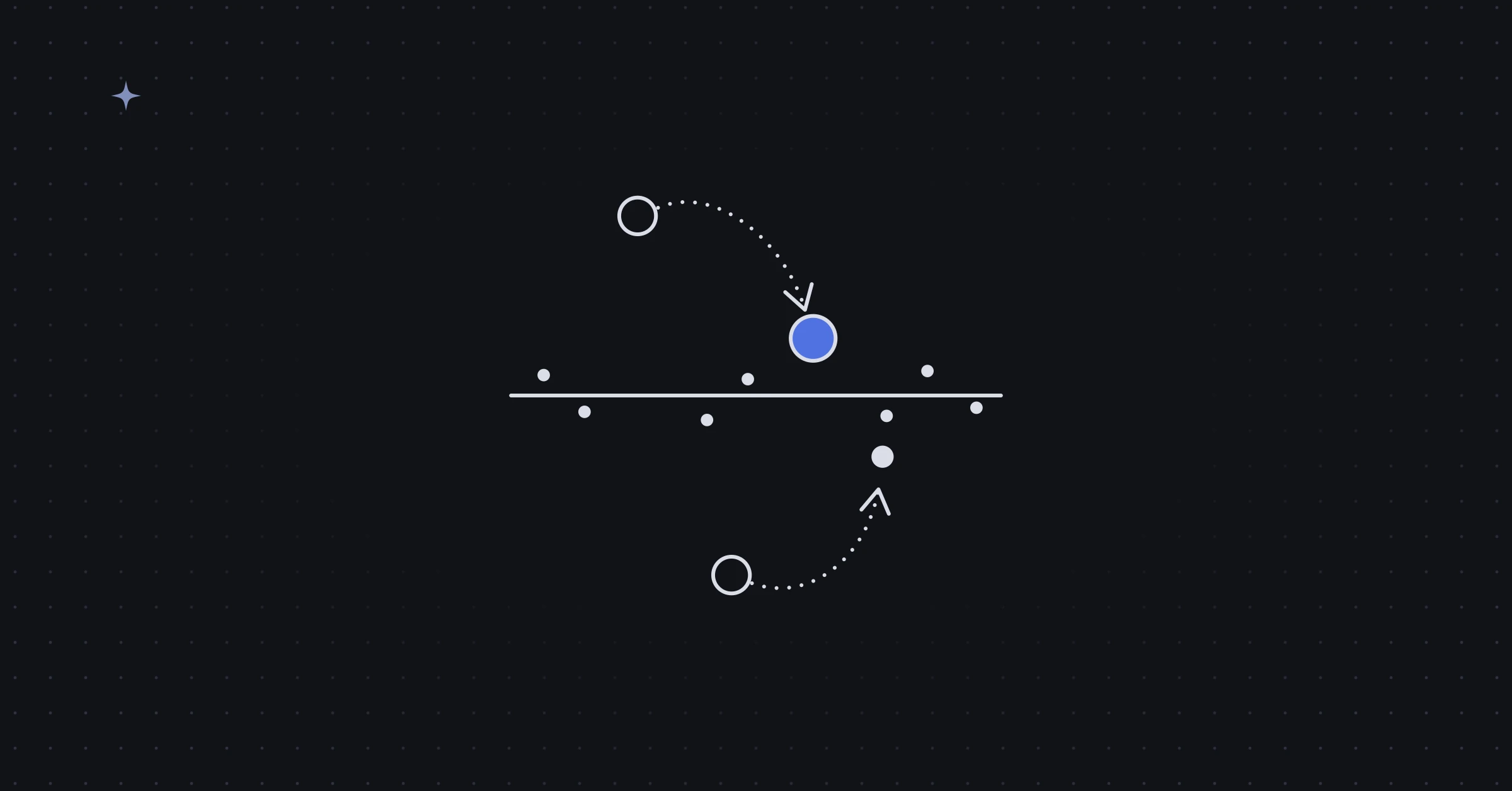
Goodhart's law says that when people are rewarded or punished according to a number, the number stops being a reliable sign of what it used to show. People find ways to raise the number that do not raise the thing you care about, so the measure improves while the real goal does not.
In the spring of 1902 the French colonial government of Hanoi, in what is now Vietnam, had a rat problem and a clear way to measure its progress. It paid a small bounty for every rat tail delivered to the police, and the daily counts soon ran into the thousands. Yet the rats did not seem to disappear. How can a number go up every day while the thing it measures stays the same?
What is Goodhart’s law?
Goodhart’s law is the observation that a number stops telling you the truth once people are rewarded or punished according to it. Before the reward, the number moves together with the thing you care about. After the reward, people find ways to raise the number that do not raise the thing you care about, so the link between the two breaks.
The Hanoi rat hunt, reconstructed by the historian Michael Vann from the city’s archive files, shows the steps.
- The goal. The city feared the plague, which was then spreading around the world, and wanted fewer rats in its streets and sewers.
- The measure. A dead rat is hard to count across a whole city, but its tail is easy to count. As long as nobody was paid for tails, the number of tails was a fair sign of the number of rats killed.
- The reward. The city paid a few cents for each tail delivered to the police. The reported counts of dead rats jumped from a few hundred a day to between 7,000 and 14,000 on many days, and to more than 20,000 on the worst day.
- The gaming. After about three months the officials discovered that people were catching rats, cutting off their tails for the money and letting the rats go free to breed. Some were farming rats, and a smuggling network brought rats into Hanoi from the surrounding region.
You might ask why anyone was surprised. The officials had not done anything foolish: the tail really was a good measure before they paid for it. The payment itself turned it into a bad one, because a tail from a living rat was now worth exactly as much as a tail from a dead one.
What Goodhart’s law teaches you
Whenever a number decides rewards, ask how someone could raise it without doing what you actually want. This question helps in many ordinary situations.
- Hospitals. In England in the early 2000s, hospitals were judged on targets such as treating emergency patients within four hours. The health researchers Gwyn Bevan and Christopher Hood found that reported performance improved sharply, but they also documented gaming. Some patients had to wait in ambulances outside the emergency department until staff were sure they could meet the four-hour target, and hospitals reported 96 percent success while an independent patient survey found 77 percent.
- Sales. In 2016 the US Consumer Financial Protection Bureau fined the bank Wells Fargo 100 million dollars. Employees, pushed by sales targets, had opened about 1.5 million deposit accounts and 565,000 credit card accounts that customers may never have asked for.
- Your own goals. If you count the hours you spend at your desk while studying, the hours will rise more easily than your understanding. A better check is one you cannot raise without learning, such as explaining a topic without notes or answering old exam questions.
The same pattern appears in computer science. A program that learns from data is trained to raise a score, and it sometimes finds a way to raise the score that its designers did not intend. The Idea What Is Overfitting? explains a close relative of this problem: a model that fits its test data too well and then fails on new cases.
Where does Goodhart’s law not hold, and what do people get wrong?
The most common misreading is that measures are useless, so you should stop measuring. Without a number you often cannot see a problem at all, and a target can push people to make real changes as well as fake ones. Bevan and Hood did not conclude that English hospitals should drop their targets. They asked for an independent body to check how genuine the reported improvements were, so that the real effort could be kept and the gaming caught.
The law also does not apply with equal force to every number. A measure breaks most easily when three things come together: people are strongly rewarded for it, it captures only part of the goal, and the people being measured can change it in ways the rule-maker cannot see. A swimmer’s time over 100 metres is hard to game, while the number of tails delivered to a police station is easy to game.
The researchers David Manheim and Scott Garrabrant pointed out in 2018 that a measure can fail under pressure even when nobody cheats. If you pick the best people, products or plans by a number that is partly luck, you also pick lucky results, which then look worse the next time. That effect is explained in What Is Regression to the Mean?. Their point weakens the simple story of a cheater and a fooled rule-maker, but it strengthens the main lesson: a rewarded number deserves more doubt, not less.
Learn more
The idea has several parents, and the famous sentence is not Goodhart’s own. The British economist Charles Goodhart worked as an adviser at the Bank of England. In a 1975 paper on British monetary policy he wrote that “any observed statistical regularity will tend to collapse once pressure is placed upon it for control purposes”. He was writing about the money supply: a link between money and the economy that looked stable in the data tended to break down once the Bank tried to steer the economy by it. The American social scientist Donald Campbell described the same danger for public programmes in 1976.
The short version, “When a measure becomes a target, it ceases to be a good measure”, comes from the British anthropologist Marilyn Strathern. She wrote it in a 1997 essay on university audits, after the accounting scholar Keith Hoskin had applied Goodhart’s name to the idea.
If you want to see how forecasters in many fields mistake noise for a real pattern, “The Signal and the Noise” by Nate Silver: Summary and Review is a good next step. What Is the Free-Rider Problem? shows another case where rules and rewards lead people to act against a shared goal.
Quiz
3 questions · up to 3 points
Open a question and pick one answer. Only your first answer counts: +1 if it is right, −1 if it is wrong.
In the Hanoi rat hunt of 1902, why did counting rat tails stop showing how many rats had been removed from the city?
Show answer
People were paid per tail, so they cut off tails, released the rats alive and even bred rats to collect more money. The bounty made the tail count worth money in itself. People raised the count in ways that left the rats alive, so the number no longer showed what it was meant to show.
A school rewards pupils with a prize for every book they report having read, and the number of books reported doubles in a month. What does Goodhart's law tell the school to check?
Show answer
Whether pupils actually read more, for example by talking with them about the books, because reporting a book is now worth a prize. The prize puts pressure on the count. The school has to look at the goal behind the number, which is reading, with a check the pupils are not rewarded for.
Which conclusion from Goodhart's law is correct?
Show answer
Measures remain useful, but a rewarded measure needs checks, other measures and human judgment beside it. English hospital targets came with a sharp rise in reported performance and with documented gaming. The law tells you to check rewarded numbers, not to stop measuring.
Your points are saved only in this browser for now. Accounts that keep them for good are on the way.
Continue learning: What Is Overfitting? →The takeaway
Goodhart's law says that a measure stops being reliable once people are rewarded for raising it, because they find ways to raise the number without improving the goal behind it. In Hanoi in 1902, a bounty on rat tails led people to cut off tails, release the rats and even breed them. Measures are still useful, but a rewarded measure needs checks that the people being measured cannot game. Before you reward a number, ask how someone could raise it without doing what you want.
Cheat card
The whole idea on one page. Tap to open it full size, download it below, or test yourself against it tomorrow.
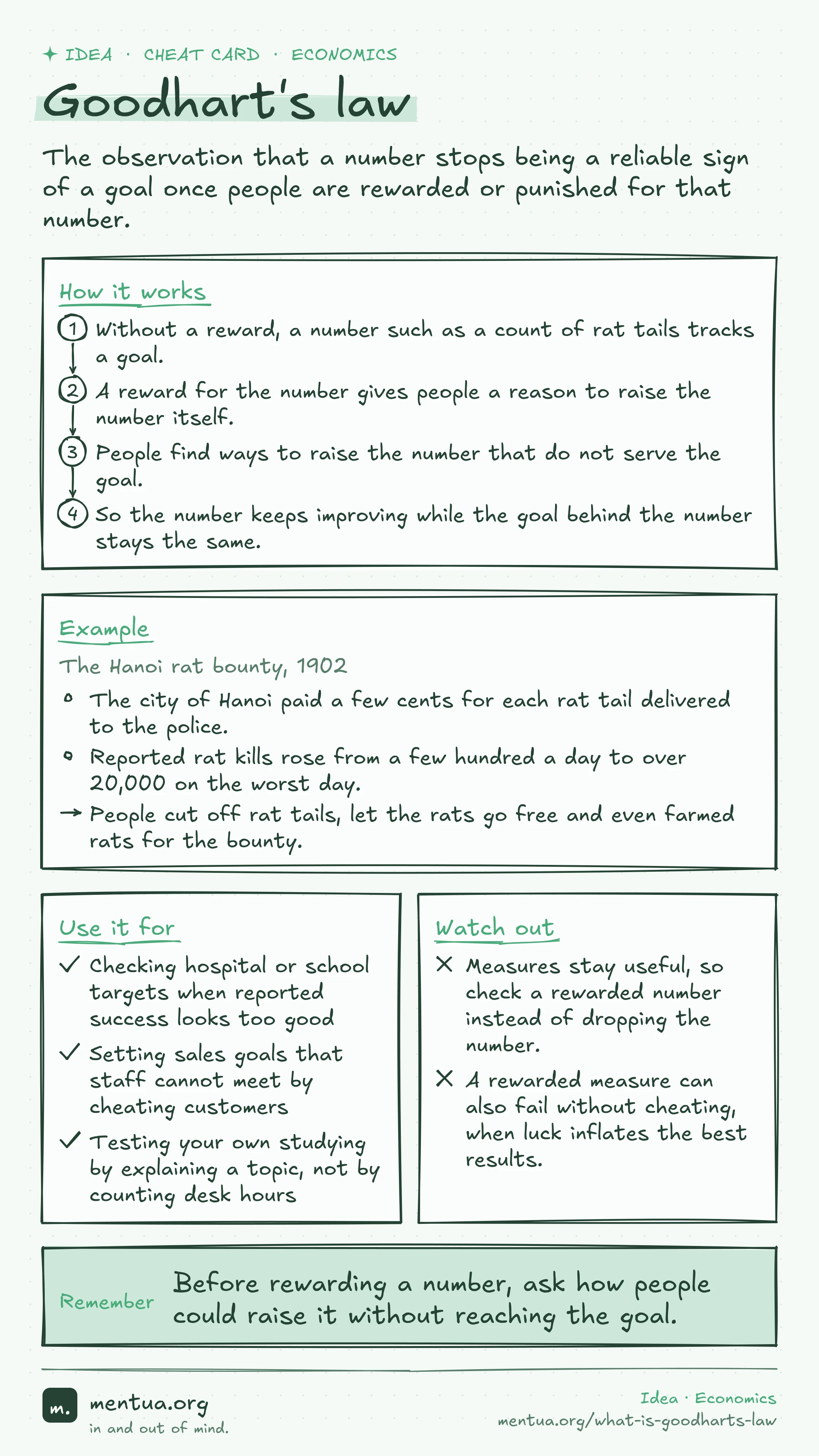
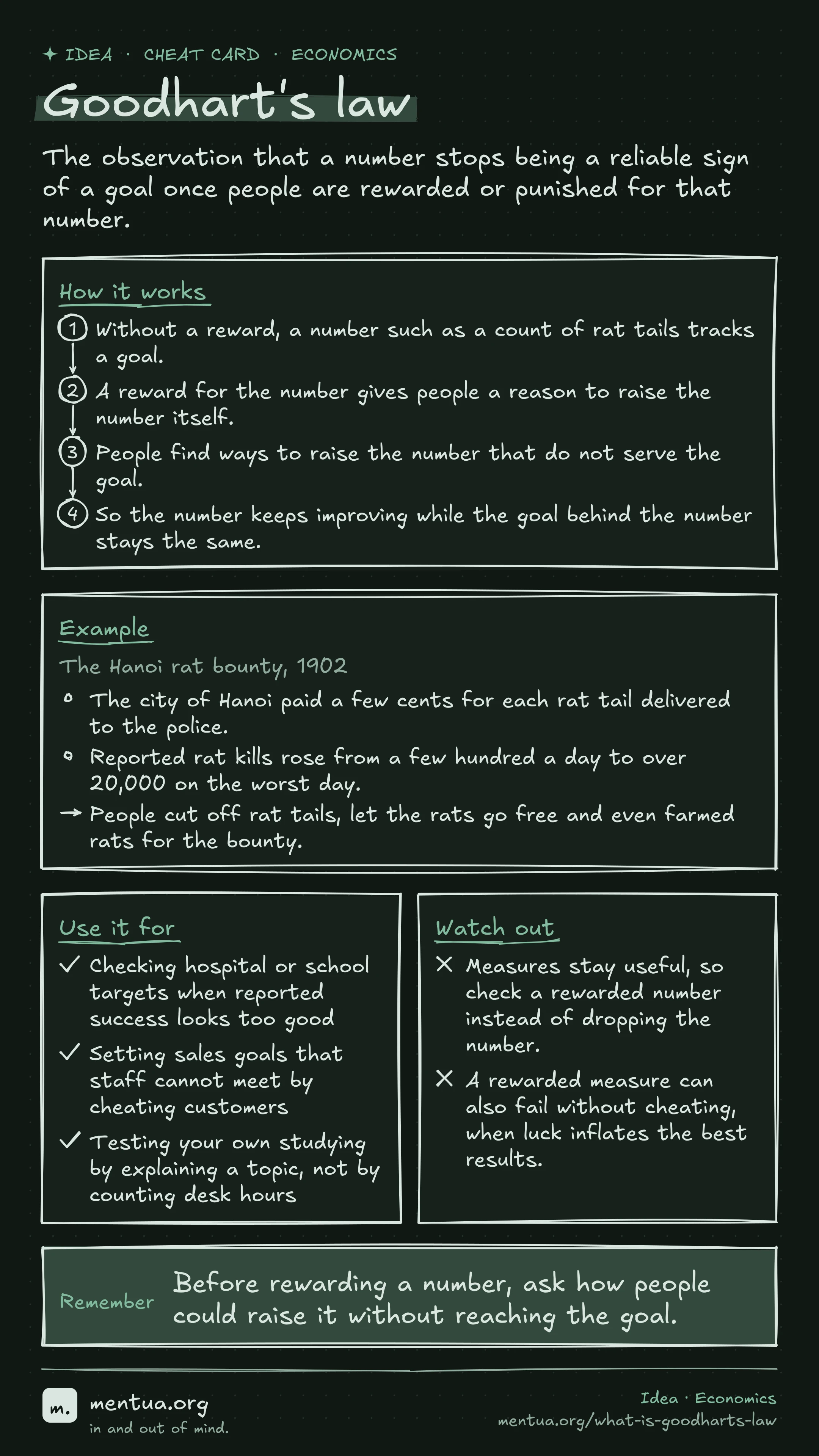
Download
- Light card · PNG image, 389 KB
- Dark card · PNG image, 397 KB
- Printable light card · PDF, searchable, 23 KB
Read the card as text
Goodhart's law: The observation that a number stops being a reliable sign of a goal once people are rewarded or punished for that number.
How it works
- Without a reward, a number such as a count of rat tails tracks a goal.
- A reward for the number gives people a reason to raise the number itself.
- People find ways to raise the number that do not serve the goal.
- So the number keeps improving while the goal behind the number stays the same.
Example: The Hanoi rat bounty, 1902
- The city of Hanoi paid a few cents for each rat tail delivered to the police.
- Reported rat kills rose from a few hundred a day to over 20,000 on the worst day.
- → People cut off rat tails, let the rats go free and even farmed rats for the bounty.
Use it for
- Checking hospital or school targets when reported success looks too good
- Setting sales goals that staff cannot meet by cheating customers
- Testing your own studying by explaining a topic, not by counting desk hours
Watch out
- Measures stay useful, so check a rewarded number instead of dropping the number.
- A rewarded measure can also fail without cheating, when luck inflates the best results.
Remember: Before rewarding a number, ask how people could raise it without reaching the goal.
Key quotes
“Any observed statistical regularity will tend to collapse once pressure is placed upon it for control purposes.”
References
- 'Improving ratings': audit in the British University system. Marilyn Strathern, European Review 5 (3), 305–321, 1997
The anthropologist's essay on university audits, with the famous sentence on page 308 and the remark that Keith Hoskin called the idea Goodhart's law.
- The Great Hanoi Rat Hunt: Interview with Michael G. Vann. Made in China Journal, Made in China Journal, 2020
The historian who found the archive files explains the rat bounty of 1902, the daily counts and how people began to farm rats.
- Have targets improved performance in the English NHS?. Gwyn Bevan and Christopher Hood, BMJ 332 (7538), 419–422, 2006
A short, free study of hospital and ambulance targets in England that lists both the real improvements and the documented cases of gaming.
- Assessing the Impact of Planned Social Change. Donald T. Campbell, Journal of MultiDisciplinary Evaluation 7 (15), reprint of the 1976 paper, 2011
The social scientist's own statement of the same pattern for public programmes, with examples from schools and policing.
- Categorizing Variants of Goodhart's Law. David Manheim and Scott Garrabrant, arXiv 1803.04585, 2018
A short paper that splits the law into four different ways a measure can fail under pressure; somewhat technical.