What Is the Dunning-Kruger Effect?
5 min read≈ 1,140 words3 questions · up to 3 points
What this is about
In 1995 a man robbed two banks in Pittsburgh with lemon juice on his face and was soon caught. You learn what two Cornell psychologists found when they tested the link between skill and confidence, why the best students misjudged themselves too, and why some statisticians think much of the famous pattern comes from the way it was measured.
In a nutshell· skip ahead
The Dunning-Kruger effect is the finding that people who perform worst at a task tend to overestimate their performance the most. David Dunning and Justin Kruger argued that the knowledge needed to do a task well is also the knowledge needed to see one's own mistakes, so those who lack it cannot tell how badly they are doing.
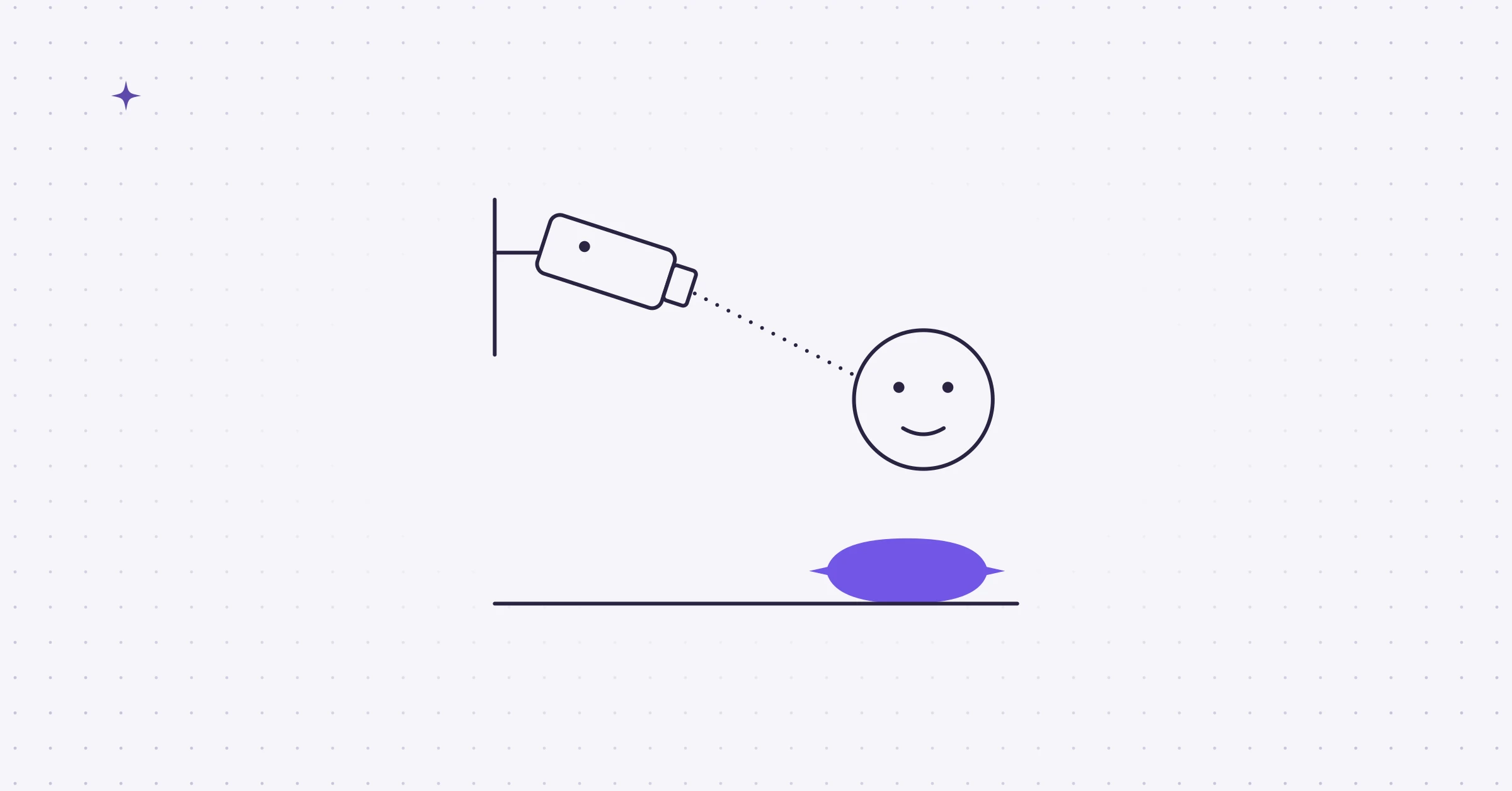
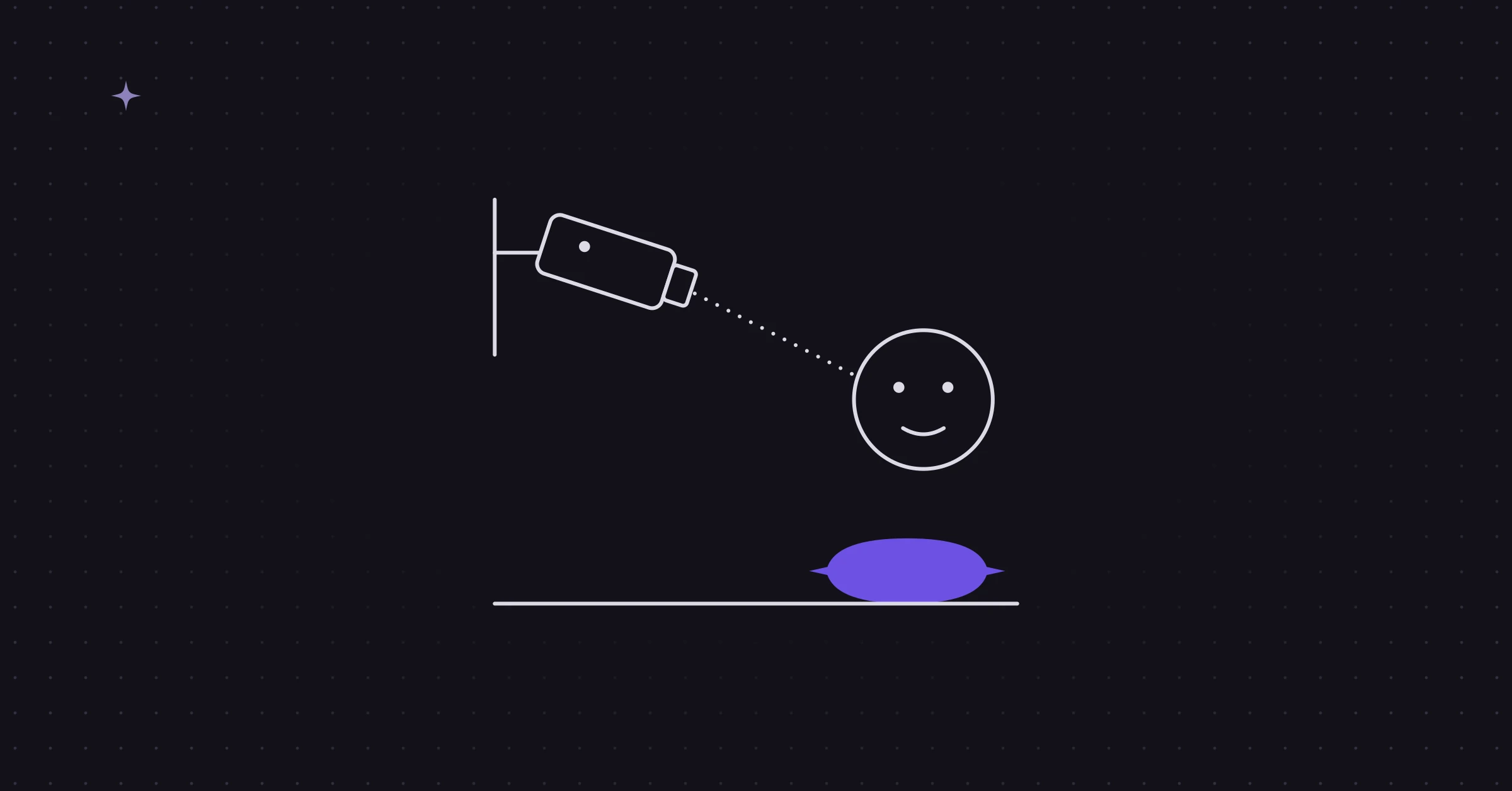
In 1995 a man named McArthur Wheeler robbed two banks in Pittsburgh without a mask, and the security cameras recorded his face. When the police arrested him soon afterwards, he could not believe it and said, “But I wore the juice.” He had rubbed lemon juice on his face because he was sure it would make him invisible to the cameras. How can someone be so wrong and so certain at the same time?
Why do people who know little often feel so sure?
The Dunning-Kruger effect is the finding that people who perform worst at a task tend to overestimate their performance the most. The psychologists David Dunning and Justin Kruger, who described it in 1999, argued that the knowledge you need to do a task well is the same knowledge you need to notice your mistakes. A person who lacks it therefore makes two errors at once: a wrong answer, and a wrong belief that the answer is right.
Their logic study at Cornell University shows how they tested this.
- The test. Forty-five students answered a set of logical reasoning questions.
- The guess. Before seeing any results, each student estimated their own logical ability and their test score as a percentile: the share of fellow students they believed they had beaten. The 50th percentile means exactly average.
- The comparison. The researchers sorted the students into four equal groups by their real scores and compared each group’s guess with its real rank.
- The result. The weakest quarter scored at the 12th percentile on average, but placed their test score at the 62nd percentile and their logical ability at the 68th. They expected to answer about 14 questions correctly and answered fewer than 10.
The surprise was at the other end. The best quarter scored at the 86th percentile but placed themselves at the 68th, so they underestimated their rank. Dunning and Kruger thought these students judged their own answers well but assumed that the questions were just as easy for everyone else.
You might ask whether the weakest students were just proud and unwilling to admit failure. A later study in the same paper suggests that ignorance plays a part. The researchers gave some of the students a short lesson in the kind of logic the test required, and afterwards the weakest of them lowered the estimate of their test score from the 51st to the 32nd percentile. Once they had learned what a right answer looked like, they could see more of their own errors.
What the Dunning-Kruger effect teaches you
The useful question is not “How sure do I feel?” but “What would show me that I am wrong, and who could check it?” Your feeling of confidence comes from the same mind that may be missing the knowledge, so a check from outside tells you more.
- Studying. Rereading notes makes a topic feel familiar, and familiarity feels like knowledge. Answering questions without notes shows what you can actually do, which is why testing yourself, described in What Is the Testing Effect?, is also a way to measure your own knowledge.
- Work. A new colleague who sees no problems in a plan may not yet know where plans usually fail. Asking an experienced person to look for mistakes catches what neither confidence nor good intentions can.
- The news. A loud and certain voice on a subject such as vaccines or the economy is not evidence of expertise. It is worth asking what training or record the speaker has, and what people who study the subject say.
The same logic explains why the best students in 1999 underrated themselves. If a task feels easy to you, you may wrongly assume it is easy for everyone, so skilled people can also benefit from comparing themselves with others instead of guessing.
Is the Dunning-Kruger effect real, and what do people get wrong?
The most common misreading is the idea that ignorant people think they are geniuses. A popular curve on the internet shows a beginner’s confidence rising to a “peak” and then falling, but that curve does not appear in the 1999 paper, which compared estimated and actual percentiles for four groups. In the logic study the weakest students still rated their ability a little lower than the best students rated theirs. Their error was much larger, but they did not believe they were the best.
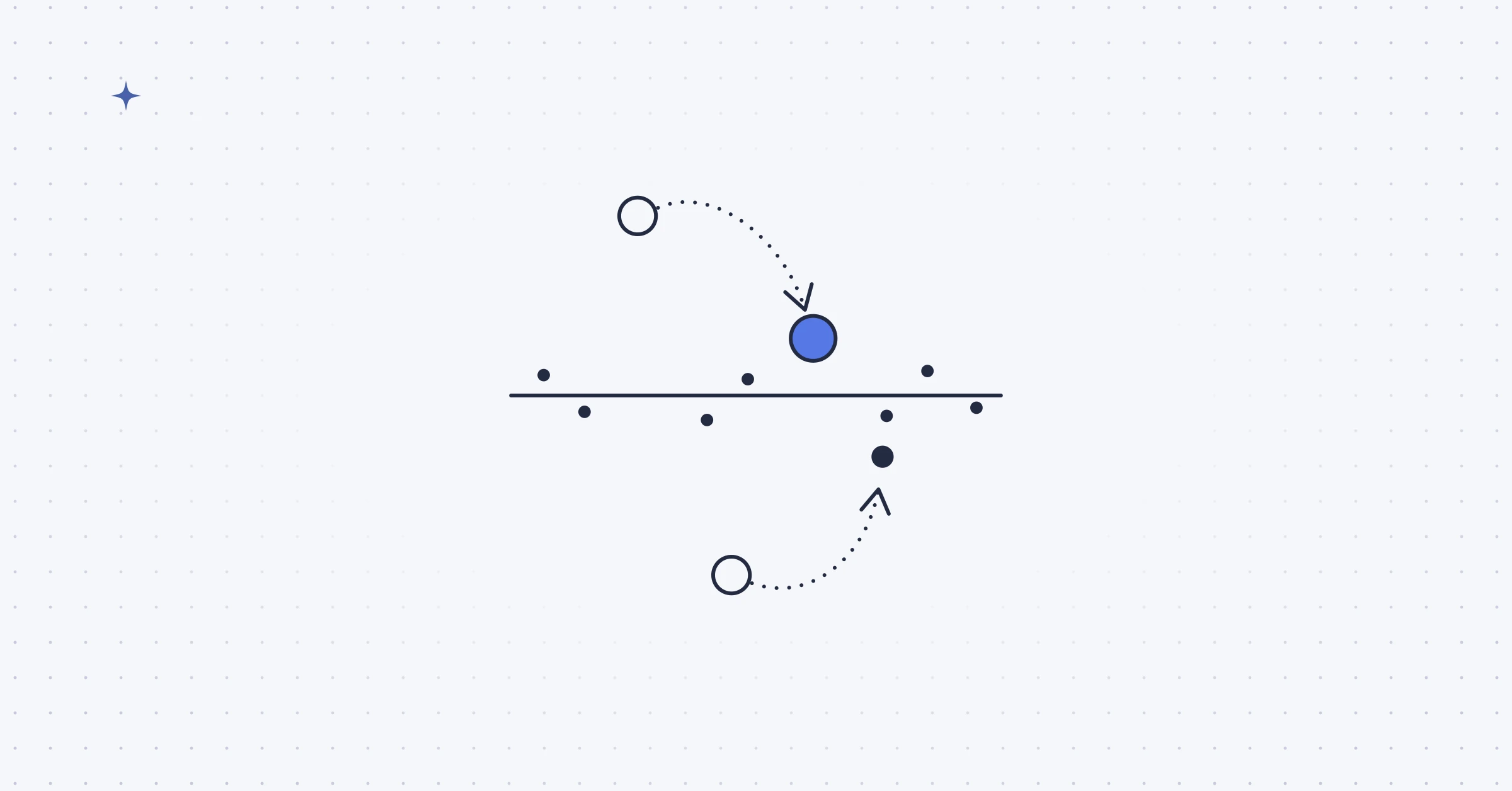
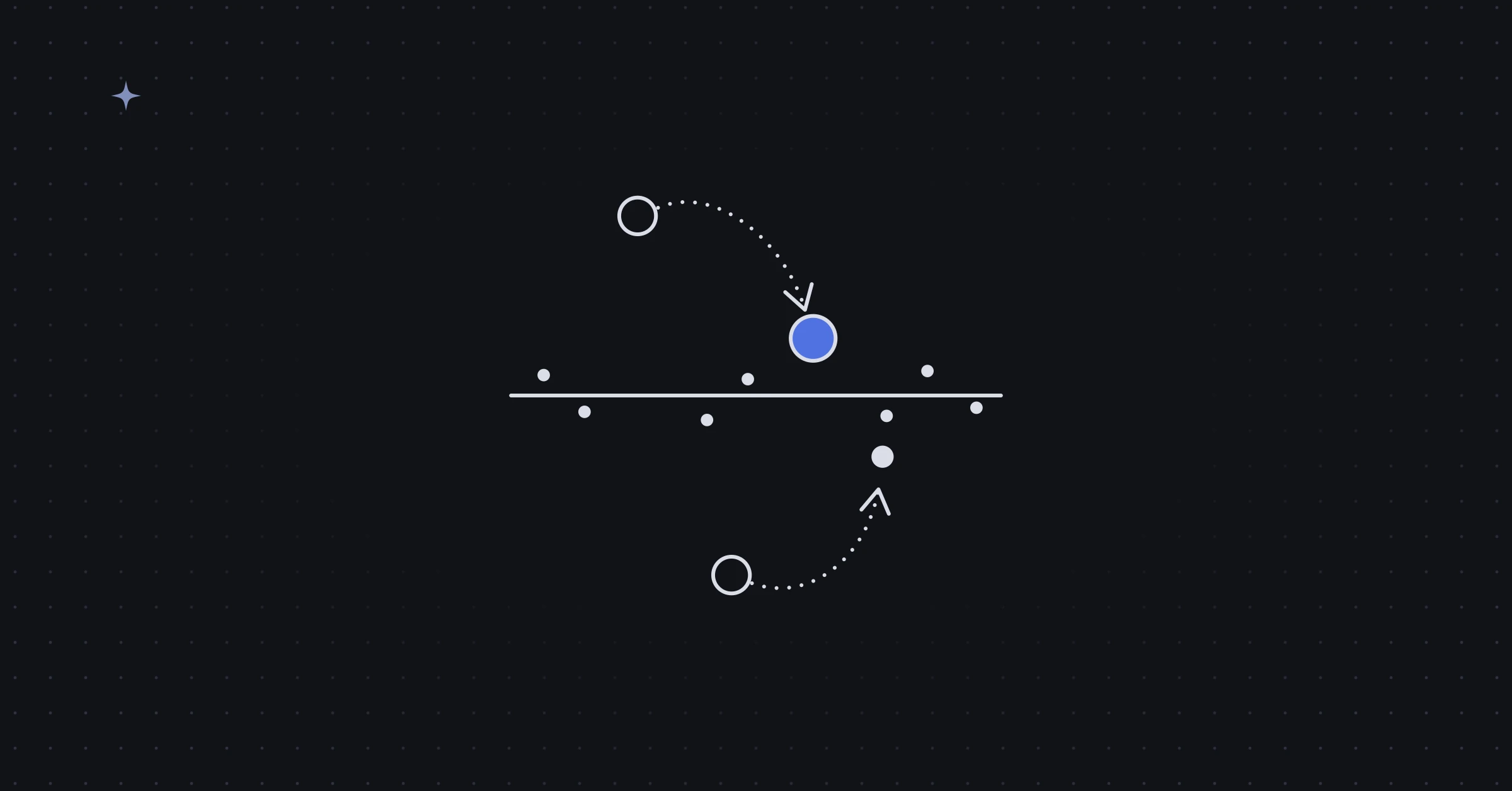
The strongest objection is statistical. Joachim Krueger and Ross Mueller pointed out in 2002 that two known effects can produce the same graph. Most people rate themselves above average on almost anything, which lifts every group’s estimate. On top of that, estimates and test scores are both partly luck, so a group chosen for very low scores will have guesses that sit closer to the middle, an effect explained in What Is Regression to the Mean?. Later researchers fed purely random numbers into the same kind of graph and got a pattern that looked very similar.
Studies with better methods give a mixed answer. Gilles Gignac and Marcin Zajenkowski tested 929 adults in 2020 and found only a weak link between how intelligent people thought they were and how they scored, with no sign that the least able were especially blind to their level. A 2021 study of about 8,000 online participants by Rachel Jansen and colleagues found that statistics explain part of the pattern. It also found that low performers in grammar and logic were less able to tell when their own answers were right.
Work by Katherine Burson and colleagues in 2006 adds that on hard tasks even good performers misjudge themselves badly. The fairest summary is that the effect exists in some tasks but is smaller than its fame suggests.
Learn more
The effect is named after David Dunning and Justin Kruger, who published their paper “Unskilled and unaware of it” in 1999, when Kruger was a graduate student working with Dunning at Cornell University. According to the filmmaker Errol Morris, who interviewed Dunning in 2010, Dunning came across the lemon juice robbery in a 1996 almanac and began to wonder whether incompetence could hide itself. The paper won a satirical Ig Nobel Prize in 2000, and Dunning summarized twelve years of follow-up research in a long review in 2011. The older idea that ignorance and confidence go together was not new, but this paper was the first to measure it in this way.
Your own sense of learning can mislead you while studying, and “Make It Stick” by Peter Brown, Henry Roediger and Mark McDaniel: Summary and Review explains the illusions of knowing and how to test yourself instead. What Is Confirmation Bias? shows another reason why people stay sure of beliefs they never test.
Quiz
3 questions · up to 3 points
Open a question and pick one answer. Only your first answer counts: +1 if it is right, −1 if it is wrong.
In Kruger and Dunning's 1999 logic test, how did students in the bottom quarter judge their own test score?
Show answer
They scored at about the 12th percentile but placed themselves at about the 62nd. This is the central result of the logic study: the weakest students thought they had done better than most of their classmates, while most of their classmates had done better than them.
After a month of chess, Lena is sure she would beat most club players, although she has never played one. What would most help her judge her skill?
Show answer
Playing rated games against club players and having a stronger player go through her mistakes. Outside feedback measures her play directly and shows her mistakes that her own limited knowledge of chess cannot show her.
Which statement about the Dunning-Kruger effect is correct?
Show answer
The popular curve with a 'peak of confidence' for beginners does not appear in the 1999 paper. The paper compares estimated and actual percentiles for four groups of students. The curve of confidence against experience was drawn later by others.
Your points are saved only in this browser for now. Accounts that keep them for good are on the way.
Continue learning: What Is Regression to the Mean? →The takeaway
The Dunning-Kruger effect is the finding that people with the least skill in a task overestimate their performance most, possibly because the knowledge they lack is also the knowledge they would need to notice their mistakes. In 1999, Cornell students in the bottom quarter of a logic test scored at the 12th percentile but placed themselves near the 60th. Later studies suggest that part of this pattern comes from measurement and that the real effect is smaller. Check your own judgment with tests and feedback from others instead of trusting how confident you feel.
Cheat card
The whole idea on one page. Tap to open it full size, download it below, or test yourself against it tomorrow.
Download
- Light card · PNG image, 432 KB
- Dark card · PNG image, 433 KB
- Printable light card · PDF, searchable, 24 KB
Read the card as text
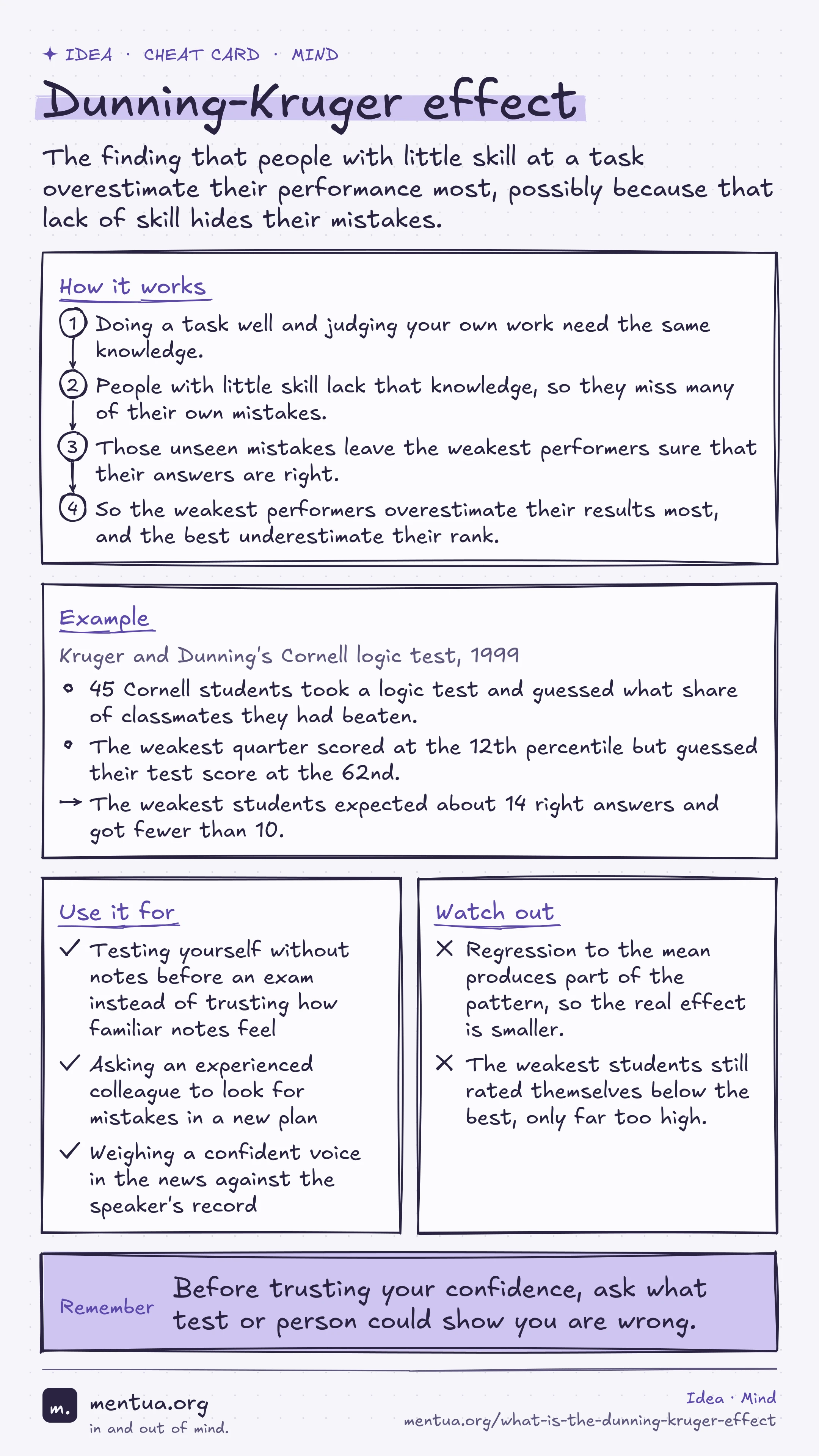
Dunning-Kruger effect: The finding that people with little skill at a task overestimate their performance most, possibly because that lack of skill hides their mistakes.
How it works
- Doing a task well and judging your own work need the same knowledge.
- People with little skill lack that knowledge, so they miss many of their own mistakes.
- Those unseen mistakes leave the weakest performers sure that their answers are right.
- So the weakest performers overestimate their results most, and the best underestimate their rank.
Example: Kruger and Dunning's Cornell logic test, 1999
- 45 Cornell students took a logic test and guessed what share of classmates they had beaten.
- The weakest quarter scored at the 12th percentile but guessed their test score at the 62nd.
- → The weakest students expected about 14 right answers and got fewer than 10.
Use it for
- Testing yourself without notes before an exam instead of trusting how familiar notes feel
- Asking an experienced colleague to look for mistakes in a new plan
- Weighing a confident voice in the news against the speaker's record
Watch out
- Regression to the mean produces part of the pattern, so the real effect is smaller.
- The weakest students still rated themselves below the best, only far too high.
Remember: Before trusting your confidence, ask what test or person could show you are wrong.
References
- Unskilled and unaware of it: How difficulties in recognizing one's own incompetence lead to inflated self-assessments. Justin Kruger and David Dunning, Journal of Personality and Social Psychology 77 (6), 1121–1134, 1999
The original paper with the four studies on humor, logic and grammar, the training study and the lemon juice robber in the opening paragraph.
- The Dunning–Kruger Effect: On Being Ignorant of One's Own Ignorance. David Dunning, Advances in Experimental Social Psychology 44, 247–296, 2011
Dunning's own long review of the research in the twelve years after the paper, including his answers to the critics.
- A rational model of the Dunning–Kruger effect supports insensitivity to evidence in low performers. Rachel A. Jansen, Anna N. Rafferty and Thomas L. Griffiths, Nature Human Behaviour 5, 756–763, 2021
A free full text of two large online studies which find that statistics explain part of the pattern but low performers also read their own results less well.
- The Dunning-Kruger effect is (mostly) a statistical artefact: Valid approaches to testing the hypothesis with individual differences data. Gilles E. Gignac and Marcin Zajenkowski, Intelligence 80, 101449, 2020
A study of 929 adults that tests the effect for intelligence with better statistics and finds it much smaller than usually reported.
- The Dunning-Kruger Effect Is Probably Not Real. Jonathan Jarry, McGill Office for Science and Society, 2020
A clear article for general readers on how random numbers can produce the famous graph.