What Is the Hero's Journey?

5 min read≈ 1,180 words3 questions · up to 3 points
What this is about
Why does a young farmer who first refuses to leave home, then follows an old mentor into danger, feel familiar from old myths? You learn the three phases and the main stages of the pattern Joseph Campbell described in 1949, what a 2023 study found when people retold their own lives with it, and why folklorists doubt that it is universal.
In a nutshell· skip ahead
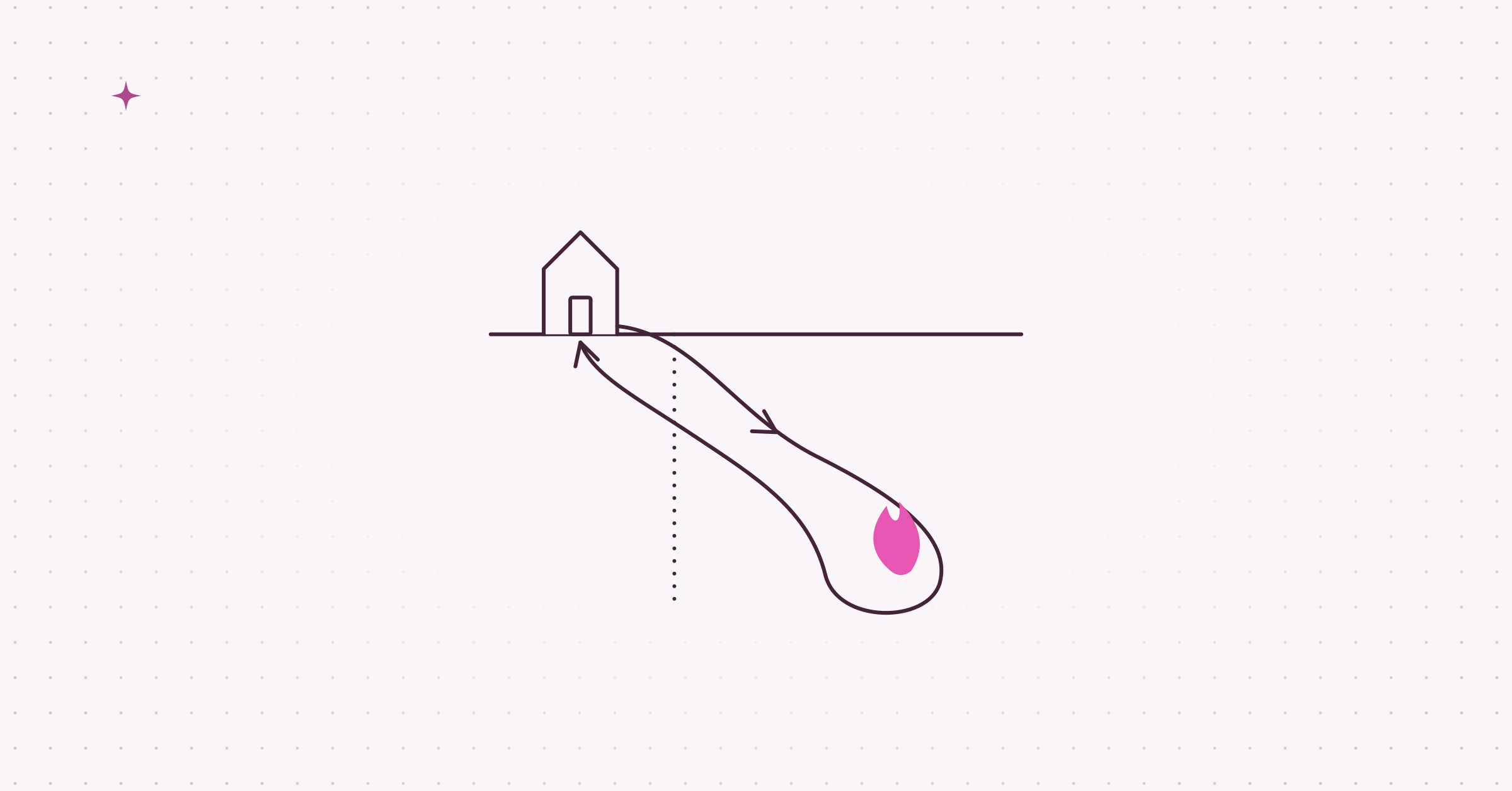
The hero's journey, or monomyth, is a story pattern in which a hero leaves everyday life, is tested in an unknown world and returns changed, with a gift for others. Joseph Campbell described it in 1949 as a pattern of myths worldwide and a picture of how people grow, and writers later used it as a plot template.
An exhibition at the University of Illinois library compares the drafts of Star Wars. In the third draft, Luke Skywalker decides to help as soon as he sees Princess Leia’s recorded call for help. In the film that reached cinemas in 1977, he first turns down the old knight Obi-Wan Kenobi and says that he has work to do at home. Why would a writer make his hero say no first?
What are the stages of the hero’s journey?
The refusal is one stage of a pattern that many myths share. The hero’s journey, which the American mythologist Joseph Campbell also called the monomyth, is a story pattern in which a hero leaves everyday life, is tested in an unknown world and returns changed, with a gift for others. Campbell described it in 1949 in The Hero with a Thousand Faces.
He took its three phases, separation, initiation and return, from rites of passage, the ceremonies that mark a change of status, such as a child becoming an adult. In 1909 the French anthropologist Arnold van Gennep had shown that such rites take a person out of the community, hold them between two states and bring them back with a new status. Campbell divided the hero’s version into seventeen stages, and Star Wars shows the main ones in order.
- The call to adventure. A robot brings Luke, a young farmer on a desert planet, a message from a princess who needs help.
- The refusal of the call. Luke says no, because his uncle needs him on the farm, and this shows how strongly the old life holds the hero.
- Supernatural aid. Obi-Wan gives Luke his father’s lightsaber and tells him about the Force, the hidden energy that the knights of the story learn to use.
- Crossing the first threshold. Soldiers of the Empire kill Luke’s aunt and uncle, so nothing holds him at home any more, and he leaves the planet with the pilot Han Solo.
- The belly of the whale. Their ship is pulled into the Death Star, the enemy’s battle station, much as a great fish swallows Jonah in the Bible.
- The road of trials and the ultimate boon. Luke loses Obi-Wan, then destroys the Death Star by trusting the Force and so wins the ultimate boon, Campbell’s name for the prize of the quest.
- The return. Luke flies back to the rebel base and receives a medal, because the farm boy has saved the rebellion.
Does every hero’s story need all seventeen stages? Campbell said no, and the Joseph Campbell Foundation suggests reading them as variations rather than steps.
What the hero’s journey teaches you
Real change often has the shape of a journey with a return, so ask where you are in it: refusing the call, in the trial, or on the way back.
- Your own life story. In 2023 the psychologist Benjamin Rogers and his colleagues reduced Campbell’s seventeen stages to seven elements, from a change of circumstances and a quest to allies, a challenge, a personal transformation and a legacy. People who retold their own lives with these elements and linked them into one story reported more meaning in life and coped better with difficulties, while naming the elements without linking them helped much less.
- Big changes. Starting university, moving abroad or changing jobs can be read as a rite of passage with the same three phases, and the pattern reminds you that the return counts too. Campbell thought the return might be the hardest part, because people at home may not understand what the hero brings.
- Reading and writing stories. The pattern explains why a hesitant hero, a mentor and a final test feel familiar in films from many countries, and it gives writers questions for a story that feels flat.
Screenwriters use the pattern most. In 1985 Christopher Vogler, a story analyst at the Disney studios, turned the stages into twelve steps in a seven-page memo, “A Practical Guide to Joseph Campbell’s The Hero with a Thousand Faces”. The memo was copied around Hollywood and became his 1992 book The Writer’s Journey.
Is the hero’s journey really universal?
The most common misunderstanding is that the hero’s journey is a formula that every good story must follow. Campbell described a pattern he found in myths and did not prescribe how stories must be built, and even Vogler warned that following the pattern too rigidly makes a story stiff. Many good stories, such as tragedies, do not follow it at all.
The strongest objection comes from folklorists, the scholars who study traditional stories in their own cultures. Barre Toelken argued in 1996 that Campbell could build his monomyth only by citing the stories that fit it, and in 2004 Alan Dundes criticized Campbell as an amateur whom the public had accepted as an expert. Campbell also wrote that a missing stage is still implied somehow, so no story can count against the pattern, which makes it hard to test. What Is Confirmation Bias? describes the same trap: once you look for a pattern, you notice mainly the cases that fit.
The pattern also puts a male hero at its centre, while women appear mostly as goddess, temptress or prize. When Maureen Murdock, who had studied Campbell’s work, asked him about women’s journeys in 1981, he told her that women do not need to make the journey, and she answered with The Heroine’s Journey in 1990. What Is the Male Gaze? asks the same question about who drives the story in film. The historians Joel Christensen and Sarah Bond add that a lone hero who comes back with a prize fits modern American individualism better than many of the cultures Campbell quotes.
Even the famous example is less clear than it looks. George Lucas later called Campbell a mentor, but his producer Gary Kurtz said in 2014 that Lucas read Campbell’s book only when he had almost finished Star Wars. The 2023 study comes from one research team and relies on what people report about themselves, so it shows that the story frame can help, not that the pattern is universal.
Learn more
Campbell is the father of the hero’s journey as one named pattern, although the name honours no person. He took the word “monomyth” from James Joyce’s novel Finnegans Wake. He explained the pattern with the psychology of Carl Jung and read myths as dreams that a whole society shares, not as one story that had spread. Before him, the psychoanalyst Otto Rank had compared hero legends in 1909, and Lord Raglan listed 22 typical events in a hero’s life in 1936.
All seventeen stages are explained in “The Hero with a Thousand Faces” by Joseph Campbell: Summary and Review. The finding that a connected life story gives meaning is close to “Man’s Search for Meaning” by Viktor Frankl: Summary and Review, which argues that people need meaning more than pleasure or power.
Quiz
3 questions · up to 3 points
Open a question and pick one answer. Only your first answer counts: +1 if it is right, −1 if it is wrong.
Where did Joseph Campbell take the three phases of the hero's journey, separation, initiation and return, from?
Show answer
From rites of passage, the ceremonies that take a person out of the community and bring them back with a new status. Arnold van Gennep had shown in 1909 that such rites have three phases, and Campbell read the hero's adventure as a larger version of them.
A student spends a hard but rich year abroad, then comes home and never uses or shares anything she learned there. Which part of the hero's journey is missing?
Show answer
The return, in which the hero brings what she gained back into ordinary life for others. In the pattern the journey is complete only when the hero comes back with a gift for others, and Campbell thought this return might be the hardest part.
Which statement about the hero's journey is correct?
Show answer
Campbell described a pattern common in myths, and in a given story stages can be missing or changed. The Joseph Campbell Foundation suggests reading the seventeen stages as variations rather than steps, and Campbell himself allowed stages to be left out.
Your points are saved only in this browser for now. Accounts that keep them for good are on the way.
Continue learning: "The Hero with a Thousand Faces" by Joseph Campbell: Summary and Review →The takeaway
The hero's journey, or monomyth, is Joseph Campbell's name for a story pattern in which a hero leaves everyday life, is tested in an unknown world and returns changed, with a gift for others. In Star Wars, Luke Skywalker refuses the call, follows Obi-Wan, destroys the Death Star and returns to the rebels he saved. Folklorists object that Campbell chose the myths that fit, so it is a common pattern, not a universal law. People who retold their lives in this shape reported more meaning, so try it on a change you are going through.
Cheat card
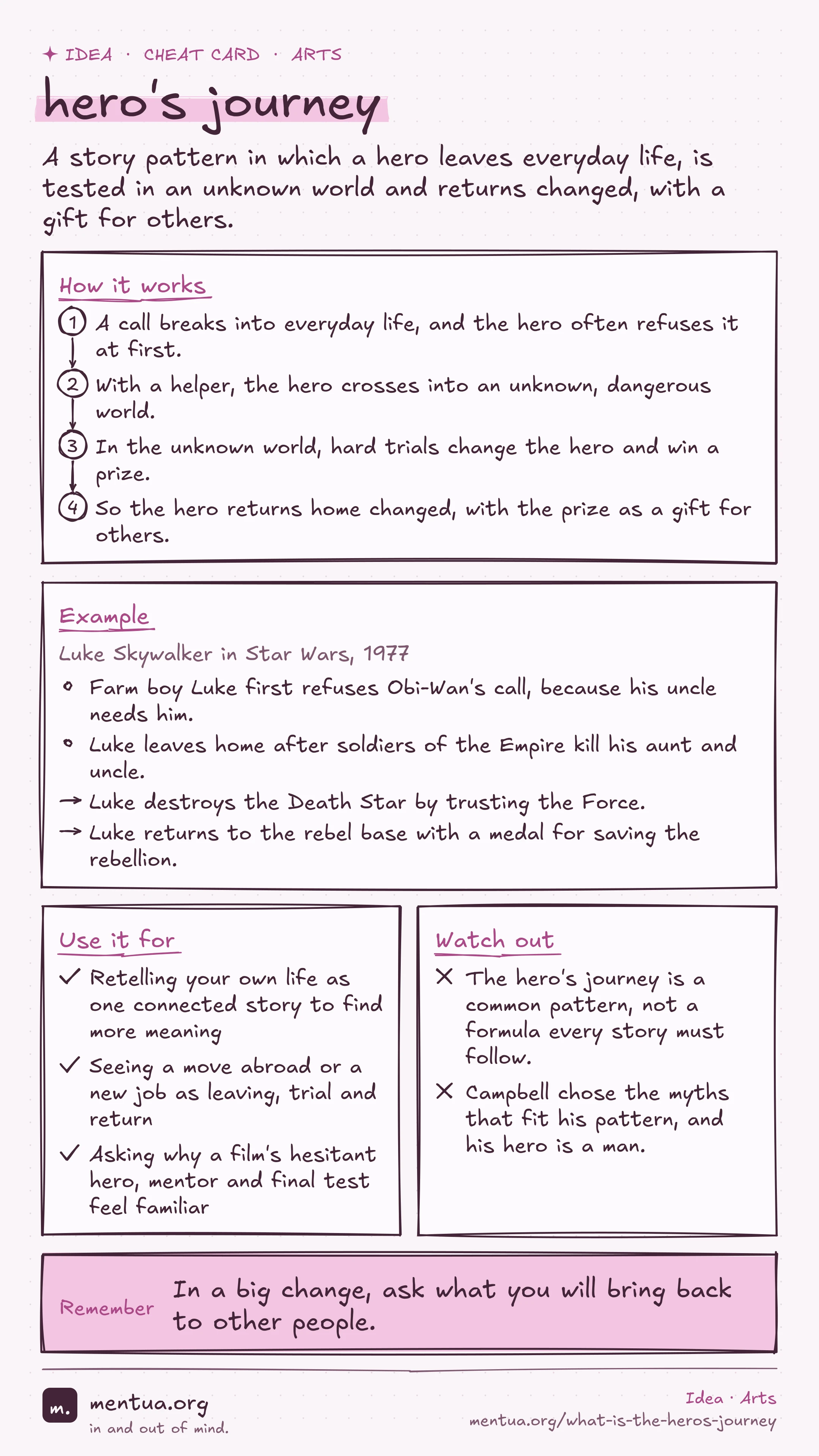
The whole idea on one page. Tap to open it full size, download it below, or test yourself against it tomorrow.
Download
- Light card · PNG image, 378 KB
- Dark card · PNG image, 382 KB
- Printable light card · PDF, searchable, 23 KB
Read the card as text
hero's journey: A story pattern in which a hero leaves everyday life, is tested in an unknown world and returns changed, with a gift for others.
How it works
- A call breaks into everyday life, and the hero often refuses it at first.
- With a helper, the hero crosses into an unknown, dangerous world.
- In the unknown world, hard trials change the hero and win a prize.
- So the hero returns home changed, with the prize as a gift for others.
Example: Luke Skywalker in Star Wars, 1977
- Farm boy Luke first refuses Obi-Wan's call, because his uncle needs him.
- Luke leaves home after soldiers of the Empire kill his aunt and uncle.
- → Luke destroys the Death Star by trusting the Force.
- → Luke returns to the rebel base with a medal for saving the rebellion.
Use it for
- Retelling your own life as one connected story to find more meaning
- Seeing a move abroad or a new job as leaving, trial and return
- Asking why a film's hesitant hero, mentor and final test feel familiar
Watch out
- The hero's journey is a common pattern, not a formula every story must follow.
- Campbell chose the myths that fit his pattern, and his hero is a man.
Remember: In a big change, ask what you will bring back to other people.
Key quotes
“A hero ventures forth from the world of common day into a region of supernatural wonder: fabulous forces are there encountered and a decisive victory is won: the hero comes back from this mysterious adventure with the power to bestow boons on his fellow man.”
References
- The Hero's Journey. Joseph Campbell Foundation, jcf.org
The foundation's introduction to the monomyth, with Campbell's own summary sentence, the three phases and the advice to read the stages as variations.
- Starkiller to Skywalker: Script Context. Rare Book & Manuscript Library, University of Illinois Urbana-Champaign, University of Illinois Library exhibits
How Luke's resistance to the call to adventure appears in the later drafts of Star Wars, while in the third draft he agrees at once.
- Seeing Your Life Story as a Hero's Journey Increases Meaning in Life. Benjamin A. Rogers and colleagues, Journal of Personality and Social Psychology 125 (4), 752–778, 2023
The seven elements of the journey, the Hero's Journey Scale and the restorying experiments in which people retold their own lives.
- The Man Behind the Myth: Should We Question the Hero's Journey?. Joel Christensen and Sarah E. Bond, Los Angeles Review of Books, 2021
Two historians of the ancient world on Campbell's selective use of myths, the male hero and the pattern's fit with American individualism.
- The Heroine's Journey. Maureen Murdock, maureenmurdock.com
Murdock explains why she wrote a model for women and quotes what Campbell told her in 1981.