What Was the Neolithic Revolution?
6 min read≈ 1,220 words3 questions · up to 3 points
What this is about
More than 11,000 years ago, hunter-gatherers in south-eastern Turkey built monuments with stone pillars three times as tall as a person, before anyone in the region grew domesticated wheat. You learn how wild wheat turned into a crop, why that took thousands of years, and what ancient skeletons reveal about whether farming made life better.
In a nutshell· skip ahead
The Neolithic revolution is the shift from hunting and gathering to farming. It began about 11,000 years ago in Southwest Asia and happened independently in at least 11 regions of the world. People started to grow plants and keep animals, which changed those species and fed far larger populations, although early farmers were often smaller and less healthy than the foragers before them.
In the hills of south-eastern Turkey, more than 11,000 years ago, people carved stone pillars up to 5.5 metres tall and set them in great round enclosures at a site now called Göbekli Tepe. The builders hunted gazelle and ground the seeds of wild grasses, long before domesticated wheat appeared in the region. A few thousand years later, people in the same region lived in villages, grew wheat and kept sheep and goats. How did that change happen, and did it make their lives better?
What changed when people began to farm?
The Neolithic revolution is the name for the shift from hunting and gathering to farming, which means growing plants and keeping animals for food. It began about 11,000 years ago in Southwest Asia, and a 2014 review by 25 specialists counts at least 11 regions where it started independently, among them northern China, southern Mexico, northern Peru and New Guinea. Neolithic means “New Stone Age”, the period in which people still used stone tools but began to farm.
At the centre of the change is domestication: the process by which a wild plant or animal changes genetically under human care until it depends on people to survive. Domesticated plants gave more food per hectare, so the same land could feed far more people. The best way to see how domestication works is to follow one plant.
How did wild wheat become a crop?
The first wheats were einkorn and emmer, two wild grasses of the Fertile Crescent, the arc of hills from the eastern Mediterranean coast through south-eastern Turkey to western Iran.
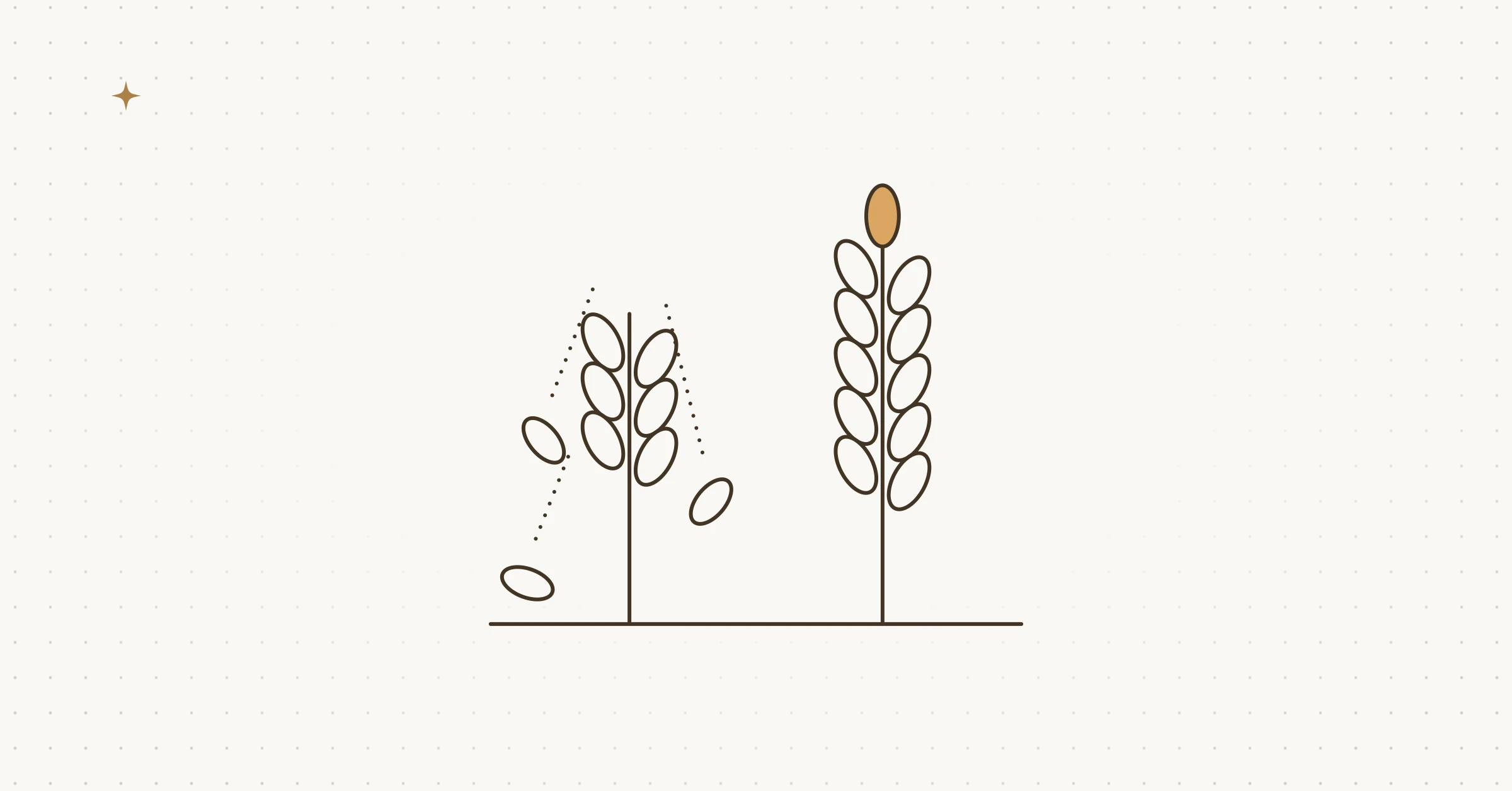
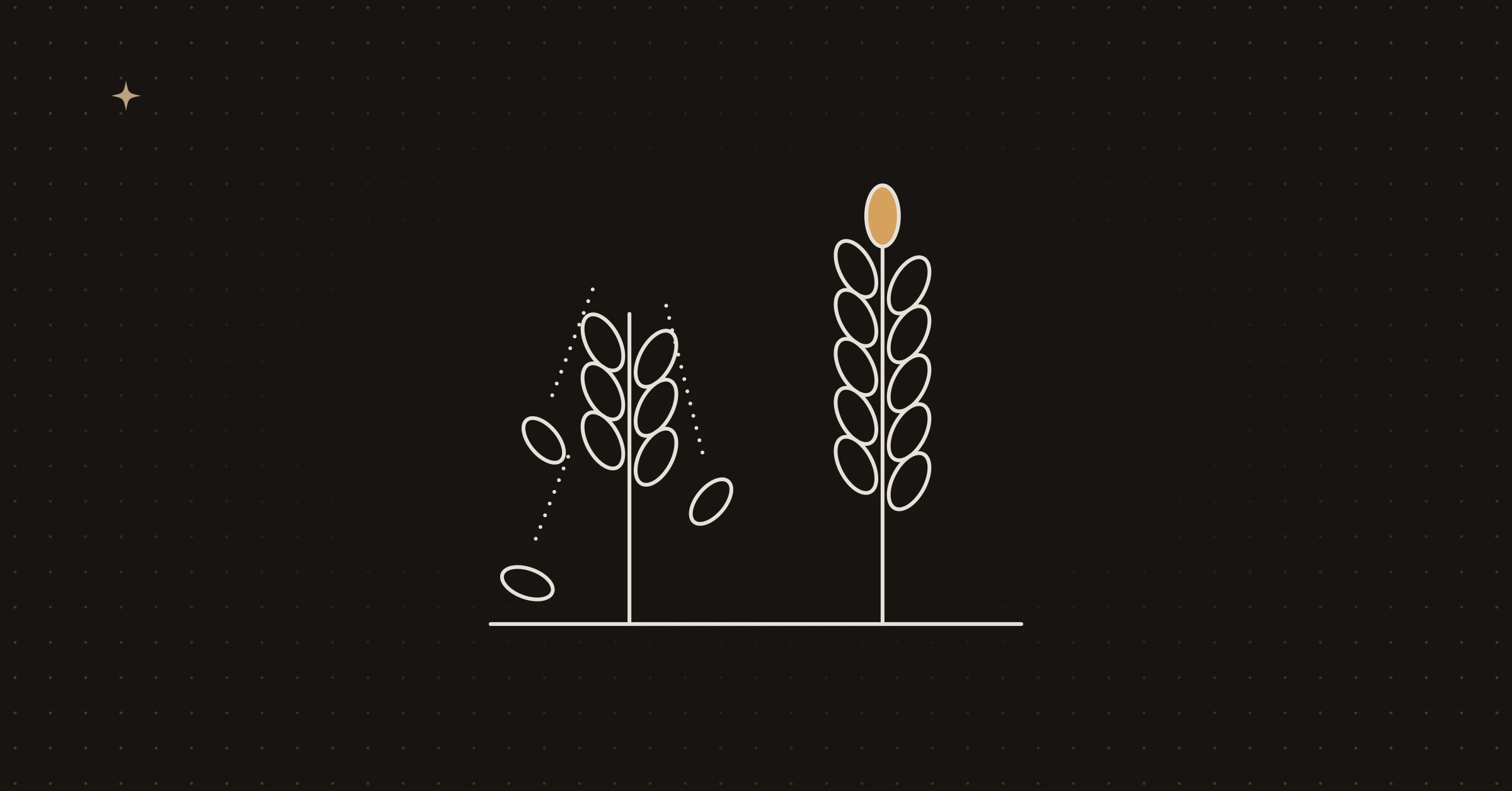
- Wild wheat sows itself. When its ear ripens, the stalk that holds the grains breaks into pieces and the grains fall to the ground. Botanists call this shattering, and it is how the wild plant spreads.
- People harvest wild stands. Foragers gathered the ripe ears and ground the grains into flour. At Göbekli Tepe, the excavators found more than 7,000 grinding stones and the remains of wild einkorn and wild barley.
- People start to sow. Some groups kept part of the harvest and sowed it the next year. A rare mutant whose ear does not shatter keeps its grains until the harvest, so its grains end up in the basket and are sown again, while the grains of normal plants have partly fallen already. Nobody had to plan this, because harvesting and sowing favoured the non-shattering plants by themselves.
- The place can be traced. In 1997 a team led by Manfred Heun compared the DNA of hundreds of einkorn lines. The wild einkorn closest to cultivated einkorn grows on Karacadağ, a mountain in south-eastern Turkey, and nearby early villages such as Çayönü and Nevalı Çori contain einkorn grains.
- The change is very slow. Ken-ichi Tanno and George Willcox studied 804 remains of wheat ears from four early villages. Ears that do not shatter appeared about 9,500 years ago, but ears that shatter were still common in fields about 7,500 years ago. Across wheat, barley and rice, it took 2,000 to 4,000 years before all plants in a field kept their grains.
The result is wheat that can no longer sow itself and depends on farmers, who in turn had to sow, weed and guard their fields every year.
What the Neolithic revolution teaches you
A change can succeed by one measure and fail by another, so ask whether it made each person’s life better or only made the total larger. Farming won by the total, because it fed many more people, but individual farmers often paid a price. The same question helps in other places:
- At work, a new tool or system can raise total output and still mean longer hours for every worker, and a report that counts only the total cannot tell you which happened.
- In the news, economic growth is a total. Whether it helps people depends on how it is shared, so economists also look at the median income, the income of the person in the middle.
- In your own life, a habit can bring more money or more followers while each day feels worse, so ask which of the two you actually wanted.
Domestication is also selection by people, the comparison with which Darwin began his argument in Natural Selection: How It Works and Why It Matters.
Did farming make people’s lives better?
Many people assume that farming was an easy improvement: more food, so better lives. The skeletons of early farmers tell a different story. In 1984 Mark Nathan Cohen and George Armelagos collected studies of societies that changed from foraging to farming, and health declined in 19 of 21 of them. A review from 2011 found the same trend for height on every continent: people grew shorter as they relied more on farming. The reasons were a narrow diet based on one or two crops, seasonal hunger, failed harvests, and diseases that spread in crowded villages with animals nearby.
In 1987 the American scientist Jared Diamond drew a radical conclusion. In an essay for the magazine Discover, he called farming the step “at which we made the worst mistake in human history”. Yuval Noah Harari later called it “history’s biggest fraud”, as explained in “Sapiens” by Yuval Noah Harari: Summary and Review. Ten years after his essay, Diamond made farming the starting point of his explanation of world history, reviewed in “Guns, Germs, and Steel” by Jared Diamond: Summary and Review.
This disagreement goes back to the man who named the change. V. Gordon Childe judged it by the number of people it could feed:
Historical changes can be judged by the extent to which they have helped our species to survive and multiply.
By that measure farming was a great success, while the skeletons measure something else, the health of each person. The strongest objection to the “mistake” view is that a mistake needs someone who chose, and no generation ever chose between foraging and farming. Each group took small steps that made sense at the time, such as sowing a little more grain, and the costs appeared only over centuries. Farming families also had more children, so over time farmers outnumbered foragers almost everywhere. The word “revolution” misleads for the same reason, and most specialists now describe a protracted change that took thousands of years.
Learn more
The term comes from the Australian-born archaeologist V. Gordon Childe, then a professor at the University of Edinburgh, who used it in the 1930s and gave it a chapter of its own in his popular book Man Makes Himself (1936). He took his yardstick from the Industrial Revolution in Britain, his example of a change that made a population grow fast. So the term has one author, but farming itself has no single inventor, because it began independently in many places. Later work by geneticists and archaeobotanists, the specialists who study ancient plant remains, replaced Childe’s sudden revolution with the slow process described above.
For another change that historians call a revolution, read What Was the Printing Revolution?. Why the shared fields and pastures of farming villages are easily overused is explained in What Is the Tragedy of the Commons?.
Quiz
3 questions · up to 3 points
Open a question and pick one answer. Only your first answer counts: +1 if it is right, −1 if it is wrong.
Why did wheat whose ears keep their grains become common in the fields of early farmers?
Show answer
Its grains stayed on the plant until harvest, so they were more often gathered and sown again the next year. Harvesting and sowing favoured these plants without anyone planning it. Grains that fell to the ground before the harvest were not sown by the farmers.
A company introduces a new system. Total output rises by 30 percent, but every worker now works longer hours and reports more stress. How would the lesson of the Neolithic revolution describe this?
Show answer
The system succeeded by the measure of total output, but that measure says nothing about whether each worker is better off. Farming fed far more people while many individuals were shorter and less healthy. Total success and individual well-being are separate questions.
Which statement about the Neolithic revolution fits the evidence best?
Show answer
It was a slow change that took thousands of years, with people cultivating wild plants long before the plants changed. Wheat that keeps its grains appeared about 9,500 years ago, and plants that drop their grains were still common in fields about 7,500 years ago.
Your points are saved only in this browser for now. Accounts that keep them for good are on the way.
Continue learning: "Sapiens" by Yuval Noah Harari: Summary and Review →The takeaway
The Neolithic revolution is the shift from foraging to farming that began about 11,000 years ago in Southwest Asia and happened independently in at least 11 regions. Wild wheat shows how it worked: when people harvested and sowed it again and again, plants whose ears kept their grains spread, but this took 2,000 to 4,000 years. Farming fed many more people, yet skeletons show that early farmers were often shorter and less healthy. When a change is called progress, ask whether it improved life for each person or only increased the total.
References
- Current perspectives and the future of domestication studies. Greger Larson, Dolores Piperno, Robin Allaby, Dorian Fuller and others, Proceedings of the National Academy of Sciences, 2014
A review by 25 specialists: where and when domestication happened, the at least 11 independent centres and why fixing non-shattering ears took 2,000 to 4,000 years.
- How fast was wild wheat domesticated?. Ken-ichi Tanno and George Willcox, Science, 2006
The short paper that dated the slow spread of wheat that keeps its grains, from plant remains found in four early villages.
- Stature and robusticity during the agricultural transition: evidence from the bioarchaeological record. Amanda Mummert, Emily Esche, Joshua Robinson and George Armelagos, Economics and Human Biology, 2011
A review of skeleton studies since 1984, which finds that people grew shorter as they came to rely on farming on every continent.
- The Worst Mistake in the History of the Human Race. Jared Diamond, Discover, 1987
The short, provocative essay that made the case against farming famous, with figures on height, teeth and life expectancy.
- Cereal processing at Early Neolithic Göbekli Tepe, southeastern Turkey. Laura Dietrich and others, PLOS ONE, 2019
The excavators' study of more than 7,000 grinding stones, which shows that the builders of Göbekli Tepe processed large amounts of wild cereals.