What Is the Trolley Problem?
5 min read≈ 1,200 words3 questions · up to 3 points
What this is about
Asked to sacrifice one life to save five, most people say yes in one version of a famous thought experiment and only about half in another, although the numbers never change. You learn what the puzzle behind these answers really is, which principle philosophers proposed to solve it and why that principle fails, and why the woman who made the problem famous later changed her mind about the easy case.
In a nutshell· skip ahead
The trolley problem is a puzzle in moral philosophy. In some cases killing one person to save five seems allowed, such as turning a runaway trolley onto a side track, and in others it seems forbidden, such as pushing a man into its path. The problem is to find the principle that explains this difference.
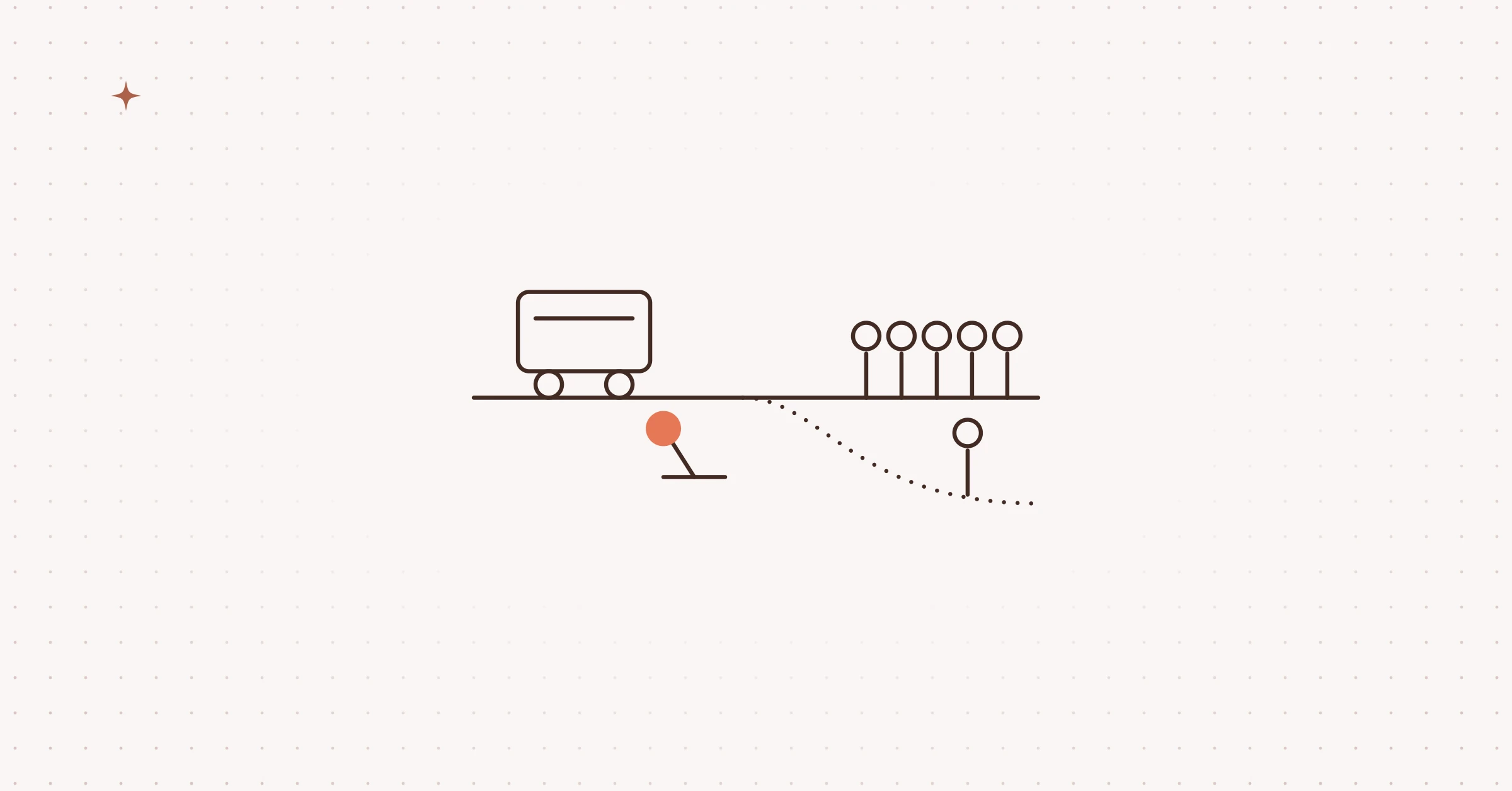
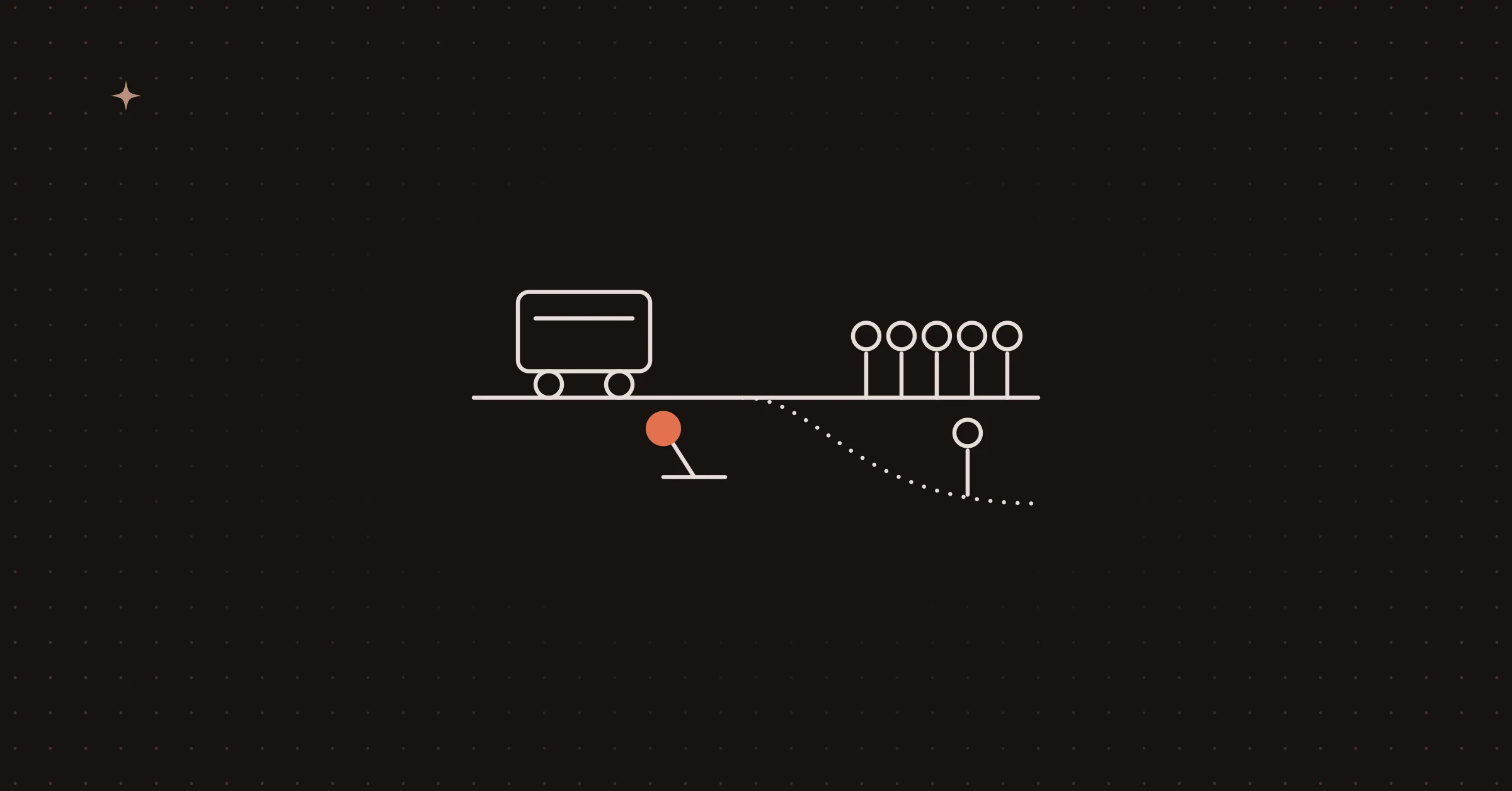
A runaway trolley is heading toward five workers who cannot get off the track, and you stand next to a lever that would send it onto a side track where it would kill one worker instead. Most people say they would pull the lever. Now change one detail: you stand on a bridge above the track, and the only way to stop the trolley is to push a heavy man off the bridge into its path. The numbers are the same, five saved and one killed, yet most people now say no. Why should the same trade feel right in one case and wrong in the other?
What does the trolley problem actually ask?
The trolley problem is the puzzle behind those two answers: in some cases killing one person to save five seems allowed, in others it seems forbidden, and the task is to find the principle that explains the difference. The question is not mainly “Would you pull the lever?” but “What separates the lever from the push?”
We can follow the puzzle in four steps, using the answers of about 70,000 people in 42 countries that Edmond Awad and his colleagues published in 2020.
- The switch. A bystander can turn the trolley onto a side track with one worker. On average across the countries, 81 percent said this was acceptable.
- The footbridge. The bystander can push a heavy man onto the track, and his body stops the trolley. Only 51 percent accepted this.
- The arithmetic. If only the number of lives counted, the two answers would be the same, so something else must matter. The order was the same in every culture the study looked at, which suggests that the difference is not a local habit.
- A candidate principle. In the switch case, the one worker dies as a side effect: if he could jump off the track, the plan would still work and you would be glad. In the footbridge case, the man’s death is the means: without his body in the way, the five are not saved. The doctrine of double effect, a principle with roots in Catholic moral theology, says that causing a harm as a foreseen side effect can be allowed when causing the same harm as a means is not.
The doctrine fits the first two cases, but a third case shows that it does not settle the problem. In the loop case the side track bends back and joins the main track before the five, so turning the trolley only saves them because a heavy man on the side track stops it. His death is now a means, as on the bridge, yet 72 percent of the participants still accepted it. People’s answers do not line up with the principle, and that gap has kept philosophers arguing since the 1970s.
What the trolley problem teaches you
The trolley problem teaches you to ask, when two choices lead to the same result but feel different, whether the harm is a side effect of your plan or the means by which the plan works.
- Work. A manager who closes a loss-making department knows some people will lose their jobs, and that is a side effect. A manager who blames an innocent colleague to calm an angry client uses that colleague as the means, which is the footbridge, not the switch.
- War. Moral philosophers distinguish a bomber who attacks a factory knowing that nearby civilians may die from a bomber who kills civilians in order to frighten the enemy. The number of deaths may be equal, but the first harm is foreseen and the second is intended.
- Medicine. In a variant by the philosopher Judith Jarvis Thomson, a surgeon could save five patients by taking the organs of one healthy patient. Thomson took it as clear that the surgeon may not do this, and the trolley cases ask what makes his act different from turning a trolley.
The same question also helps when you read the news: a policy that “saves more lives than it costs” can still be wrong if it uses particular people as the means.
Where does the thought experiment mislead?
A common mistake is to treat the trolley problem as a personality test that sorts people into those who count lives and those who follow rules. Most people do both, counting lives at the switch and refusing at the bridge, and the problem is to explain that pattern, not to label the people who show it.
The cases also leave out what real choices contain. They promise certainty: the push will stop the trolley, and nobody can warn the workers. Real decisions are made without such guarantees, which is why A Good Decision Can End Badly is a useful companion here.
Answers on paper may not predict real behaviour either. In a 2018 experiment by Dries Bostyn and colleagues at Ghent University, students chose whether to give one mouse an electric shock to spare five others (the shocks were fake, but the students did not know this). Among students who answered the same question only on paper, 34 percent refused to shock the one mouse, but in the real situation only 16 percent refused.
The strongest objection came from Thomson herself, the philosopher who had made the switch case famous. In her 2008 paper “Turning the Trolley”, she argued that a bystander may not turn the trolley after all. If the bystander would not turn the trolley onto himself, he has no right to force that sacrifice on a stranger, and even if he would, he cannot assume that the stranger agrees. The driver is different, because whatever he does, his own trolley kills someone. If Thomson is right, the “easy” case was never easy, and part of the puzzle disappears.
Learn more
The case was invented by Philippa Foot, a philosopher at Somerville College, Oxford, who died in 2010 on her 90th birthday. In a 1967 paper about abortion, she compared the driver of a runaway tram with a judge who could stop a deadly riot by punishing an innocent man. Her answer was that the duty not to harm people is stricter than the duty to help them. The driver kills someone whichever way he steers, so he may kill fewer, but the judge would harm one man to help others. Judith Jarvis Thomson named the puzzle in 1976 and added the bystander at the switch in 1985, and the many later variants are called “trolleyology”. Michael Sandel opens his book on justice with the driver’s version of the case, and “Justice: What’s the Right Thing to Do?” by Michael J. Sandel: Summary and Review shows how he uses it to introduce the main theories of justice. Judging the case without knowing which person you would be changes many answers, as What Is the Veil of Ignorance? shows.
What Is Karma? shows another tradition that puts intention at the center of moral judgment, since the Buddha taught that intention is what makes an act good or bad.
Quiz
3 questions · up to 3 points
Open a question and pick one answer. Only your first answer counts: +1 if it is right, −1 if it is wrong.
What is the trolley problem, as philosophers use the term?
Show answer
The search for a principle that explains why killing one to save five seems allowed in some cases and forbidden in others The puzzle is the difference between the cases. The lever and the footbridge both trade one life for five, yet most people judge them differently, and the problem is to explain why.
A client threatens to leave unless someone is blamed for a failed project. A manager knows the junior analyst did nothing wrong but blames her anyway to keep the client. Which trolley case is this closest to?
Show answer
The footbridge, because the analyst's harm is the means by which the manager gets what he wants The client stays only because the analyst is blamed, just as the trolley stops only because the man's body blocks it. This is the shape of Foot's judge who punishes an innocent man to stop a riot.
What did Judith Jarvis Thomson conclude about the switch case in her 2008 paper "Turning the Trolley"?
Show answer
That a bystander may not turn the trolley onto the one, although the driver may Thomson argued that a bystander may not force on a stranger a sacrifice he would not make himself. So she reversed the judgment she had made famous in 1985.
Your points are saved only in this browser for now. Accounts that keep them for good are on the way.
Continue learning: What Is Karma? →The takeaway
The trolley problem asks why killing one person to save five seems allowed in some cases and forbidden in others, although the numbers are the same. In a study of 70,000 people in 42 countries, on average 81 percent would turn a runaway trolley onto one person, but only 51 percent would push a man into its path. No simple principle explains every answer, the cases assume a certainty that real life never offers, and answers on paper do not predict real choices well. Use it to ask whether a harm you accept is a side effect of your plan or the means by which it works.
References
- Philippa Foot. John Hacker-Wright, Stanford Encyclopedia of Philosophy, 2026
Foot's life and work, with a section on the 1967 paper where the trolley case first appeared and her answer based on negative and positive duties.
- Doctrine of Double Effect. Alison McIntyre, Stanford Encyclopedia of Philosophy, 2023
The principle that separates intended harm from foreseen side effects, with the trolley cases, the bomber example and the main objections.
- Universals and variations in moral decisions made in 42 countries by 70,000 participants. Edmond Awad, Sohan Dsouza, Azim Shariff, Iyad Rahwan and Jean-François Bonnefon, Proceedings of the National Academy of Sciences 117 (5), 2332–2337, 2020
The large survey behind the figures in this article: how often people in 42 countries accept the sacrifice in the switch, loop and footbridge cases.
- Of Mice, Men, and Trolleys: Hypothetical Judgment Versus Real-Life Behavior in Trolley-Style Moral Dilemmas. Dries H. Bostyn, Sybren Sevenhant and Arne Roets, Psychological Science 29 (7), 1084–1093, 2018
An experiment in which students faced a real choice about electric shocks to mice, and decided differently from students who answered the same question on paper.