What Is Wu Wei?
5 min read≈ 1,190 words3 questions · up to 3 points
What this is about
An old man swims in a waterfall that no fish can survive and says he has no method at all. You learn what the Taoist ideal of wu wei means in the oldest texts, why it cannot be reached by trying harder, and when its advice helps you and when it does not.
In a nutshell· skip ahead
Wu wei, Chinese for "no doing", is the Taoist ideal of acting without forcing. It describes the way a person moves when long practice has made a skill their nature, so that they follow the situation instead of fighting it. It does not mean doing nothing, only no strained, self-conscious doing.
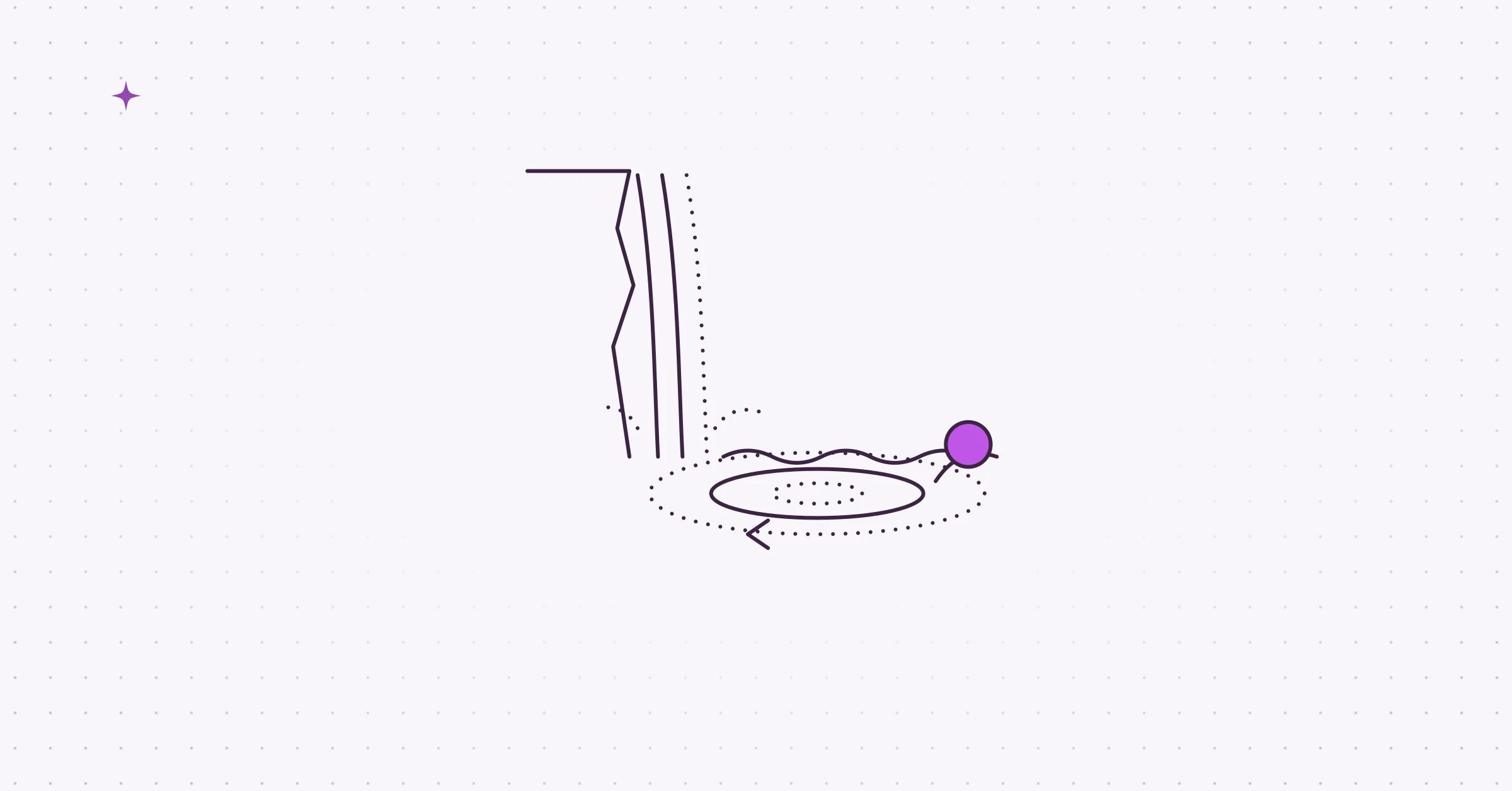
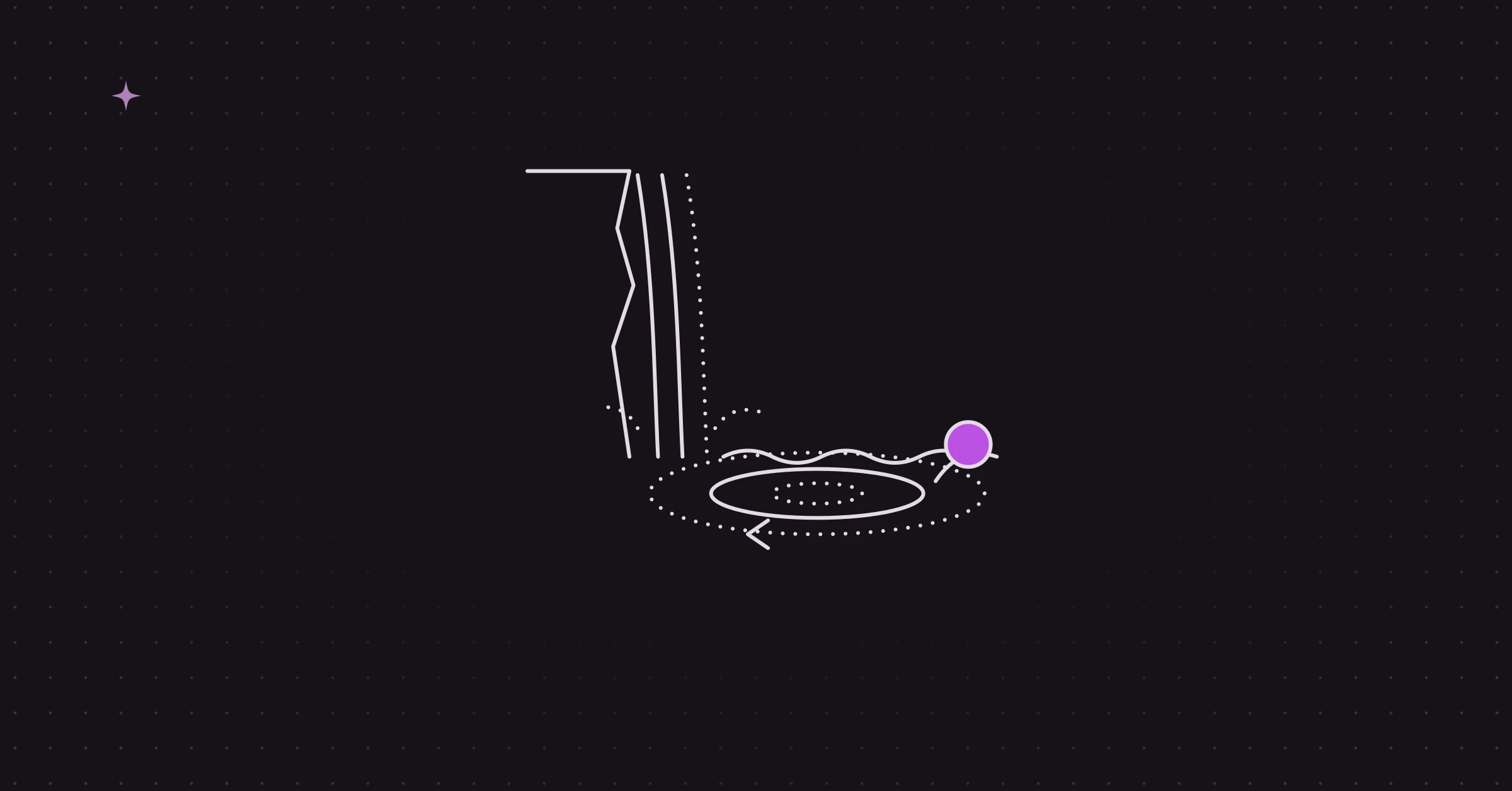
According to an old Chinese story, Confucius once stood by a waterfall so high and wild that no fish or turtle could live in the water below it. Then he saw an old man swimming in it and sent his students to pull him out, but the man came out by himself and walked along the bank singing. When Confucius asked for his method, the man said he had none. How can someone master the most dangerous water by doing nothing special at all?
What does it mean to act without forcing?
Wu wei, Chinese for “no doing”, is the Taoist ideal of acting without forcing. It describes the way a person moves when long practice has made a skill their nature, so that they follow the situation instead of fighting it. The “no doing” refers to strained, self-conscious doing, because the person still acts, often with great skill.
The story of the swimmer comes from the Zhuangzi, one of the two founding books of Taoism, and it shows the steps by which wu wei comes about. Asked how he does it, the man describes three stages of his life.
- He began with what he was used to. He was born among these hills, so the water was part of his world from the start.
- Practice became his nature. He grew up by the water, and what he first learned slowly became something he no longer had to think about.
- Now he follows the water. He goes down with the whirl and comes up with the eddy, and does nothing against the water’s movement.
In James Legge’s translation of 1891, the man puts the last stage like this:
I follow the way of the water, and do nothing contrary to it of myself;–this is how I tread it.
The order of the steps matters. The swimmer did not skip the practice and jump to the ease, because the ease is what a lifetime of practice left behind.
The Tao Te Ching, the other founding book, describes the same process in chapter 48. It says that a student adds to his knowledge every day, while a follower of the Tao takes something away every day, “till he arrives at doing nothing (on purpose)”. The words in brackets are Legge’s additions, and they point to the right reading, because what disappears is the deliberate, effortful part of the action, not the action itself. The chapter goes on to say that from this point “there is nothing which he does not do”.
Why can’t you reach wu wei by trying?
Wu wei is hard to reach because trying to be spontaneous is itself a kind of forcing. The scholar Edward Slingerland calls this the paradox of wu wei, and he shows that early Chinese thinkers argued about it for centuries. You know the problem from daily life: the harder you try to fall asleep, or to look relaxed in a photo, the less it works.
The Confucian thinker Mencius told a story about this. A farmer from the state of Song worried that his young plants were growing too slowly, so he pulled at each one to help it, and the next day all the plants had withered. Mencius’s point was that a good character grows slowly, like a plant, and that pushing it only harms it. The Taoists gave a different answer, telling people to let go of ambition and learning rather than to cultivate them. Both sides agreed, however, that the natural ease of wu wei cannot be produced by direct effort.
What wu wei teaches you
When a skill you have already learned suddenly fails, ask whether you have started watching and steering each step instead of attending to the task.
- Exams, talks and interviews. Under pressure, people often check every word they say, and the speech they gave easily at home comes out stiff. Practising until the material is familiar, and then thinking about the listener instead of yourself, is the wu wei advice.
- Sport and music. The psychologists Sian Beilock and Thomas Carr found in 2001 that experienced golfers putted worse when they attended to the details of their stroke and worse under pressure. Their explanation was that pressure makes people monitor a skill that normally runs automatically, which is close to what the Taoist texts describe.
- Relationships. Someone who tries very hard to seem natural or to be liked often seems the opposite. Here the transfer is the same: the effort that helps you learn a skill gets in the way once you use it.
The psychologist Mihaly Csikszentmihalyi described a similar state in his book Flow, published in 1990, in which people fully absorbed in a task lose the sense of themselves while acting. Flow is a modern psychological concept and not the same as the Taoist ideal, but both describe action in which the effort no longer feels like effort.
Does wu wei mean doing nothing?
The most common misreading takes wu wei as passivity, so that the wise person withdraws and lets everything happen. The swimmer shows why this is wrong, because he spent his whole life learning the water before he could move in it without effort. The Tao Te Ching also speaks to rulers, and when it praises non-action it means government that does not interfere at every step, not a ruler who does nothing.
The strongest objection is that ease is no guide to what is right. A cruel or careless act can also feel effortless, and a habit can be smooth and harmful at the same time. The Taoist texts assume a person whose mind has become calm and whose skill fits the situation, and they say little about how to judge which way of acting is the right one.
The research on choking supports only a narrow part of the idea. Attending to each step seems to hurt skills that are already well learned, while beginners often do better when they think about what they are doing. So the advice to stop watching yourself belongs at the end of practice, not at its beginning.
Learn more
Wu wei has no single inventor. The phrase appears in the Tao Te Ching, traditionally credited to Laozi and probably written down from the late 5th century BCE onwards, and in the stories of the Zhuangzi. The Analects of Confucius also praise the ancient ruler Shun for governing by wu wei, which shows that the ideal was shared across early Chinese schools. Its modern study owes most to Edward Slingerland, whose Effortless Action (2003) traced the debate, and whose Trying Not to Try (2014) connected it with modern psychology.
What Is the Tao? explains the larger idea behind wu wei with the story of Cook Ding, a butcher whose knife stays sharp for nineteen years. Taoist Parables: Six Old Stories and What They Teach collects the best-known stories of this kind. For a readable book on the whole subject, try Trying Not to Try by Edward Slingerland (Affiliate Link).
Quiz
3 questions · up to 3 points
Open a question and pick one answer. Only your first answer counts: +1 if it is right, −1 if it is wrong.
In the Zhuangzi, how does the old swimmer explain that he survives the waterfall?
Show answer
He follows the way of the water, a habit he has built since he was born among those hills. He says he goes down with the whirl and comes up with the eddy, and that this ease grew from a lifetime by the water.
A pianist plays a piece perfectly at home but stumbles at a recital, where she watches every finger. What does the idea of wu wei suggest?
Show answer
Focus on the music as a whole and let the well-practised movements run on their own. Wu wei describes action that has become natural through practice. Watching each step of a learned skill can break it, as the research on choking under pressure suggests.
Which statement about wu wei is correct?
Show answer
Wu wei means acting without strain, usually after long practice, not doing nothing. The "no doing" in wu wei refers to forced, self-conscious doing. The skilled person still acts, and often acts a great deal.
Your points are saved only in this browser for now. Accounts that keep them for good are on the way.
Continue learning: What Is the Tao? →The takeaway
Wu wei is the Taoist ideal of acting without forcing: after long practice a skill becomes so natural that a person follows the situation instead of fighting it. The swimmer in the Zhuangzi survives a waterfall because a lifetime of practice taught him to move with the water. Wu wei cannot be reached by trying to be spontaneous, and it is no guide to right and wrong on its own. When a well-learned skill fails under pressure, stop watching each step and attend to the task itself.
Cheat card
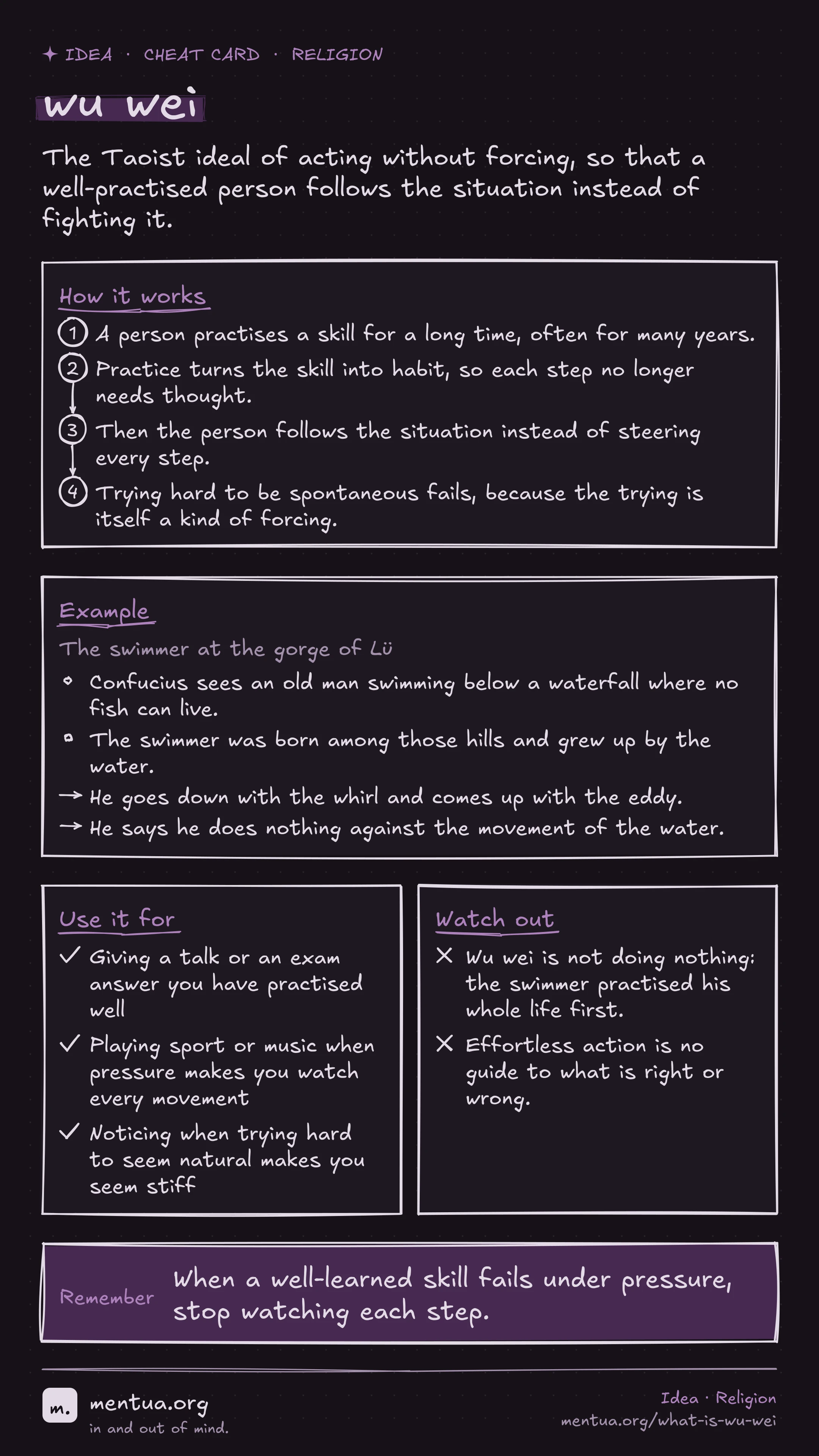
The whole idea on one page. Tap to open it full size, download it below, or test yourself against it tomorrow.
Download
- Light card · PNG image, 356 KB
- Dark card · PNG image, 362 KB
- Printable light card · PDF, searchable, 23 KB
Read the card as text
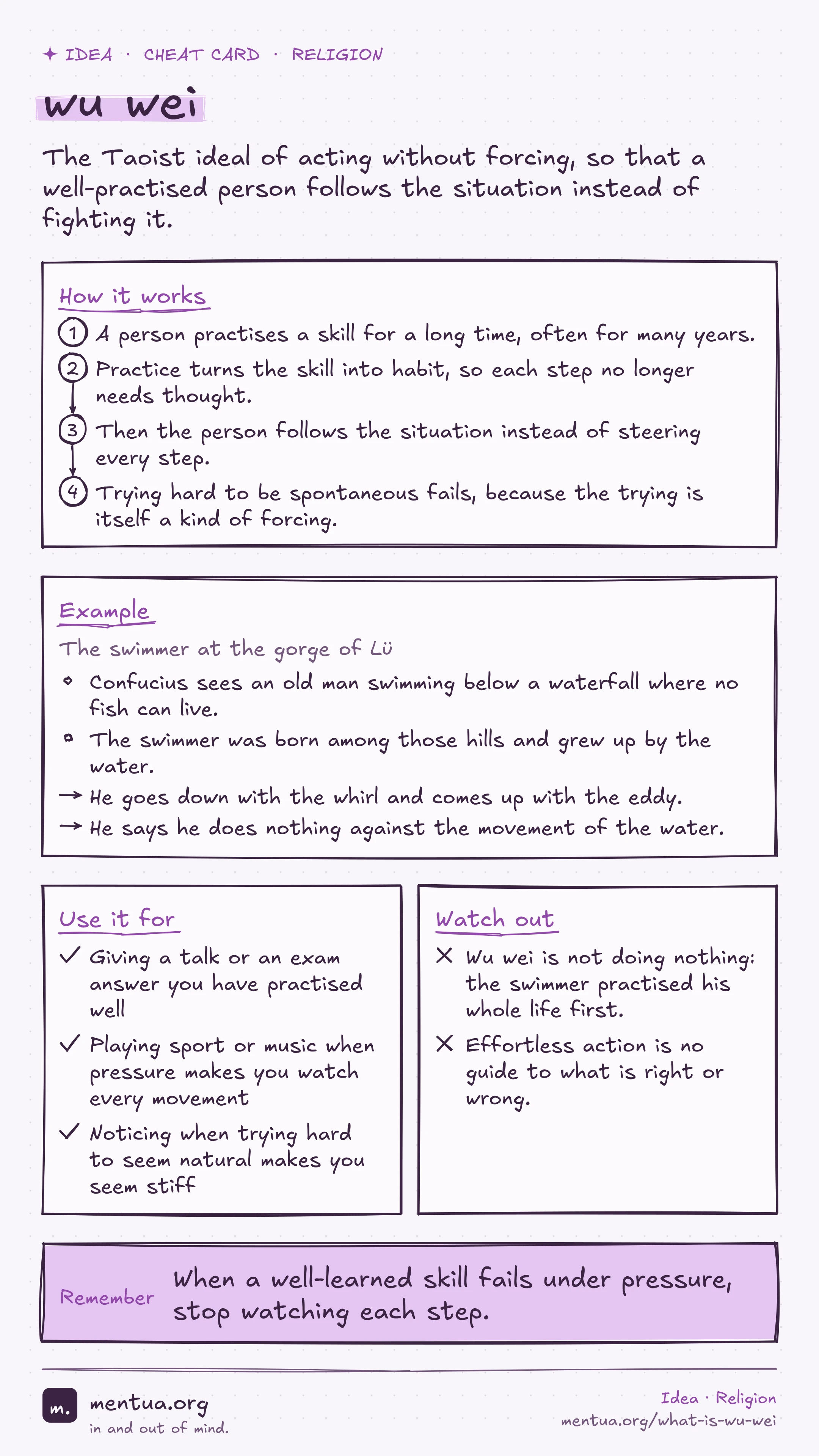
wu wei: The Taoist ideal of acting without forcing, so that a well-practised person follows the situation instead of fighting it.
How it works
- A person practises a skill for a long time, often for many years.
- Practice turns the skill into habit, so each step no longer needs thought.
- Then the person follows the situation instead of steering every step.
- Trying hard to be spontaneous fails, because the trying is itself a kind of forcing.
Example: The swimmer at the gorge of Lü
- Confucius sees an old man swimming below a waterfall where no fish can live.
- The swimmer was born among those hills and grew up by the water.
- → He goes down with the whirl and comes up with the eddy.
- → He says he does nothing against the movement of the water.
Use it for
- Giving a talk or an exam answer you have practised well
- Playing sport or music when pressure makes you watch every movement
- Noticing when trying hard to seem natural makes you seem stiff
Watch out
- Wu wei is not doing nothing: the swimmer practised his whole life first.
- Effortless action is no guide to what is right or wrong.
Remember: When a well-learned skill fails under pressure, stop watching each step.
References
- Daoism. Chad Hansen, Stanford Encyclopedia of Philosophy, 2020
A scholarly overview of Taoist thought, including how wu wei, naturalness and the Tao relate to each other.
- The Texts of Taoism, Book XIX: Tâ Shäng, or 'The Full Understanding of Life'. Zhuangzi, translated by James Legge, Sacred Texts (from Sacred Books of the East, vol. 40), 1891
The chapter with the swimmer at the gorge of Lü, the cicada catcher and the ferryman, all stories of effortless skill.
- Tao Te Ching, translated by James Legge. Laozi, Sacred Texts, 1891
The full text in Legge's translation; chapters 37 and 48 speak of non-action directly.
- Effortless Action: Wu-wei as Conceptual Metaphor and Spiritual Ideal in Early China. Edward Slingerland, Oxford University Press, 2003
The standard scholarly study of wu wei and of the paradox of trying not to try in early Chinese thought.
- On the fragility of skilled performance: What governs choking under pressure?. Sian L. Beilock and Thomas H. Carr, Journal of Experimental Psychology: General 130 (4), 701–725, 2001
Experiments with golfers on why well-learned skills can break down when people attend to them step by step.