What Is the Relativity of Simultaneity?

5 min read≈ 1,210 words3 questions · up to 3 points
What this is about
Lightning strikes a railway line at two distant places, and a person beside the track and a passenger on a fast train disagree about whether the strikes happened at the same moment. You learn which of them is right, why, and how large the disagreement is for a train and for a spacecraft. You also learn why cause and effect can never swap places, and what the idea does and does not say about the present moment.
In a nutshell· skip ahead
The relativity of simultaneity is the result of Einstein's special relativity that two events at different places can happen at the same time for one observer and at different times for another who moves relative to the first. Neither view is wrong, because there is no single, universal 'now'. Only events that no signal could connect can change their order.
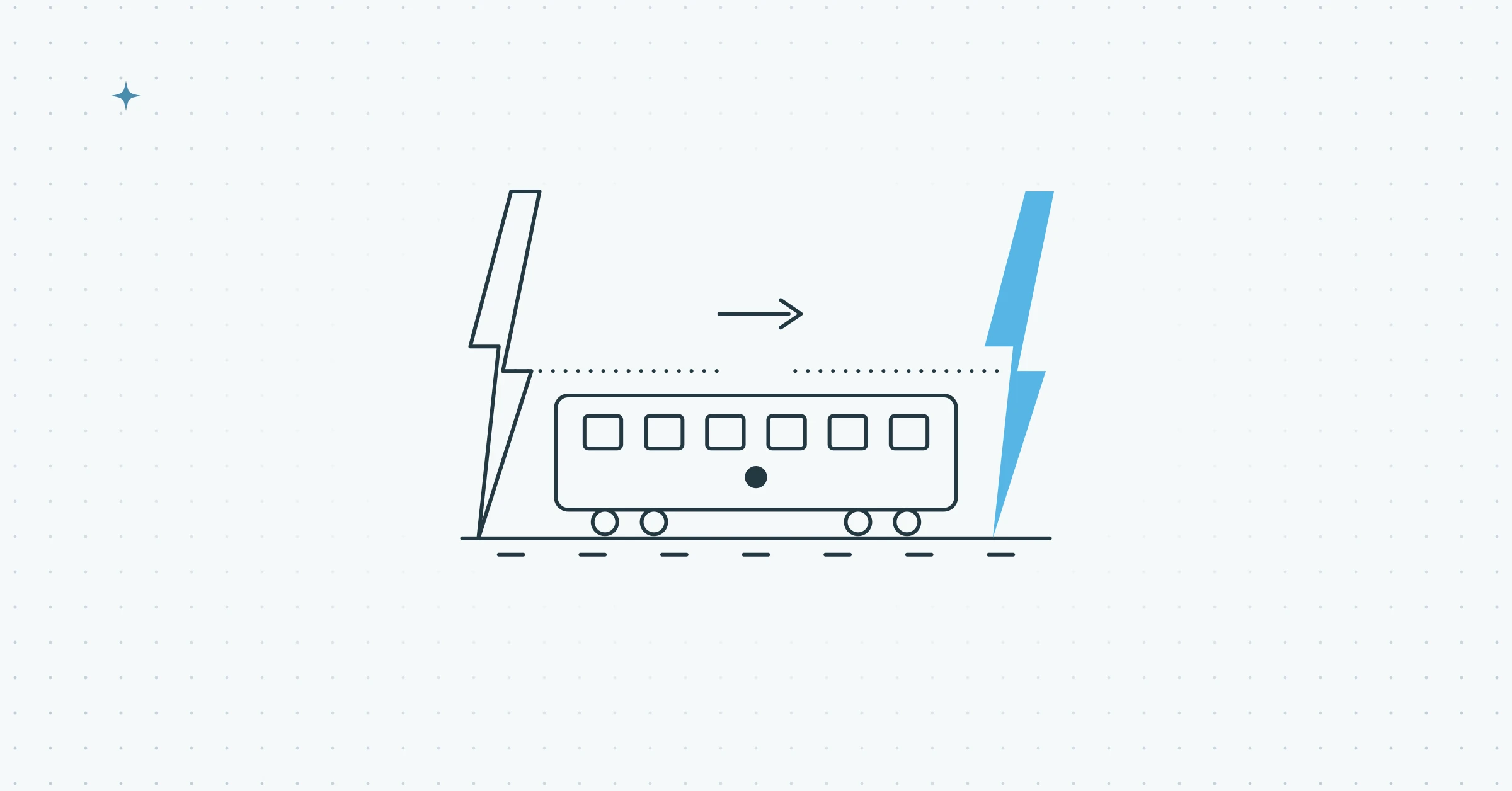
Lightning strikes a railway line at two places 30 kilometres apart. A woman standing exactly halfway between them sees both flashes at the same instant, while a passenger at the middle of a very long, fast train, passing her at that moment, sees the flash ahead of the train first. Who is right?
What does it mean that simultaneity is relative?
Both are right, according to the relativity of simultaneity, which says that whether two events at different places happen at the same time depends on how the observer moves. Physicists call the point of view of everything that moves together, such as the embankment or the train, a frame of reference. Einstein showed in 1905 that each frame has its own valid answer to “Which distant events are happening now?”, and no experiment can single out one frame as the true one.
- Einstein’s test for “at the same time”. If light from two events reaches an observer exactly halfway between them at the same instant, the events were simultaneous. Einstein set it as a rule, not a measured fact, that light needs the same time for the same distance in both directions.
- On the embankment. The woman stands at the midpoint, 15 kilometres from each strike. Both flashes need about 50 microseconds (millionths of a second) to reach her and arrive together, so for her they were simultaneous.
- On the train. The lightning hits the track just where the two ends of the train are, and the passenger sits halfway between them. While the light travels, the train carries her toward the front flash and away from the rear one, so the front flash reaches her first.
- Her conclusion. In special relativity light has the same speed for every observer, so for her, sitting at the middle, the flash that arrived first must have started first. In her frame the front strike happened earlier.
How much earlier? The difference is about the train’s speed times the distance between the strikes, divided by the square of the speed of light. For a high-speed train at 300 kilometres per hour, it comes to about 28 trillionths of a second, in which light moves 8 millimetres, which is why nobody notices. For a spacecraft passing at 60 percent of the speed of light, the same two strikes are 75 microseconds apart, three quarters of the time light needs to cross the whole 30 kilometres.
How is it different from time dilation?
The two ideas come from the same theory but answer different questions. What Is Time Dilation? is about the rate of a clock: a moving clock ticks slower, and two clocks that travelled differently disagree when they meet again. The relativity of simultaneity is about the setting of clocks that are far apart. If passengers set clocks at the front and rear of their train to the same time, then judged from the embankment the rear clock is ahead by about the amount we just calculated.
This keeps time dilation free of contradiction, because each observer finds the other’s clocks running slow, which sounds impossible until you see that they also disagree about which readings of distant clocks happen “at the same time”.
Can two observers disagree about which event came first?
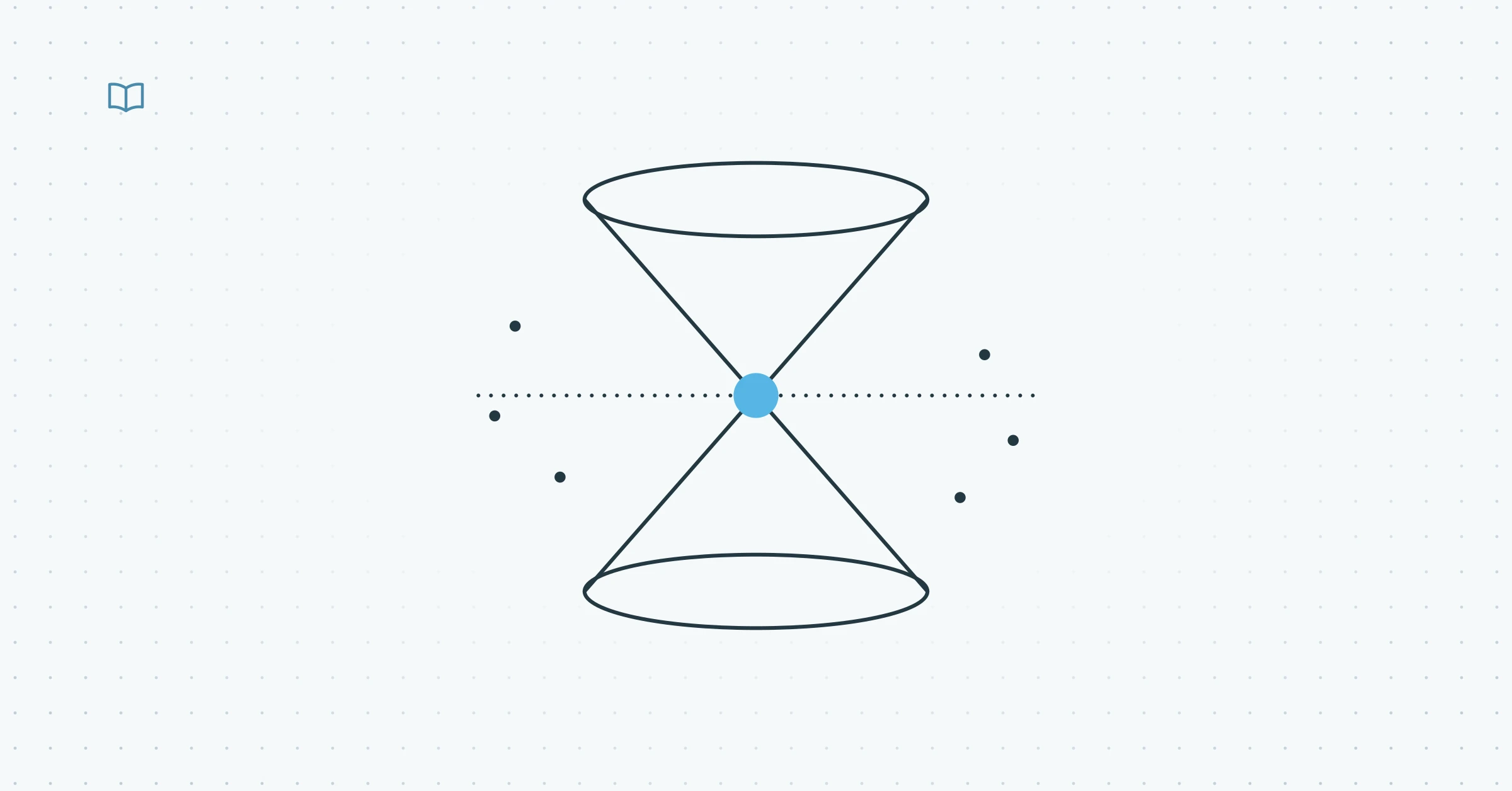
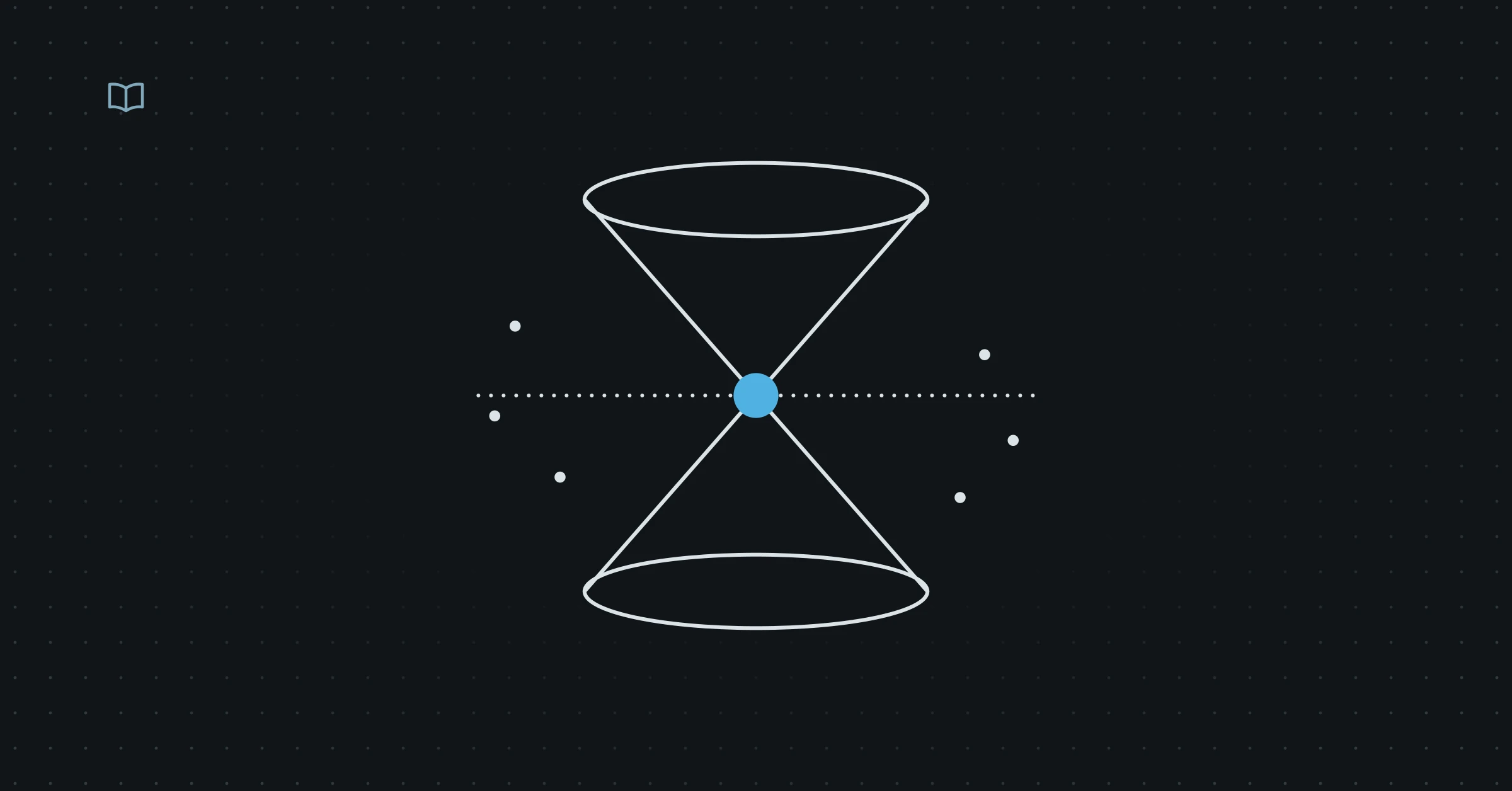
Sometimes, but never when one event could have caused the other. The light cone of an event contains all the events a signal at or below light speed could reach from it, or could have come from. Events outside each other’s light cones, called spacelike separated, can be simultaneous, earlier or later depending on the frame, while events inside cannot change order.
Light needs about 100 microseconds to cross our 30 kilometres, which sets the boundary. If on the embankment the front strike came 50 microseconds after the rear one, the spacecraft observer would conclude that the front strike came first, 12.5 microseconds before the rear one. If the gap was 200 microseconds, a signal could have travelled from one strike to the other, and the spacecraft observer still puts the rear strike first, 175 microseconds earlier. Reversing that order would need twice the speed of light, so cause comes before effect for everyone.
What the relativity of simultaneity teaches you
Some questions have no answer until you name the reference point, and “When did it happen?” across a distance is one of them. Asking “Relative to whom?” helps beyond physics.
- Computer networks. Servers spread across the world have no shared clock either. In 1978 the computer scientist Leslie Lamport drew on special relativity to define a “happened before” order, in which one event comes before another only if it could have affected it. Logical clocks based on his rule are still used in distributed databases.
- Everyday arguments. “Have prices risen?” or “Is this a good salary?” has an answer only once both sides say which year, currency or comparison group they mean. This is an analogy, not physics, but here too a disagreement can disappear once each side names its reference.
- Reading about time. Popular books build large claims about the present on this idea, and knowing the physics shows where measurement ends and interpretation begins.
Where does the usual reading of simultaneity go wrong?
The most common mistake is to blame the delay of light, as if the passenger only saw the front strike first. She sits at the middle of her train, so the delay is equal for both flashes, and the disagreement remains after every correction. A second mistake is to read it as “everything is relative”, although the speed of light and the order of events that can influence each other are the same for every observer.
The hardest question is what this means for the present. The physicist Wim Rietdijk (1966) and the philosopher Hilary Putnam (1967) argued that if your “now” includes events still in the future for someone walking past you, then the future is as real as the past. This view is called the block universe. In Roger Penrose’s version, two people walk past each other at 4 kilometres per hour, and their “now” on the distant Andromeda galaxy differs by about five and three quarter days. Carlo Rovelli concludes instead that there is only a local present and a partial order of events. Both readings use the same physics, which means the choice between them is philosophy, not measurement.
Learn more
The idea has a clear source in Einstein’s 1905 paper “On the Electrodynamics of Moving Bodies”, whose first section defines simultaneity by clocks set with light signals. The French mathematician Henri Poincaré had asked in 1898 whether simultaneity at distant places means anything without a rule for comparing clocks, and Hendrik Lorentz had introduced a “local time” in 1895. In 1908 Hermann Minkowski turned the theory into the geometry of space-time with light cones, and in 1916 Einstein explained the idea for general readers with the train and the lightning.
For the debate about the present and Rovelli’s partial order of events, continue with “The Order of Time” by Carlo Rovelli: Summary and Review.
Quiz
3 questions · up to 3 points
Open a question and pick one answer. Only your first answer counts: +1 if it is right, −1 if it is wrong.
In Einstein's example, lightning strikes the front and the rear of a moving train at the same moment for an observer on the embankment. What does a passenger at the middle of the train conclude?
Show answer
The strike at the front of the train happened first, because she moves toward its light and that light reaches her earlier. She sits at the middle of her train and light has the same speed for her in both directions, so the flash that arrives first must have started first in her frame.
Two events happen 30 kilometres apart. On the ground, the second happens 200 microseconds after the first, which is longer than light needs to cross that distance. Can any observer see them in the reverse order?
Show answer
No, because a signal could travel from the first event to the second, so every observer agrees on their order. Light needs about 100 microseconds for 30 kilometres. When the time gap is larger than that, the order is the same for all observers, and reversing it would require moving faster than light.
Which statement about the relativity of simultaneity is correct?
Show answer
It remains after each observer has corrected for the time light takes to travel, because it concerns when events happen, not when they are seen. Einstein's passenger already sits at the middle of her train, so the delay is the same for both flashes. The disagreement is about the events themselves.
Your points are saved only in this browser for now. Accounts that keep them for good are on the way.
Continue learning: What Is Time Dilation? →The takeaway
The relativity of simultaneity says that whether two distant events happen at the same time depends on how the observer moves, because light has the same speed for everyone. Lightning strikes 30 kilometres apart that are simultaneous on the ground are 28 trillionths of a second apart for a fast train and 75 microseconds apart for a spacecraft at 60 percent of light speed. Cause and effect never change order, and physics alone does not settle whether there is a shared present. So when someone says two distant events happen at once, ask for which observer.
Key quotes
“Every reference-body (co-ordinate system) has its own particular time; unless we are told the reference-body to which the statement of time refers, there is no meaning in a statement of the time of an event.”
References
- Relativity: The Special and General Theory, Section IX: The Relativity of Simultaneity. Albert Einstein, translated by Robert W. Lawson, Methuen (1931 edition), transcribed on Wikisource, 1920
Einstein's own popular account of the train and the lightning, in about two pages. Section VIII, just before it, explains how he defines simultaneity with light signals.
- On the Electrodynamics of Moving Bodies. Albert Einstein, translated by W. Perrett and G. B. Jeffery, Annalen der Physik 17 (1905); English edition 1923, web text by Fourmilab, 1905
The paper that founded special relativity. Its first section defines simultaneity by clocks set with light signals, and its second shows that moving observers disagree about it.
- Being and Becoming in Modern Physics. Steven Savitt, Stanford Encyclopedia of Philosophy, 2021
A careful survey of what the relativity of simultaneity means for the present, including the Andromeda argument for the block universe and the replies to it.
- The Conventionality of Simultaneity. Allen Janis, Stanford Encyclopedia of Philosophy, 2018
The debate about whether Einstein's rule for setting distant clocks is a fact of nature or a convention, for readers who want to go deeper.